

Maintenance heads and planners
Need to pick the jobs that matter most for the window, and to explain why others were deferred.


Plants that run around the clock get a short shutdown window each month and a backlog far longer than the crew can clear. Agnotic Technologies builds shutdown maintenance planning software that scores every pending job, reads shift logbooks and technician photos, and proposes a plan that fits the window.
Trusted by global innovators









Shutdown maintenance planning software gathers every pending job, logbook abnormality and breakdown record into one list, scores each job on criticality, safety and failure risk, and proposes which jobs fit the next shutdown window and crew. Agnotic Technologies builds it in front of SAP PM, so the planner approves the plan and the jobs become work orders.
One shutdown plan serves several people. Each one needs a different view of the same job list.
Need to pick the jobs that matter most for the window, and to explain why others were deferred.
Want vibration, temperature and breakdown history to count when jobs are ranked.
Record abnormalities during the shift and need them to reach the plan without retyping.
Need to see the risk carried by every deferred job before the line restarts.
Size contractor manpower to the jobs that fit, and brief outside crews on isolation steps.
Most plants have the data. It is spread across sheets, a book and a chat group.
The maintenance plan, the breakdown record and the shutdown record sit in separate Excel sheets.
Abnormalities are written in a hard copy logbook on the shop floor, one page per shift.
Technicians share photos and videos of a fault in a chat group, and the planner walks back to the equipment to understand it.
Priority codes say how fast to act, not how much a job matters, so supervisors mark their own jobs as top priority.
The plan is built from one senior engineer's experience, and nobody else knows why a job was deferred.
A job that should have been done during the shutdown slips through and comes back as a breakdown.
The scoring rule we start from. The weights are agreed with your maintenance head; the rule that every job is scored the same way does not change.
| Factor | What it measures | Where the data comes from | How it moves the score |
|---|---|---|---|
| Equipment criticality | How much the plant depends on the asset | Criticality ranking on the equipment master or functional location | Critical assets start higher |
| Safety and environmental risk | Harm if the job is not done | Abnormality notes, inspection findings and the job's isolation needs | Any open safety risk lifts the job to the top band |
| Condition margin | How close readings are to their limits | Vibration, temperature, current and oil readings from condition monitoring | Readings near the limit raise the score; a rising trend raises it more |
| Failure probability | Likelihood of failure in the next 30 days | Breakdown records and condition history for the asset | Added where there is enough history; left out where there is not |
| Deferral count | How many shutdowns the job has already missed | The plan's own record of past shutdowns | Each deferral adds weight, so no job disappears |
| Line stop impact | Whether a failure would stop production | Process flow and redundancy for the asset | Single points of failure score higher |
Three decisions shape the build. We make them with your planners before writing any code.
Plan items, logbook abnormalities, breakdown follow-ups and inspection findings land in one register, so nothing waits in a separate sheet or book.
AI maintenance job prioritization works only if people trust it, so the score shows its factors and the planner can see why one job ranks above another.
The system suggests a plan that fits the window and the crew. The planner adjusts it, and every change and deferral is recorded with a reason.
Modules that follow one abnormality from the shop floor to a closed work order.
Fixed fields for equipment, parameter, reading and observation on a tablet, working offline on the shop floor and syncing when back in range.
Crews who prefer paper photograph the logbook page, and an AI model reads it into rows that a supervisor checks before they join the list.
Photos and short videos attach to the abnormality itself. Vision models suggest the likely issue, such as a leak, misalignment or abnormal wear, for the planner to confirm.
Every job scored on criticality, safety, condition margin, failure probability, deferrals and line stop impact, with the factors shown next to the score.
Models trained on your breakdown records and condition data estimate which assets are most likely to fail in the next 30 days.
Fits the highest-scoring jobs to the window, the permanent crew and the contractor manpower available, and shows what is deferred and the risk it carries.
Each planned job carries its lockout or tagout steps, permits, parts and tools, so crews and contractors start with the same brief.
What was done, what was found and what was deferred is recorded after every shutdown, and deferred jobs carry their score into next month.
The planning workflow we build. Scoring is one step in it, not the whole system.
A shift crew logs an abnormality on the checklist, or photographs the logbook page, with a photo or video of the equipment.
Vision and language models suggest what the fault is likely to be and which asset it belongs to; a supervisor confirms.
The job is scored on the agreed factors and joins the register beside plan items and breakdown follow-ups.
Before the shutdown, the plan builder proposes the jobs that fit the hours, crew and contractors; the planner adjusts and approves.
Approved jobs go to SAP PM as work orders with their job packs, isolation steps and parts.
Completion and findings come back from SAP PM, and deferred jobs carry their score and a higher deferral weight into the next plan.
Maintenance work order prioritization software should sit in front of the system of record, not replace it. Clean, ranked jobs flow into SAP PM, and completion data flows back.
Measures that show whether the plan is choosing the right jobs, not just more jobs.
Jobs finished against jobs planned, by shutdown.
How many top-band jobs were deferred, and why.
Shows whether the scoring rule needs new weights.
Hours from backlog to an approved shutdown plan.
First releases scoped to one line or one step of the workflow.
Import the Excel plan and breakdown record, and score every open job the same way.
Checklists or logbook photos turned into one list of open abnormalities.
Technicians attach photos and videos to faults instead of posting them to a chat group.
Motors, pumps, fans and gearboxes with vibration and breakdown history.
Matching contractor crews to the jobs that fit the window.
The full workflow run on one line beside the current plan before it goes wider.
Where jobs come from and where planned jobs go.
The readiness checks the plan builder runs for each shutdown. A job that fails a check is flagged, not silently dropped.
We build secure, scalable products designed for privacy, interoperability, and regulatory readiness from day one across every sector we serve.

Adhering to the international gold standard for managing information security risks.

Ensuring consistent quality in software delivery and operational process optimization.
We combine deep technical expertise with industry-specific knowledge to deliver solutions that aren't just functional, but transformational.
We implement rigorous security protocols and compliance standards (HIPAA, GDPR, SOC2) across all industrial solutions to protect sensitive data.
Our architectures are built to handle massive data loads and user bases, keeping performance steady whether you're serving ten or ten million.
Using our suite of internal tools and proven frameworks, we cut setup work so your first release reaches users sooner.
Beyond simple wrappers, we build deep-learning integrations and predictive analytics directly into the core of your industry-specific workflows.
We start with your own backlog. It depends on scope; we agree a fixed first release on the scoping call.
We review how the shutdown plan is built today, the records it draws on and how SAP PM is rolled out in your plant.
Your planners and our engineers score a real backlog together, which fixes the factors and their weights.
The register, scoring, shift capture and plan builder for one line, with work orders going to SAP PM.
The software proposes a plan for a real shutdown while the planner still builds one the usual way, so the two can be compared.
More lines, failure prediction and photo analysis, retrained from what each shutdown found.
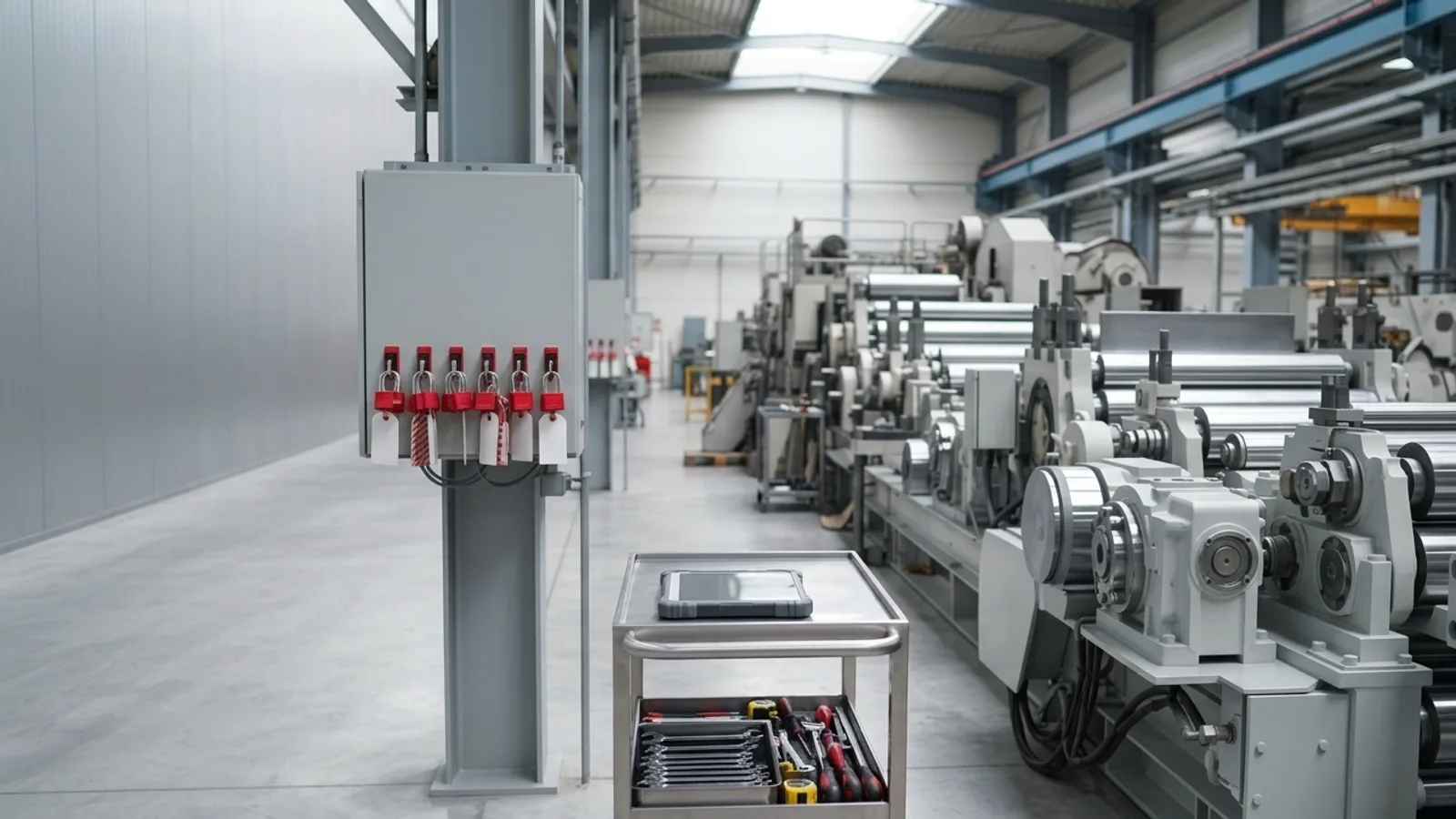
Shutdown jobs are servicing work on isolated equipment, so the US lockout/tagout rule shapes the job packs and the crew plan. Your local rules may add more.
OSHA's lockout/tagout standard requires employers to develop, document and use procedures for controlling hazardous energy whenever employees service or maintain machines or equipment.
Source: 29 CFR 1910.147(c)(4), OSHA (eCFR)When servicing or maintenance is performed by a crew, craft, department or other group, OSHA requires a group lockout or tagout procedure that gives each worker protection equivalent to a personal lockout or tagout device.
Source: 29 CFR 1910.147(f)(3), OSHA (eCFR)When outside servicing personnel such as contractors work on equipment, OSHA requires the on-site employer and the outside employer to inform each other of their lockout or tagout procedures.
Source: 29 CFR 1910.147(f)(2), OSHA (eCFR)OSHA requires specific procedures during shift or personnel changes so that lockout or tagout protection is transferred in an orderly way between off-going and oncoming employees.
Source: 29 CFR 1910.147(f)(4), OSHA (eCFR)We don't just build products; we forge lasting partnerships. See how we've helped industry leaders transform their vision into technical reality.
“I can clearly see how Agnotic has a unique way of handling end-to-end development. They are always active on quick chat and provide support quickly.”

Aaron Phelan
Founder, Benchmark
This page covers choosing and planning shutdown jobs. These pages cover the systems around it.
Equipment health scores from vibration, thermal and SCADA data, feeding the failure risk in each job score.
Vibration, temperature and other machine readings checked against alarm limits, with confirmed alarms sent to maintenance.
Production schedules that need to know when the shutdown window falls.
Image review and defect flags that add inspection findings to the maintenance backlog.
Quality records and corrective actions that often trace back to equipment condition.
Notifications, maintenance orders and measurement readings exchanged with SAP PM as it rolls out line by line.
When a planning module inside your CMMS is enough, and when a separate planning tool fits better.
Plant software built around your own lines, records and systems.
The technical patterns behind this platform translate naturally into adjacent verticals.
Showing 10 of 19 industries