



A digital therapeutic is software that delivers a treatment, not just information about one. That changes what the software has to do: deliver therapy content in the right order, prove the patient actually used it, show clinicians progress, collect outcome data that stands up as evidence, and catch the moment a patient's answers suggest risk.
This post walks through the feature set a digital therapeutics product needs, from the prescription access code that starts therapy to the outcome data that supports claims about it. It is for product and engineering teams scoping a build, and for clinical teams checking what the software must support.
What features does digital therapeutics software need?
Building a digital therapeutic?
Our digital therapeutics page covers the therapy apps, clinician tools and evidence data we build.
Digital therapeutics software needs prescription access and activation, a therapy content engine, adherence tracking, a clinician dashboard, outcome measurement, safety signal handling and an audit trail for every therapy change. Agnotic Technologies builds these features so the therapy can be delivered, monitored and evidenced consistently.
Content quality decides whether the therapy works. The features decide whether you can show that it did.
How does a patient get from prescription to therapy?
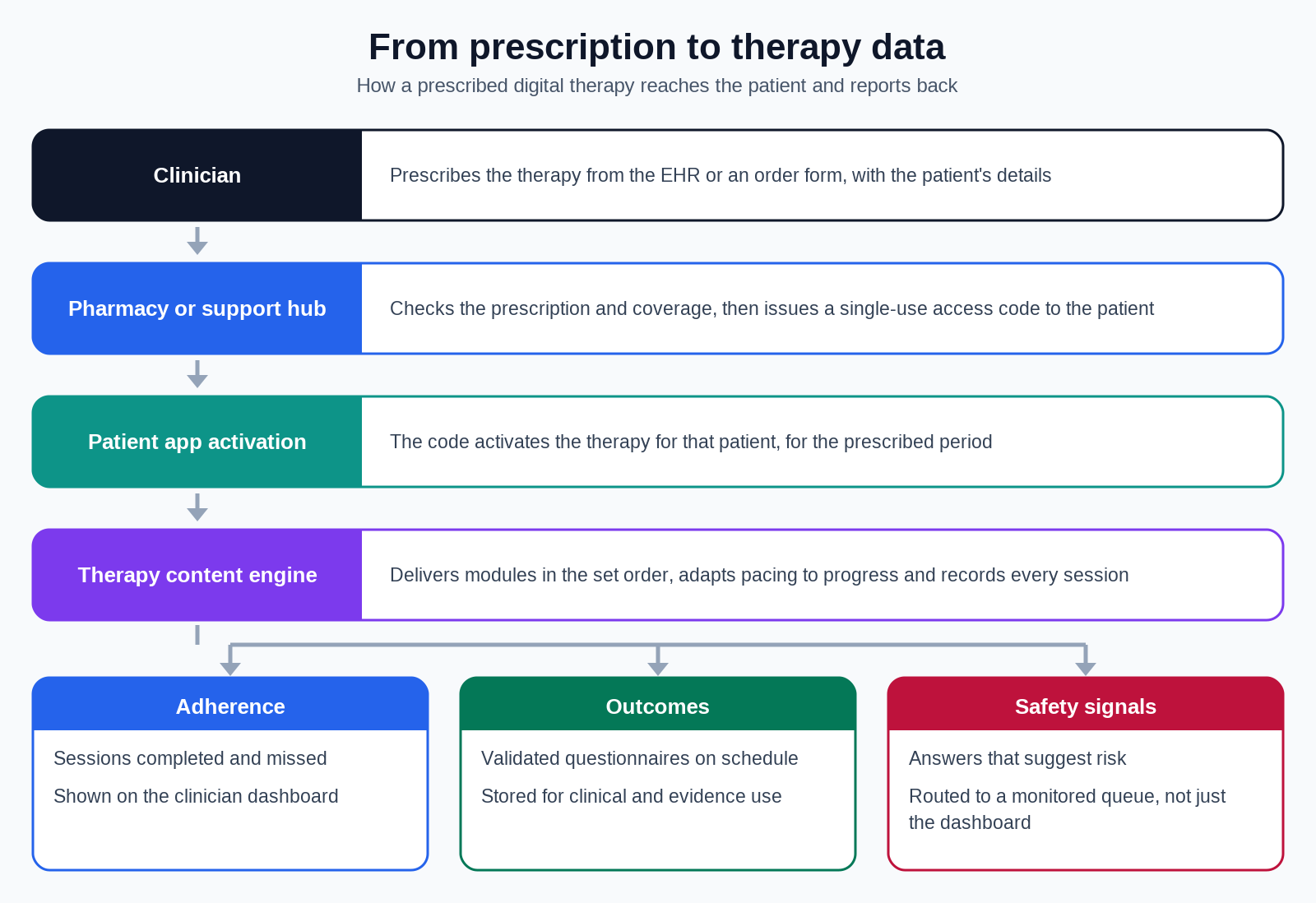
A patient usually gets from prescription to therapy through an access code. The clinician prescribes, a pharmacy or patient support hub verifies the prescription and coverage, and the patient activates the app with a single-use code.
- Single use: each code activates one patient once, and expires if unused.
- Duration: the code sets the prescribed period, after which a renewal is needed.
- Linking: activation links the app account to the prescription record and prescriber.
- Support: a path for lost codes and activation problems that does not need engineers.
What does a therapy content engine do?
A therapy content engine delivers therapy modules in a defined sequence, controls pacing, releases new content as the patient progresses and records each session. Clinical content authors should be able to change content without code, under review.
- Sequencing: modules ordered by the treatment protocol, with prerequisites.
- Pacing: limits on how fast patients advance, and catch-up rules after gaps.
- Personalization: branching by answers, within limits the clinical team approved.
- Versioning: every content change tracked, so you know which version each patient saw.
Versioning matters more than it seems. If outcome data is used as evidence, you need to know exactly which therapy each patient received.
Is digital therapeutics software a medical device?
Often it is, because it is intended to treat or manage a condition. That decision shapes how the software is built, documented and changed.
FDA's guidance on device software functions focuses oversight on software that meets the definition of a medical device and could put patient safety at risk if it does not work as intended.
When the product is a device, content changes and algorithm changes can be design changes under control. Build the content tools and release process with that in mind from the start.
How should adherence be tracked?
Track adherence as meaningful completion, not app opens. A session counts when the patient finishes the therapeutic activity, and the record shows what they completed and when.
- Definition: what counts as a completed session for each module, agreed with clinicians.
- Nudges: reminders at the patient's chosen times, reduced if ignored repeatedly.
- Lapses: a gap in use triggers a check-in or, if prescribed, a note to the clinician.
- Offline use: sessions completed without a signal recorded and synced later in order.
What should the clinician dashboard show?
The clinician dashboard should show which patients need attention, not every data point. Most clinicians will look for a few minutes between visits.
Sort patients by need: safety flags first, then lapses in use, then worsening scores. Show each patient's progress through the program, recent outcome scores and adherence, with the ability to export a summary into the EHR note.
How should outcome data be collected?
Collect outcome data with validated questionnaires on a fixed schedule, stored with the instrument name, version, timing and the therapy version the patient was on. Free-form ratings rarely count as evidence.
Keep outcome data separate from engagement data, with stricter access and change control. Analysts, regulators and payers will ask how it was collected and whether it was altered.
How are safety signals handled?
Safety signals are answers or patterns that suggest risk, such as a high score on a depression item about self-harm. They need a defined response, not just a red flag on a dashboard nobody is watching at night.
- Detection: rules agreed with clinicians on which answers trigger a signal.
- In-app response: immediate crisis resources shown to the patient.
- Routing: a monitored queue with named staff and hours, or a documented handoff to the prescriber.
- Record: every signal, response and outcome logged.
Which systems should a digital therapeutic connect to?
A digital therapeutic should connect to the systems that start and close the loop: the prescriber's EHR, the pharmacy or support hub that issues codes, and the payer processes that decide coverage. Standalone apps that clinicians must log in to separately see little use.
- EHR: prescription from an order, and a progress summary back into the chart.
- Hub or pharmacy: prescription intake, coverage checks and code issue.
- Payers: coverage and claims data handled by the hub or the manufacturer's billing partner.
- Identity: clinician sign-in through the health system's identity provider where possible.
Start with the progress summary into the EHR. Therapy data that appears in the chart clinicians already use is the data they are most likely to act on.
Privacy outside HIPAA
Some digital therapeutics are offered directly to consumers or through employers, where HIPAA may not apply to the vendor. Other rules can still apply to the health data the app holds.
The FTC Health Breach Notification Rule requires vendors of personal health records and related entities, including many health apps outside HIPAA, to notify consumers after a breach of unsecured health information.
Map who your customer is for each channel, then decide which rules apply. Many teams apply the strictest set everywhere to avoid running two privacy models.
What goes wrong in digital therapeutics builds?
Digital therapeutics projects tend to stumble on evidence and safety plumbing rather than on the app itself. These are frequent problems.
- Unversioned content: no way to say which version of a module a trial patient used.
- Opens counted as adherence: engagement numbers that do not reflect therapy completed.
- Dashboard-only safety flags: risk signals nobody sees outside clinic hours.
- Manual code handling: access codes emailed by staff and reused.
- Mixed data: outcome scores stored alongside analytics events and edited by mistake.
A worked example: a digital therapy for insomnia
A team builds a prescribed program based on cognitive behavioral therapy for insomnia. Patients activate with a code from a support hub after their clinician prescribes it.
The content engine delivers weekly modules and a nightly sleep diary, adjusting sleep window advice from the diary entries within limits the clinicians set. Adherence counts completed diaries and modules.
A validated insomnia questionnaire runs at the start, midpoint and end. Clinicians see patients sorted by lapses and score changes, and a mood item routes concerning answers to a monitored queue.
Who owns which feature?
Clinical, regulatory and engineering owners each hold part of the feature set. Write the split down before the build.
- Clinical lead: therapy content, sequencing rules, outcome instruments and safety rules.
- Regulatory lead: device status, design controls and change classification.
- Engineering lead: content engine, activation, data stores and audit trail.
- Operations: support hub, code issue and the safety signal queue staffing.
How do you test digital therapeutics features?
Test the therapy journey end to end with synthetic patients who behave like real ones: skipping sessions, answering inconsistently and losing their codes.
- Activation: reuse, expiry and renewal of access codes.
- Content: every branch and pacing rule against the protocol.
- Safety: every trigger answer, inside and outside staffed hours.
- Data: outcome scores traced from entry to the evidence store unchanged.
What are digital therapeutics software best practices?
Version every piece of therapy content, define adherence as completed therapy, keep outcome data in a controlled store, route safety signals to people, automate access codes and decide device status early.
Design the evidence trail before the first patient uses the product, because adding it afterwards rarely satisfies anyone who reviews it.
How Agnotic can help
Agnotic builds digital therapeutics software: access code activation, content engines clinical authors can manage, adherence and outcome tracking, clinician dashboards and safety signal routing, built to support device documentation where it applies.
Plan your digital therapeutic with Agnotic
We set up the design controls and evidence trail a regulated therapy needs.
Related reading on Agnotic
Device rules, monitoring and mental health products.


