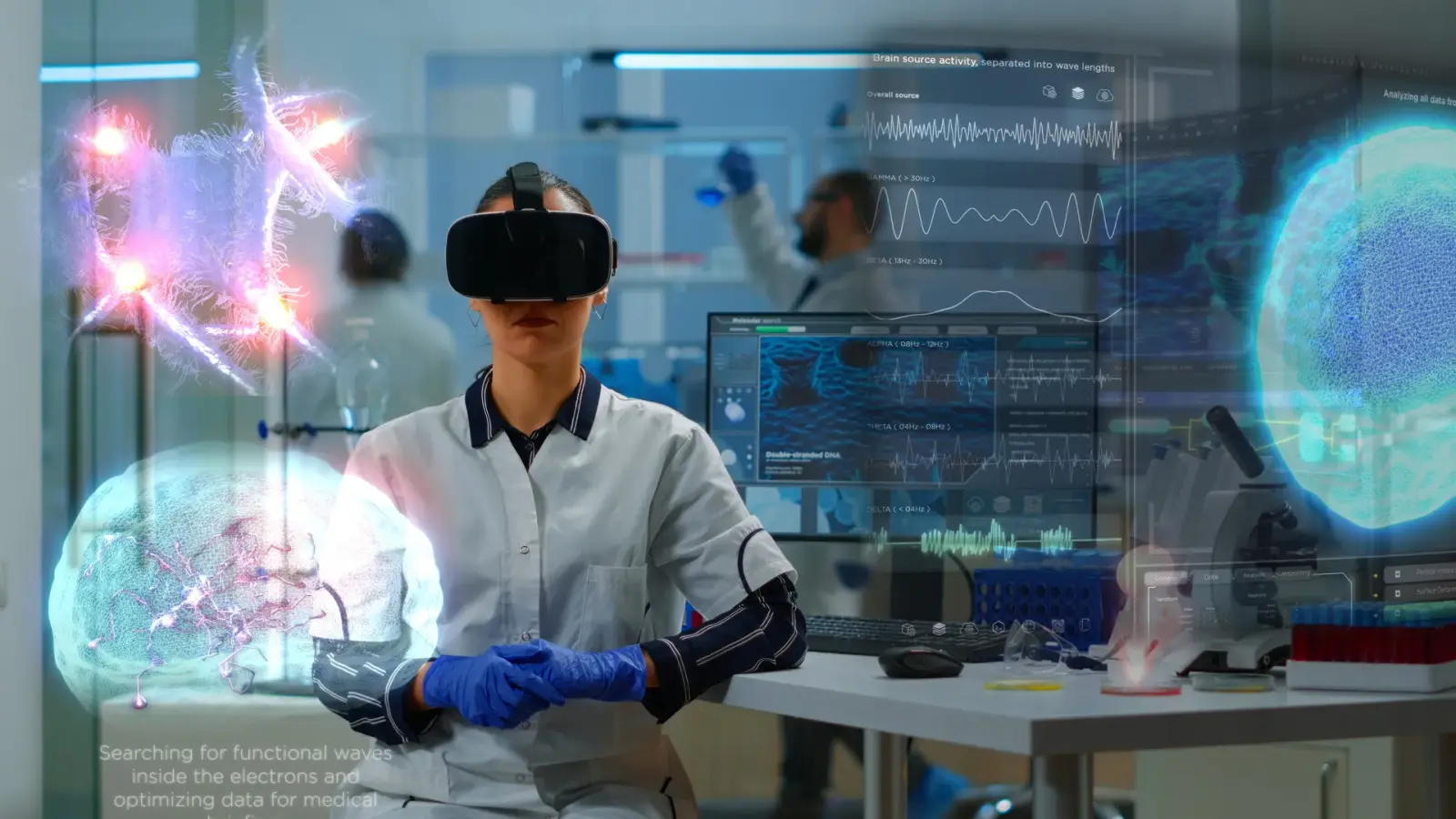











Clinician in a white coat and blue gloves wearing a virtual reality headset in a medical laboratory, with brain scan visuals and data overlays around her
    Healthcare / Virtual Reality

    Virtual reality software for therapy and rehabilitation

    A VR session that helps a patient through a painful procedure or a stroke rehab exercise is clinical software, with a headset that someone has to charge, clean and get back. Agnotic Technologies builds VR therapy and rehab apps together with the fleet tools, session data handling and clinician dashboard they depend on.

    Therapy
    Pain, motor rehab and exposure therapy apps
    Fleet
    Headsets in clinics and patients' homes
    Clinician
    Sessions prescribed, adjusted and reviewed

    Trusted by global innovators

    Benchmark
    Chibasco
    Fundency
    Lantimer
    Lauren
    Lera
    One Minute
    Pento Pix
    TAP
    Xtrium
    Healthevolve
    Benchmark
    Chibasco
    Fundency
    Lantimer
    Lauren
    Lera
    One Minute
    Pento Pix
    TAP
    Xtrium
    Healthevolve
    Benchmark
    Chibasco
    Fundency
    Lantimer
    Lauren
    Lera
    One Minute
    Pento Pix
    TAP
    Xtrium
    Healthevolve
    Benchmark
    Chibasco
    Fundency
    Lantimer
    Lauren
    Lera
    One Minute
    Pento Pix
    TAP
    Xtrium
    Healthevolve
    Industry Overview

    What is VR healthcare software development?

    VR healthcare software development is building virtual reality applications that deliver or support clinical care, such as pain distraction, motor rehabilitation after stroke, exposure therapy and clinician training, together with the headset fleet tools, session data handling and clinician dashboard around them. Agnotic Technologies builds this software for digital health companies, providers and device makers.

    Clinical uses

    Which clinical uses does VR software serve?

    Each use needs different data and a different level of clinician control. We design the session, the data and the dashboard for the use you are building.

    Pain distraction and behavioral therapy for pain

    Immersive sessions during procedures, or a home program for chronic pain.

    • Pain scores captured before and after each session
    • Session length and completion sent to the clinician
    • Comfort check and a stop control always in reach
    Upper limb motor rehabilitation

    Reach, grasp and range of motion exercises after a stroke or injury, set by a therapist.

    • Therapist sets difficulty, range targets and repetitions
    • Reach distance and joint range from controllers or hand tracking
    • Home program with adherence the therapist can review

    Exposure therapy

    Graded scenes for phobias and anxiety, run by a therapist.

    • Therapist controls scene intensity during the session
    • Distress ratings logged at each step
    • Session notes linked to the treatment plan

    Clinical staff training

    Procedure rehearsal and team drills for staff.

    • Scenarios with recorded completion
    • Educator review of each run
    • No patient data in the session

    Relaxation and stress management

    Calm environments for waiting rooms or staff rest areas, with no disease claim.

    • Simple start and stop
    • Minimal data collected
    • Kiosk mode on shared headsets
    Industry Challenges

    Where do VR therapy programs fail?

    The failure points we design against from the first prototype.

    • Cybersickness: motion, frame rate or session length makes patients nauseous, and they stop using the program.

    • Home headsets are lost, kept or returned with a flat battery and a broken controller.

    • Shared clinic headsets are not cleaned between patients, and the next patient opens the previous session.

    • Motion and session data leave the headset unencrypted, or sit on a consumer cloud account.

    • A headset firmware or OS update changes tracking behaviour and nobody retests the exercises.

    • Clinicians cannot see session results in the record, so the therapy is invisible in the chart.

    • Charging and storage are not planned, so half the fleet is flat on a clinic morning.

    Decision table

    Is your VR app a medical device?

    Our starting decision table. Regulatory status depends on the intended use and claims you make; your regulatory team or counsel confirms it for your product.

    VR healthcare uses with their likely regulatory position, the data captured and the clinician control needed
    VR useLikely regulatory positionData it capturesClinician control it needs
    Behavioral therapy for pain reliefFDA device, Class II under 21 CFR 890.5800, when intended to provide behavioral therapy for painPain scores, session time, adverse eventsPrescription, program set-up and review of results
    Upper limb motor rehabilitationOften a device when it claims to treat or rehabilitate a condition; your regulatory team confirms the pathwayRange of motion, repetitions, reach and adherenceDifficulty and targets set per patient
    Exposure therapy for phobia or anxietyA device when it claims to treat a psychiatric conditionDistress ratings, step reached, session notesLive control of scene intensity
    Relaxation or stress management, no disease claimGeneral wellness under FDA's January 2026 policy, if the claims stay within itMinimal: session use onlyNone required
    Clinical staff trainingUsually not a medical device, because it is not used to diagnose or treat patientsCompletion and performance for training recordsEducator review
    Our Approach

    How should a VR therapy product be built?

    Three decisions that shape the code, the data and the rollout.

    Decide the claim first

    The intended use decides the regulatory path, the evidence and the records. We agree it before the first scene is built, so the software is designed for the path it will take.

    Run the session on the headset

    Sessions work offline, store data encrypted on the device and sync when a connection is available, so a weak home connection never stops a therapy session.

    Treat the headset as shared hardware

    Each patient has a profile, sessions are cleared between patients and the device is managed centrally, in clinics and in homes.

    Capabilities

    What do we build for VR therapy and rehab programs?

    Software across the headset, the cloud and the clinician's screen.

    Therapy apps on standalone headsets

    Exercises and scenes built on OpenXR, so the app is not tied to one headset model.

    Session engine with comfort controls

    Session length, locomotion options and a stop control designed to reduce cybersickness.

    Motion capture and metrics

    Reach, range of motion and repetitions calculated from controller or hand tracking data.

    Clinician dashboard

    Prescribe programs, adjust difficulty and review results for each patient.

    Patient profiles on shared headsets

    Per-patient sign-in, with sessions cleared between patients.

    Fleet management

    Device management, kiosk mode, app updates and battery status for every headset.

    Home program logistics

    Headset shipping, check-in calls and returns tracked per patient.

    Record export

    Session results sent to the EHR as FHIR Observations or documents.

    Engineering Stack

    Which engines, devices and standards do VR health apps use?

    Chosen for the headsets your program can buy, manage and clean.

    XR runtime

    OpenXRUnity or Unreal EngineNative headset SDKs where needed

    Devices

    Standalone headsetsControllers and hand trackingCharging and storage stations

    Fleet

    Mobile device management with kiosk modeOver-the-air app updatesRemote wipe

    Data and security

    Encrypted on-device storageHL7 FHIR R4 Observation exportAudit logsAWS or Azure in your account
    Sizing

    What sizes a VR therapy or rehab build?

    A VR therapy or rehab build is sized by the headsets supported, the number of modules, the hand and body tracking data kept, the clinician dashboard and remote prescribing, session data sent to the EHR, device fleet management and offline use, and whether the product is a device under FDA rules. Agnotic Technologies scopes each driver with clinicians.

    VR therapy and rehabilitation software sizing drivers with the question to answer before scoping and what each changes in the build
    DriverQuestion to answer before scopingWhat it changes in the build
    Headsets supportedWill the program run on one standalone headset model, or on several models and brands?Each extra model adds performance tuning, input differences and a test pass on real hardware.
    Number of therapy modulesHow many exercises or exposure scenes does the first release need, and who designs their clinical content?Modules are usually the largest share of the build, since each needs 3D content, difficulty levels and clinician review.
    Hand and body tracking data keptDoes the clinician need range of motion or movement data, or only completion and session length?Keeping tracking data adds on-device processing, storage, encryption and a data retention rule.
    Clinician dashboard and remote prescribingWill clinicians assign exercises and review sessions remotely for home patients?Adds a web dashboard, patient assignment, remote configuration of the headset and messaging to the patient.
    Session data sent to the EHRMust session results appear in the EHR, and does your EHR accept FHIR Observations or only documents?Adds an interface, mapping of session measures and testing with your EHR team.
    Device fleet management and offline useAre headsets shared in a clinic or sent home, and will they work without Wi-Fi?Shared headsets need kiosk mode and patient sign-in; offline use needs local storage and later sync.
    Device status under FDA rulesDoes the intended use make the software a medical device, or does it stay a general wellness or distraction tool?Device status adds design controls, risk management and the documentation a submission needs.
    Measured Impact

    What should a VR therapy program measure?

    Measures we build into the clinician dashboard and the program report.

    Adherence
    Sessions completed

    Prescribed sessions against completed sessions, per patient.

    Comfort
    Cybersickness

    Sessions stopped early and discomfort reports.

    Outcomes
    Data captured

    Sessions with pain scores or range of motion recorded.

    Fleet
    Headset readiness

    Headsets charged, updated and assigned, by site.

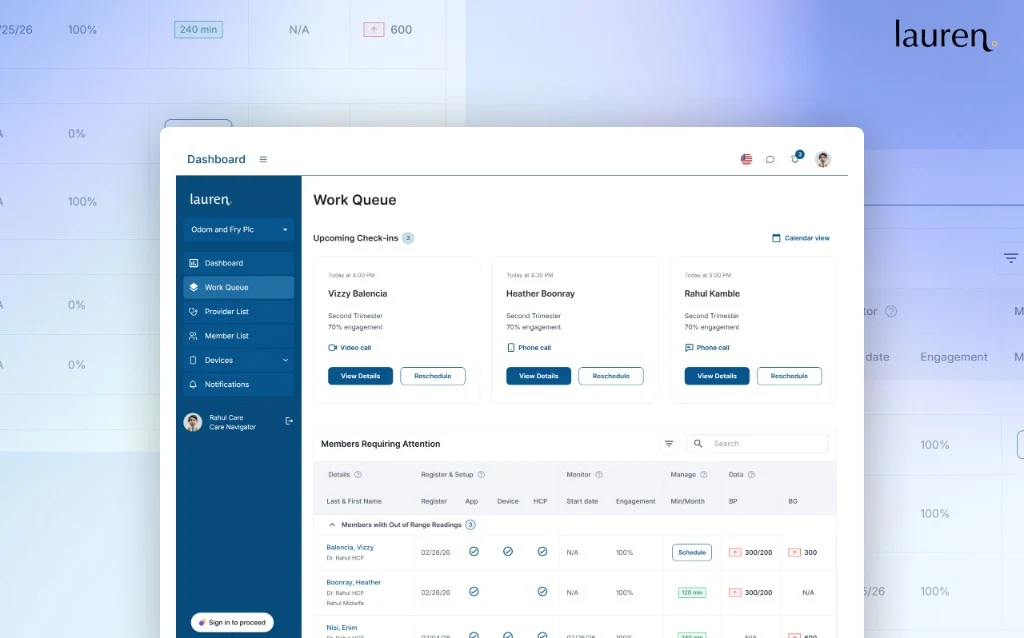
    My Lauren Maternal Health Platform | Built by Agnotic

    A HIPAA-ready maternal health platform enabling remote patient monitoring, care coordination, and personalized engagement from pre-pregnancy through postpartum.

    Case Study
    My Lauren Maternal Health Platform | Built by Agnotic
    LERA Health: Women's Health App Platform

    LERA Health: Women's Health App Platform

    A women’s health product experience focused on guided care journeys, education, and compliance-aware workflows to support long-term engagement.

    Case Study
    Use Cases

    Who builds VR healthcare software with us?

    Teams putting VR in front of patients, not just in a demo room.

    01

    Digital therapeutics companies

    A VR therapy product with the records a regulatory path needs.

    02

    Rehabilitation providers

    Therapist-set exercise programs for clinic and home.

    03

    Children's hospitals

    Procedural distraction on shared headsets.

    04

    Behavioral health practices

    Therapist-led exposure therapy sessions.

    05

    Device makers adding VR

    VR modules for existing therapy or rehab devices.

    06

    Hospital education teams

    Staff training scenarios with completion records.

    Integrations

    Which systems does VR software connect to?

    The systems around the headset.

    Session results through FHIR

    EHR

    Headset fleet

    Mobile device management

    App distribution

    Headset vendor platforms

    Home program data

    Remote therapeutic monitoring tools

    Reminders and check-ins

    Patient app

    Program reporting

    Analytics platform

    Compliance-First Development Services Backed by Global Standards

    We build secure, scalable products designed for privacy, interoperability, and regulatory readiness from day one across every sector we serve.

    HIPAA logo

    Health Insurance Portability and Accountability Act

    Protect PHI with privacy-first architecture, encrypted storage and transmission, and strict access controls.

    GDPR logo

    General Data Protection Regulation

    Implement lawful consent flows, data minimization, and secure processing for global data privacy.

    Our Edge

    Why Global Leaders Choose Us

    We combine deep technical expertise with industry-specific knowledge to deliver solutions that aren't just functional, but transformational.

    Enterprise-Grade Security

    We implement rigorous security protocols and compliance standards (HIPAA, GDPR, SOC2) across all industrial solutions to protect sensitive data.

    High-Performance Scaling

    Our architectures are built to handle massive data loads and user bases, keeping performance steady whether you're serving ten or ten million.

    Accelerated Time-to-Market

    Using our suite of internal tools and proven frameworks, we cut setup work so your first release reaches users sooner.

    Embedded AI Integration

    Beyond simple wrappers, we build deep-learning integrations and predictive analytics directly into the core of your industry-specific workflows.

    Engagement Model

    How does a virtual reality healthcare engagement work?

    We test on the real headset early. Timing depends on scope; we agree a fixed first release on the scoping call.

    01

    Scoping call

    We review the clinical use, the claim you plan to make, the headsets and the care setting.

    02

    Workflow and claim review

    Clinicians, therapists and your regulatory lead agree the session, the data and the intended use.

    03

    Prototype on the target headset

    One exercise or scene tested for comfort with clinicians before more are built.

    04

    First release

    Sessions, patient profiles, the clinician dashboard and fleet set-up working for a pilot site.

    05

    Scale and support

    More exercises, sites and home patients, with retesting after every headset update.

    Facts and sources

    Which rules and standards shape VR healthcare software?

    Short facts we design the product, data and devices around, each linked to its primary source.

    • FDA keeps an AR/VR Medical Device List of augmented and virtual reality medical devices authorized for marketing in the United States, and describes VR as an immersive experience that may use a headset to replace the user's surrounding view.

      Source: FDA, Augmented Reality and Virtual Reality in Medical Devices
    • A virtual reality behavioral therapy device for pain relief is a Class II device with special controls, including software verification, validation and hazard analysis, and labeling that warns of the risk of nausea and motion sickness.

      Source: 21 CFR 890.5800 (eCFR)
    • FDA's General Wellness guidance, issued 6 January 2026, lists claims to promote relaxation or manage stress among general wellness claims that make no reference to a disease or condition.

      Source: FDA, General Wellness: Policy for Low Risk Devices (January 2026)
    • The HIPAA Security Rule requires a unique name or number to identify and track each user, and treats automatic logoff and encryption of ePHI as addressable implementation specifications.

      Source: 45 CFR 164.312(a)(2) (eCFR)
    • OpenXR is a royalty-free open standard from the Khronos Group that gives developers a common set of APIs for XR applications running across a wide range of AR and VR devices.

      Source: Khronos Group, OpenXR

    Voice of success

    We don't just build products; we forge lasting partnerships. See how we've helped industry leaders transform their vision into technical reality.

    Benchmark

    “I can clearly see how Agnotic has a unique way of handling end-to-end development. They are always active on quick chat and provide support quickly.”

    Aaron Phelan

    Aaron Phelan

    Founder, Benchmark

    Latimer

    “Agnotic combines deep technical expertise with strong domain knowledge. They understand the business context, anticipate challenges, and make collaboration smooth and effective.”

    John Pasmore

    John Pasmore

    Founder, Latimer

    My Lauren

    “Agnotic is the best technical team we evaluated. Their engineering excellence made our work dramatically easier and allowed us to stay focused on what matters most for maternal care outcomes. They took full ownership of the technical execution, and we are always happy to continue working together.”

    Kim Smith

    Kim Smith

    Founder, My Lauren

    Related services

    Related therapy and immersive software

    This page covers VR delivered to patients. These pages cover the therapy programs and immersive learning around it.

    More in Healthcare

    More Healthcare Solutions

    Explore other production-grade engineering platforms we deliver across healthcare.

    Cross-Industry Reach

    The Same Engineering Patterns, Across Other Industries

    The technical patterns behind this platform translate naturally into adjacent verticals.

    Frequently Asked Questions

    If it is intended to provide behavioral therapy for pain, FDA classifies it as a Class II device under 21 CFR 890.5800, with special controls. A relaxation app that makes no disease claim can fall under the general wellness policy. Your claims decide which applies.