

Memory care and nursing facilities
Residents at risk of leaving a unit unsafely.
- Risk flag from the resident's care plan
- Tag assigned at admission and checked each shift
- Exit rules set per unit and door


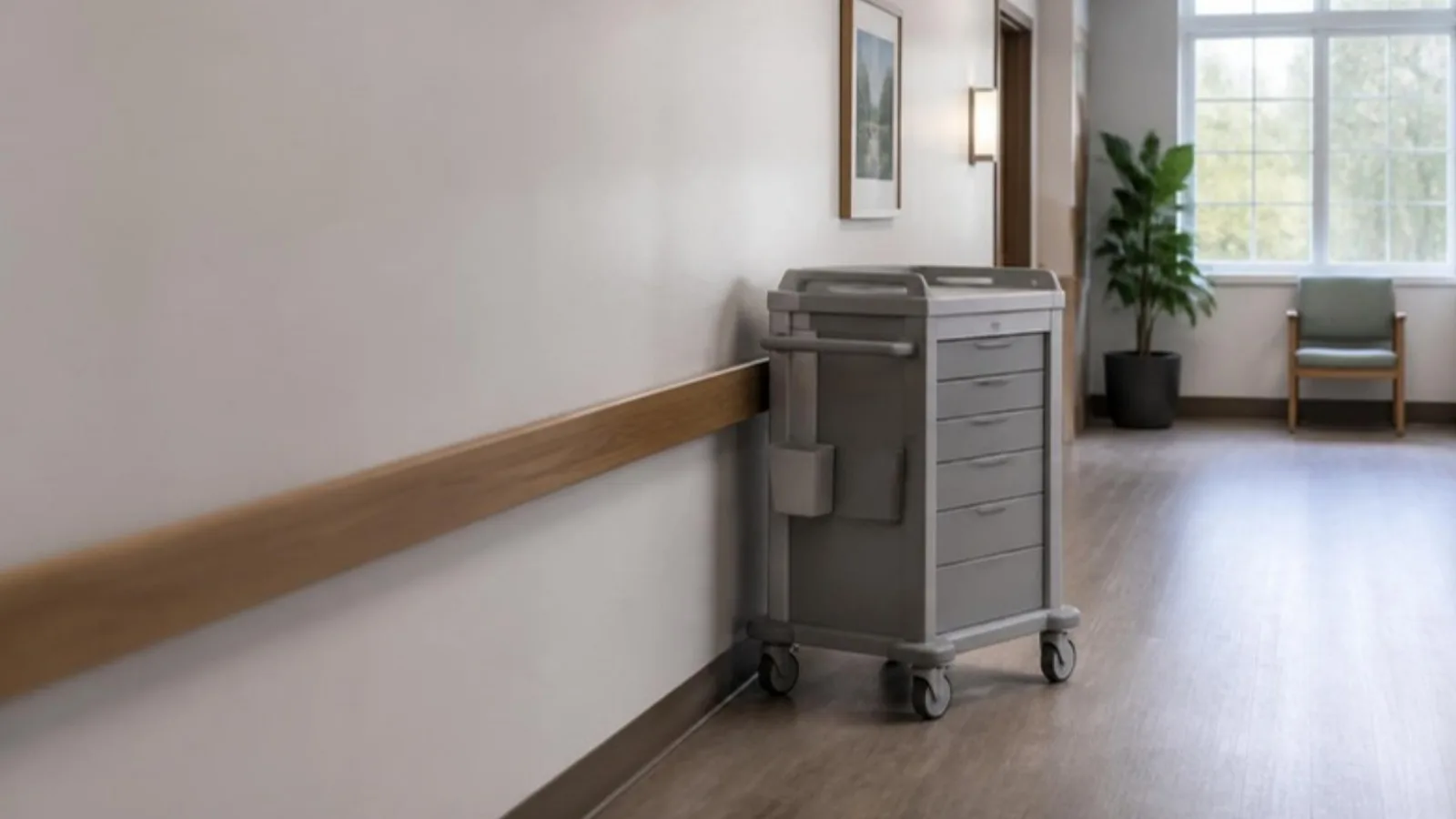
A tag near an exit door means nothing until the right person gets the alert, the door does what the life safety plan allows and the event is on record. Agnotic Technologies builds the software layer of resident wander management and infant security systems, on the tags, readers and door hardware you have chosen.
Trusted by global innovators











A wander management system is the software that links resident or newborn tags, exit door controllers and staff devices, so an elopement or infant abduction attempt raises the right alarm. Agnotic Technologies builds that software layer: enrollment from the ADT feed, alarm routing and escalation, door actions within the life safety plan, and test and incident records.
The hardware is similar across settings. The people at risk, the alarm rules and the records are not.
Residents at risk of leaving a unit unsafely.
Infant security from birth to discharge.
Patients who must not leave without an escort.
Several communities with different rules.
Most failures we see are in the software and the process around the hardware, not in the tags.
Tags are enrolled by hand at the nurses' station, so a newly admitted resident or a newborn goes unprotected until someone remembers.
Every alarm sounds at the same panel, so staff learn to silence it, and the one real event gets the same response as a door held for a delivery.
Escort bypass codes are shared on sticky notes, and the log cannot show who walked a resident through the door.
Discharged residents keep active tags, and newborns moving between units trigger alarms at the right door for the wrong reason.
Monthly door and tag tests are written on paper, so the facility cannot show which doors were tested and what happened.
Low tag batteries and readers that stop reporting are found only when an alarm does not sound.
Agnotic builds software only. These three decisions shape every wander management build.
Admit, birth, transfer and discharge events from the ADT feed create, move and release tag assignments. Manual enrollment stays possible, with a reason recorded.
Alerts route by unit, event type and staff assignment to phones, badges or nurse call, with acknowledgement and escalation timers the facility sets.
The software sends only the door and elevator actions your life safety engineer and the authority having jurisdiction approved. Fire alarm release stays in the door hardware and always wins.
Modules we build on top of your tag and door vendor's interfaces. Choosing the location technology itself is covered on our RFID in hospitals page.
ADT-driven assignment, transfer and release of tags, plus manual enrollment with a recorded reason.
Rules by unit, event type and staff assignment, delivered to phones, badges, nurse call or pagers.
Timers per event type, acknowledgement by a named person and handoff to the next level.
Badge or PIN authorizes one passage for one resident, and every bypass is logged.
Commands to the door controller or access control system through the vendor's supported interface.
Scheduled door and tag tests, expected and actual results, failures and the fix for each.
A timeline for each alarm from tag event to resolution, ready for the safety committee.
Tag batteries, check-in gaps and reader status, with alerts to biomedical engineering or IT.
The feeds and systems a wander management build connects, chosen with your clinical, security and facilities teams.
We agree this table with nursing, security and facilities before writing alarm rules. Escalation timers are the facility's choice; door actions are limited to what the life safety plan allows.
| Event | Who is alerted first | Escalation if not acknowledged | Door action allowed | Record kept |
|---|---|---|---|---|
| Tag near a monitored exit | Staff assigned to the resident's unit | Charge nurse, then the whole unit | Lock or hold only where the life safety plan permits; released by the fire alarm | Time, door, tag, responder and outcome |
| Door opened with a tag present | Unit staff and the nearest station | Supervisor and security | Alarm continues until staff reset it at the door | Who reset it and after what check |
| Door held open past the set time | Unit staff | Facilities | None beyond the local alarm | Door and duration |
| Band cut, tag removed or tag loose | Maternity charge nurse and security | The hospital's own code procedure | Unit exits and elevators move to the state the plan allows | Tamper time, last known location and staff actions |
| Tag stops checking in | Unit staff | Biomedical engineering or IT | None | Last seen time and replacement tag |
| Newborn registered with no tag enrolled | Nursery charge nurse | Unit manager | None | Time from birth registration to enrollment |
| Approved escort through an exit | No alarm | Not needed | Bypass for one passage | Staff badge, resident and time |
Views we build for nursing leaders, security and the safety committee.
Alarms that passed their escalation timer without a response.
Admissions or births at risk with no tag enrolled yet.
Tests done, missed and failed, by door and unit.
Tags and readers that stopped checking in.
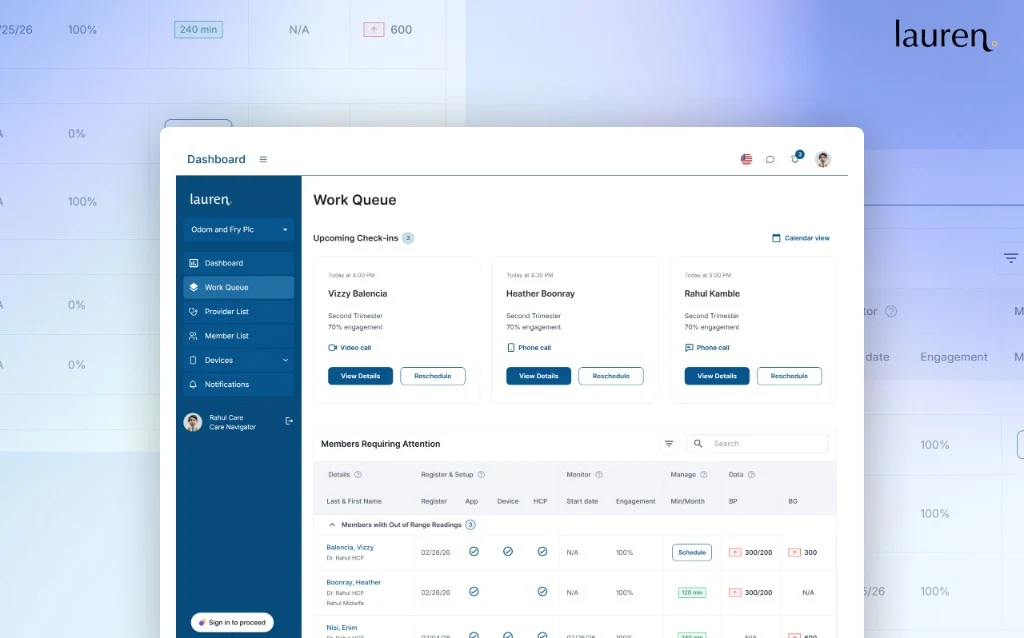
A HIPAA-ready maternal health platform enabling remote patient monitoring, care coordination, and personalized engagement from pre-pregnancy through postpartum.
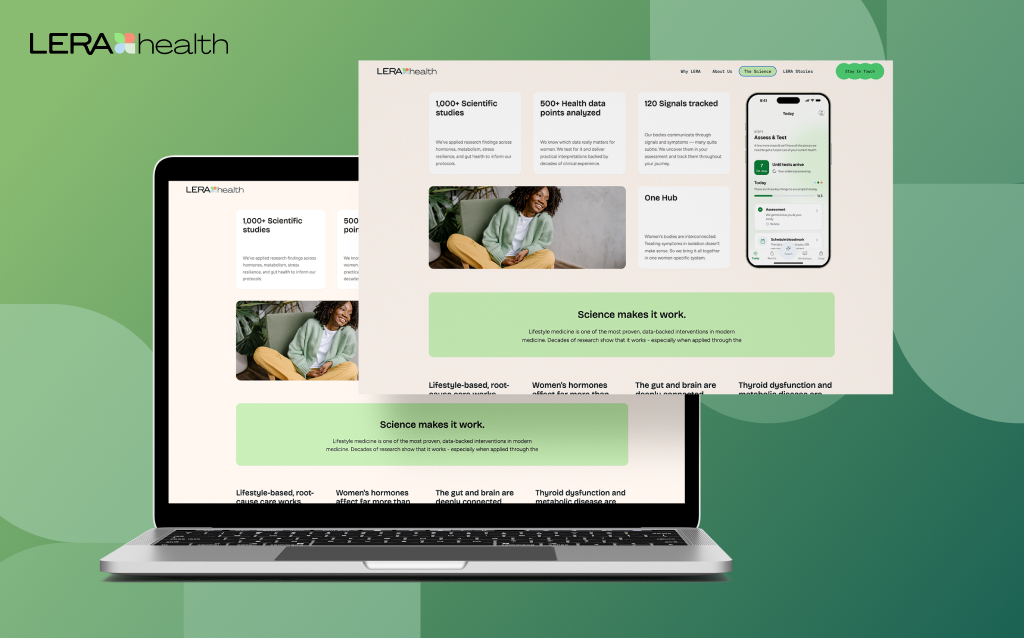
A women’s health product experience focused on guided care journeys, education, and compliance-aware workflows to support long-term engagement.
First releases we scope, each small enough to prove on one unit.
Paper test sheets replaced with scheduled tests, results and fixes by door.
Admissions and births create tag assignments in an existing tag system.
Alerts sent to assigned staff with escalation, instead of one panel.
Newborn enrollment, tamper alarms and an authorized discharge release.
The software layer for a tag hardware company: enrollment, routing, test logs and reports.
One alarm and test history across a senior living operator's communities.
The systems around the alarm path. We integrate through each vendor's supported interface.
We build these fields into the test log and incident review, so a safety committee or surveyor can see what was tested, what failed and what was fixed.
We build secure, scalable products designed for privacy, interoperability, and regulatory readiness from day one across every sector we serve.

Protect PHI with privacy-first architecture, encrypted storage and transmission, and strict access controls.

Supporting enterprise-grade interoperability for clinical messaging and record workflows.
We combine deep technical expertise with industry-specific knowledge to deliver solutions that aren't just functional, but transformational.
We implement rigorous security protocols and compliance standards (HIPAA, GDPR, SOC2) across all industrial solutions to protect sensitive data.
Our architectures are built to handle massive data loads and user bases, keeping performance steady whether you're serving ten or ten million.
Using our suite of internal tools and proven frameworks, we cut setup work so your first release reaches users sooner.
Beyond simple wrappers, we build deep-learning integrations and predictive analytics directly into the core of your industry-specific workflows.
We start with one unit and the hardware already on the walls. Timing depends on the vendor interfaces, and we agree a fixed first release on the scoping call.
Units, tag and door hardware, alert devices and the life safety plan.
Vendor APIs, door controllers and the ADT feed tested with your teams.
The event table agreed with nursing, security and facilities.
Enrollment, routing and the test log working end to end on one unit.
More units, then more sites, on the same rules engine.
Rule changes and vendor updates under agreed change control.
Short facts we design around, each linked to its primary source.
A nursing facility must ensure that the resident environment remains as free of accident hazards as possible and that each resident receives adequate supervision and assistance devices to prevent accidents.
Source: 42 CFR 483.25(d) (eCFR)A long-term care facility must meet the applicable provisions of the Life Safety Code, NFPA 101, and its Tentative Interim Amendments TIA 12-1 to TIA 12-4.
Source: 42 CFR 483.90(a)(1)(i) (eCFR)A hospital must meet the applicable provisions of the Life Safety Code, and the regulation incorporates NFPA 101, Life Safety Code, 2012 edition, by reference.
Source: 42 CFR 482.41(b) and (e) (eCFR)The hospital patients' rights condition of participation gives every patient the right to receive care in a safe setting.
Source: 42 CFR 482.13(c)(2) (eCFR)We don't just build products; we forge lasting partnerships. See how we've helped industry leaders transform their vision into technical reality.
“I can clearly see how Agnotic has a unique way of handling end-to-end development. They are always active on quick chat and provide support quickly.”

Aaron Phelan
Founder, Benchmark
“Agnotic combines deep technical expertise with strong domain knowledge. They understand the business context, anticipate challenges, and make collaboration smooth and effective.”

John Pasmore
Founder, Latimer
“Agnotic is the best technical team we evaluated. Their engineering excellence made our work dramatically easier and allowed us to stay focused on what matters most for maternal care outcomes. They took full ownership of the technical execution, and we are always happy to continue working together.”

Kim Smith
Founder, My Lauren
This page covers the alarm software. These pages cover the systems around it.
Location technology choices and tracking for equipment, patients and staff.
MDS, eMAR and care plans for nursing and senior living.
The staff messaging that alarms can be delivered through.
Device connectivity and data pipelines for connected hardware.
Explore other production-grade engineering platforms we deliver across healthcare.