

01
Assessment deadline tracker
MDS and care plan clocks for every resident, with alerts for the MDS coordinator.


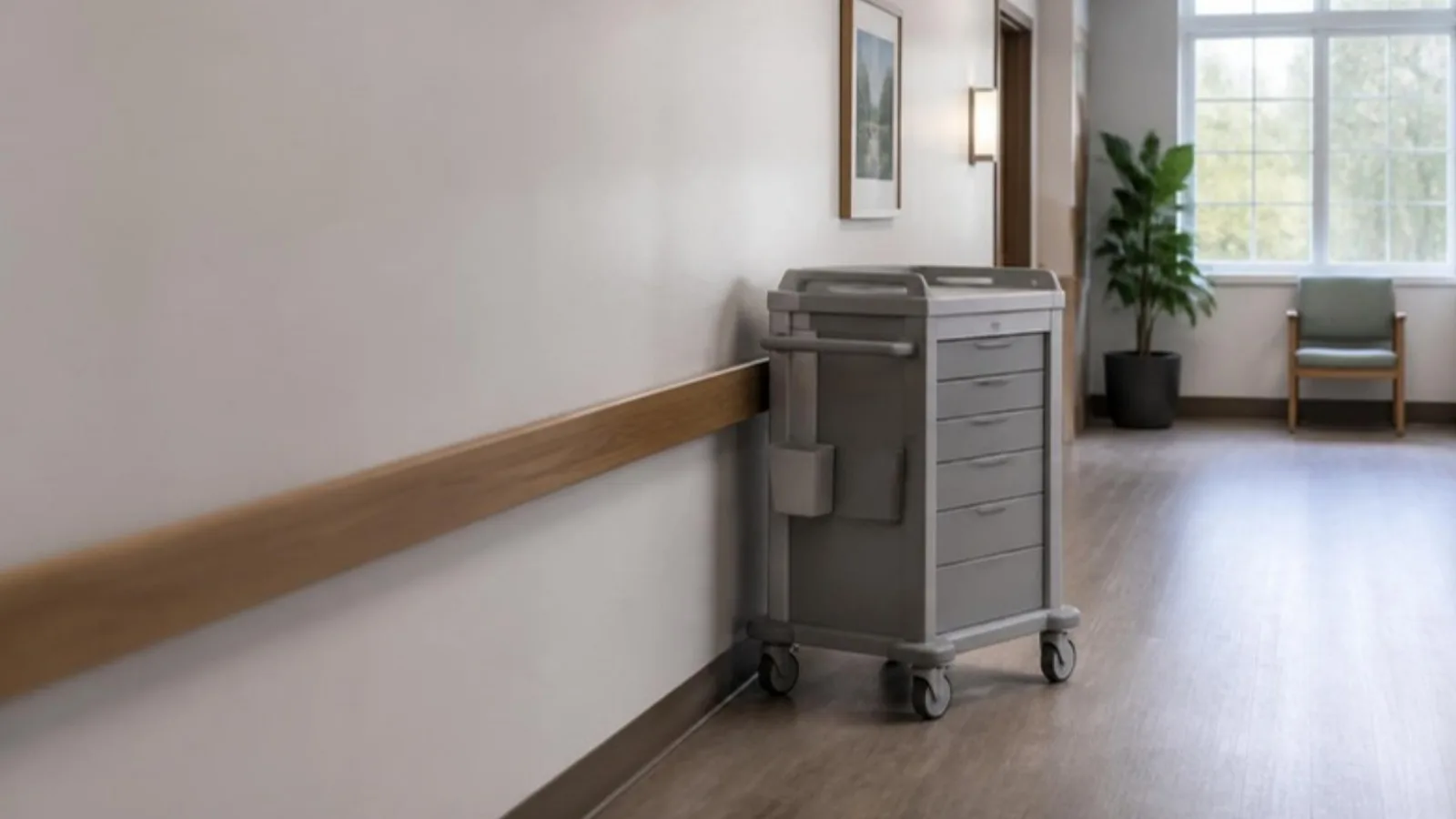
Nurses in skilled nursing facilities juggle assessments, care plans, medication passes and staffing gaps across tools that don't talk to each other. Agnotic Technologies builds long-term care software that keeps resident records, MDS deadlines, eMAR and shift coverage in one place, connected to pharmacy, lab and your EHR.
Trusted by global innovators











Long-term care software runs the daily work of skilled nursing and long-term care facilities: resident records, MDS assessments, care plans, eMAR, staffing and shifts, family updates and survey readiness. Agnotic Technologies builds and integrates this software for facility operators and health tech teams, connected to pharmacy, lab and the facility's EHR.
Facility software problems show up on the floor first. These are the ones we hear most from directors of nursing and administrators.
Assessment due dates are tracked in spreadsheets, so a significant change assessment is missed when a resident's condition shifts.
Care plans are not updated after an assessment, and the aides on the next shift work from an old plan.
Pharmacy orders, eMAR and the resident record disagree, so nurses reconcile medications by phone.
Shift gaps are filled by calls and texts, and the posted staffing data is rebuilt by hand each day.
Families call the nurses' station for updates because there is no secure channel to share them.
Survey preparation means days of pulling paper and screenshots instead of running a report.
Three decisions on the scoping call shape long-term care software development.
Most facilities already run a long-term care EHR. We decide together which work stays in it and which moves to custom tools, such as staffing, family updates or survey reporting.
Aides and nurses use shared devices on busy shifts, so screens are built for quick entry, large touch targets and fast hand-offs between users.
Assessment, care plan and review clocks drive the facility's week, so the rules engine that tracks them comes before dashboards.
Modules we build or integrate for skilled nursing and long-term care operators.
Admissions, room assignments, diagnoses, preferences and leave of absence, with a census view for every unit.
Assessment scheduling, section assignments, completion tracking, validation before export and submission history.
Care plans built from assessment results and admission orders, with goals, interventions and resident and family input.
Medication administration records tied to pharmacy orders, with pass lists, PRN follow-up and drug regimen review tracking.
Shift schedules, open shift requests, agency use and the daily nurse staffing posting built from real hours.
A secure portal or app for updates, messages and visit booking, limited to the representatives the resident authorizes.
Reports that pull assessments, care plans, medication reviews and staffing records for a resident or a unit on demand.
Artificial intelligence in long-term care where it saves nurse time, such as drafting shift summaries or flagging possible significant changes, always reviewed by a nurse.
Chosen to fit your EHR, your pharmacy partner and your staff's devices.
These are the federal clocks in 42 CFR Part 483 that drive most long-term care workflows. State rules can add more; we load those during scoping.
| Requirement | Federal timing | What the software should do |
|---|---|---|
| Admission assessment | Within 14 calendar days after admission (42 CFR 483.20) | Start the assessment clock at admission and alert the MDS coordinator before it runs out |
| Significant change assessment | Within 14 calendar days after the facility determines a significant change (42 CFR 483.20) | Prompt a review when nursing notes or orders suggest a major change |
| Quarterly and annual assessments | Quarterly review at least every 3 months; comprehensive assessment at least every 12 months (42 CFR 483.20) | Schedule each resident's cycle and show what is coming due |
| MDS encoding and transmission | Encode within 7 days of completion; transmit to the CMS System within 14 days (42 CFR 483.20) | Validate records before export and track every submission and correction |
| Baseline and comprehensive care plans | Baseline within 48 hours of admission; comprehensive within 7 days after the assessment (42 CFR 483.21) | Draft the plan from admission orders and assessment results, then route it to the team |
| Drug regimen review | At least once a month by a licensed pharmacist (42 CFR 483.45) | Give the consultant pharmacist chart access and track each irregularity to a physician response |
| Nurse staffing posting | At the start of each shift; keep for at least 18 months (42 CFR 483.35) | Build the posting from the schedule and timekeeping data, and archive it |
Measures we build dashboards around and review with administrators and directors of nursing.
Assessments and care plans completed within their federal windows, by unit.
Late, missed and held doses, with the reasons recorded.
Planned against worked hours by role, and open shifts filled.
Records a surveyor may request that can be produced from the system.
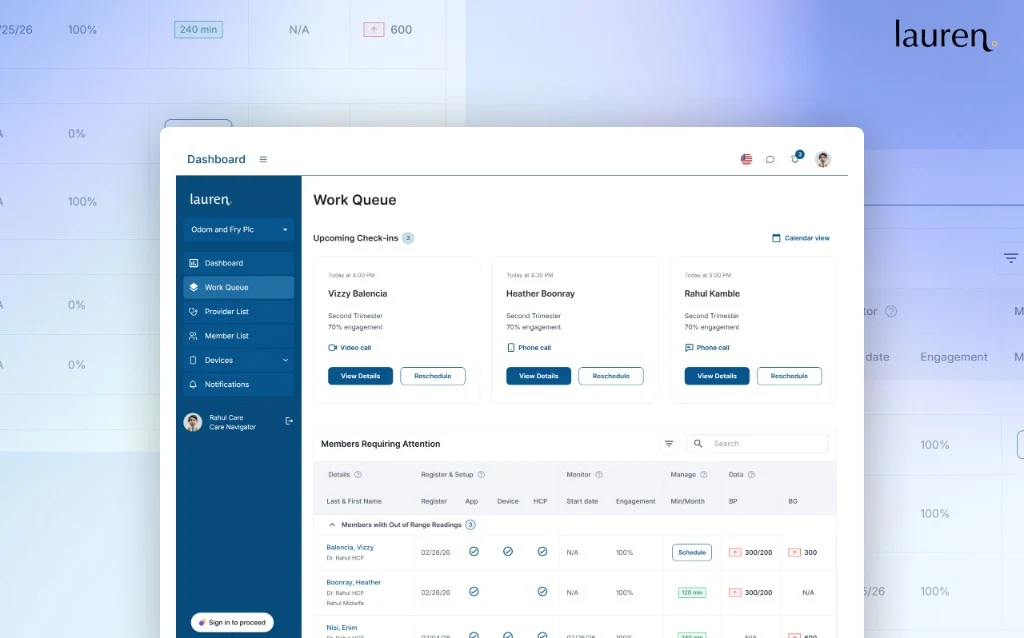
A HIPAA-ready maternal health platform enabling remote patient monitoring, care coordination, and personalized engagement from pre-pregnancy through postpartum.
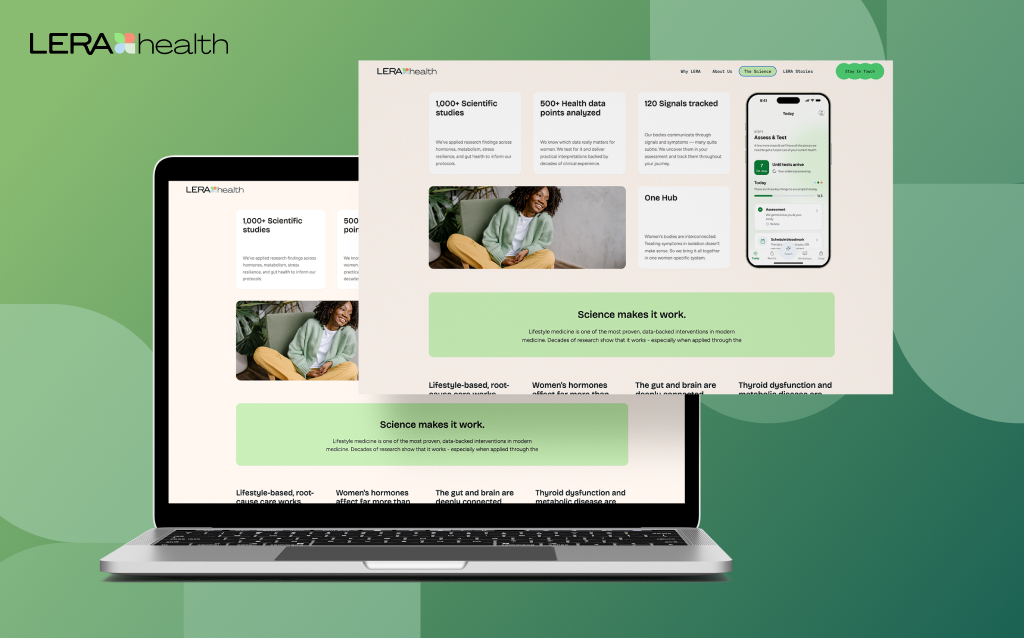
A women’s health product experience focused on guided care journeys, education, and compliance-aware workflows to support long-term engagement.
Common first releases, each scoped to one facility or one workflow.
MDS and care plan clocks for every resident, with alerts for the MDS coordinator.
Shift scheduling with the daily nurse staffing posting built in.
Secure messages and updates for authorized resident representatives.
Orders, administration records and regimen reviews kept in step.
Admission and discharge documents received and sent electronically.
Resident and unit reports pulled on demand for surveyors.
The systems a facility's software reads from and writes to.
Tick what your current tools can do today. Every gap is a candidate for the first release.
We build secure, scalable products designed for privacy, interoperability, and regulatory readiness from day one across every sector we serve.

Protect PHI with privacy-first architecture, encrypted storage and transmission, and strict access controls.

Supporting enterprise-grade interoperability for clinical messaging and record workflows.
We combine deep technical expertise with industry-specific knowledge to deliver solutions that aren't just functional, but transformational.
We implement rigorous security protocols and compliance standards (HIPAA, GDPR, SOC2) across all industrial solutions to protect sensitive data.
Our architectures are built to handle massive data loads and user bases, keeping performance steady whether you're serving ten or ten million.
Using our suite of internal tools and proven frameworks, we reduce development cycles and get your product to market 40% faster.
Beyond simple wrappers, we build deep-learning integrations and predictive analytics directly into the core of your industry-specific workflows.
We start with one facility or one workflow. Timing depends on scope; we agree a fixed first release on the scoping call.
We review your EHR, pharmacy and staffing tools and pick the workflow that causes the most pain.
We watch a shift change, a medication pass and an MDS meeting, remotely or on site, before designing screens.
One workflow, such as assessment tracking or staffing posting, working in one facility with audit logging.
More facilities and workflows added on the same platform, with training for each unit.
Rule updates when federal or state requirements change, interface changes and monitoring under agreed change control.
Short facts from 42 CFR Part 483 we design around, each linked to its primary source.
A long-term care facility must complete a comprehensive resident assessment within 14 calendar days after admission, within 14 calendar days after it determines there has been a significant change, and at least once every 12 months, with a quarterly review at least every 3 months.
Source: 42 CFR 483.20(b) and (c) (eCFR)A facility must encode each resident assessment within 7 days of completing it and electronically transmit accurate, complete MDS data to the CMS System within 14 days.
Source: 42 CFR 483.20(f) (eCFR)A long-term care facility must develop a baseline care plan within 48 hours of a resident's admission, and a comprehensive care plan within 7 days after the comprehensive assessment is completed.
Source: 42 CFR 483.21(a) and (b) (eCFR)Each long-term care resident's drug regimen must be reviewed at least once a month by a licensed pharmacist, and irregularities must be reported to the attending physician, the medical director and the director of nursing.
Source: 42 CFR 483.45(c) (eCFR)A long-term care facility must post its nurse staffing data at the beginning of each shift and keep the posted data for at least 18 months, or longer if State law requires.
Source: 42 CFR 483.35(g) (eCFR)We don't just build products; we forge lasting partnerships. See how we've helped industry leaders transform their vision into technical reality.
“I can clearly see how Agnotic has a unique way of handling end-to-end development. They are always active on quick chat and provide support quickly.”

Aaron Phelan
Founder, Benchmark
“Agnotic combines deep technical expertise with strong domain knowledge. They understand the business context, anticipate challenges, and make collaboration smooth and effective.”

John Pasmore
Founder, Latimer
“Agnotic is the best technical team we evaluated. Their engineering excellence made our work dramatically easier and allowed us to stay focused on what matters most for maternal care outcomes. They took full ownership of the technical execution, and we are always happy to continue working together.”

Kim Smith
Founder, My Lauren
This page covers software for long-term care facilities. These pages cover the integrations and care workflows around it.
Connecting custom tools to a long-term care EHR.
Shared care plans and hand-offs between facilities, hospitals and families.
Electronic prescriptions between prescribers and the facility's pharmacy.
Lab orders and results exchanged with reference laboratories.
The safeguards we build into every system that holds resident data.
Explore other production-grade engineering platforms we deliver across healthcare.
The technical patterns behind this platform translate naturally into adjacent verticals.