











Two engineers at a long desk in a health information exchange operations room, facing a wall screen with an abstract map of connected nodes
    TEFCA integration

    TEFCA

    Your product needs records from providers you have no contract with, and point-to-point interfaces do not scale to the whole country. Agnotic Technologies builds your connection to TEFCA through a Qualified Health Information Network: query, retrieve, consent, directory entries and the audit trail, delivered as a fixed first release.

    QHIN connectivityIHE and FHIR exchangeExchange PurposesHIPAA-ready

    Trusted by global innovators

    Benchmark
    Chibasco
    Fundency
    Lantimer
    Lauren
    Lera
    One Minute
    Pento Pix
    TAP
    Xtrium
    Healthevolve
    Benchmark
    Chibasco
    Fundency
    Lantimer
    Lauren
    Lera
    One Minute
    Pento Pix
    TAP
    Xtrium
    Healthevolve
    Benchmark
    Chibasco
    Fundency
    Lantimer
    Lauren
    Lera
    One Minute
    Pento Pix
    TAP
    Xtrium
    Healthevolve
    Benchmark
    Chibasco
    Fundency
    Lantimer
    Lauren
    Lera
    One Minute
    Pento Pix
    TAP
    Xtrium
    Healthevolve

    What is TEFCA?

    TEFCA, the Trusted Exchange Framework and Common Agreement, is the US framework for nationwide health information exchange through Qualified Health Information Networks (QHINs). A provider, payer or health tech product connects as a Participant or Subparticipant of a QHIN. Agnotic Technologies builds that connection for you: the query and retrieve interfaces, consent handling, directory entries and the audit trail.

    The 21st Century Cures Act asked ONC (ASTP) to develop the framework. ONC chose The Sequoia Project as the Recognized Coordinating Entity (RCE), which runs QHIN onboarding and publishes the Common Agreement and its standard operating procedures.

    For a software team, TEFCA is less a product than a set of obligations. You join through a QHIN, you state an Exchange Purpose on every request, and you must respond to the requests that the Common Agreement says you must respond to.

    Exchange Purposes

    Which Exchange Purposes does TEFCA support?

    Every request under TEFCA names its purpose, and the purpose decides who must respond and what consent is needed. The Common Agreement defines these Exchange Purposes today, and the RCE can add more.

    • Treatment: a provider requests records for a patient it is treating, and participating providers are required to respond
    • Payment: a payer or provider requests information needed to pay for care
    • Health Care Operations: quality, care coordination and other operations as defined under HIPAA
    • Public Health: reporting and queries by public health authorities
    • Government Benefits Determination: agencies confirming eligibility for benefits
    • Individual Access Services: a person, through an app, requests their own records

    The parties

    QHINs, Participants and Subparticipants

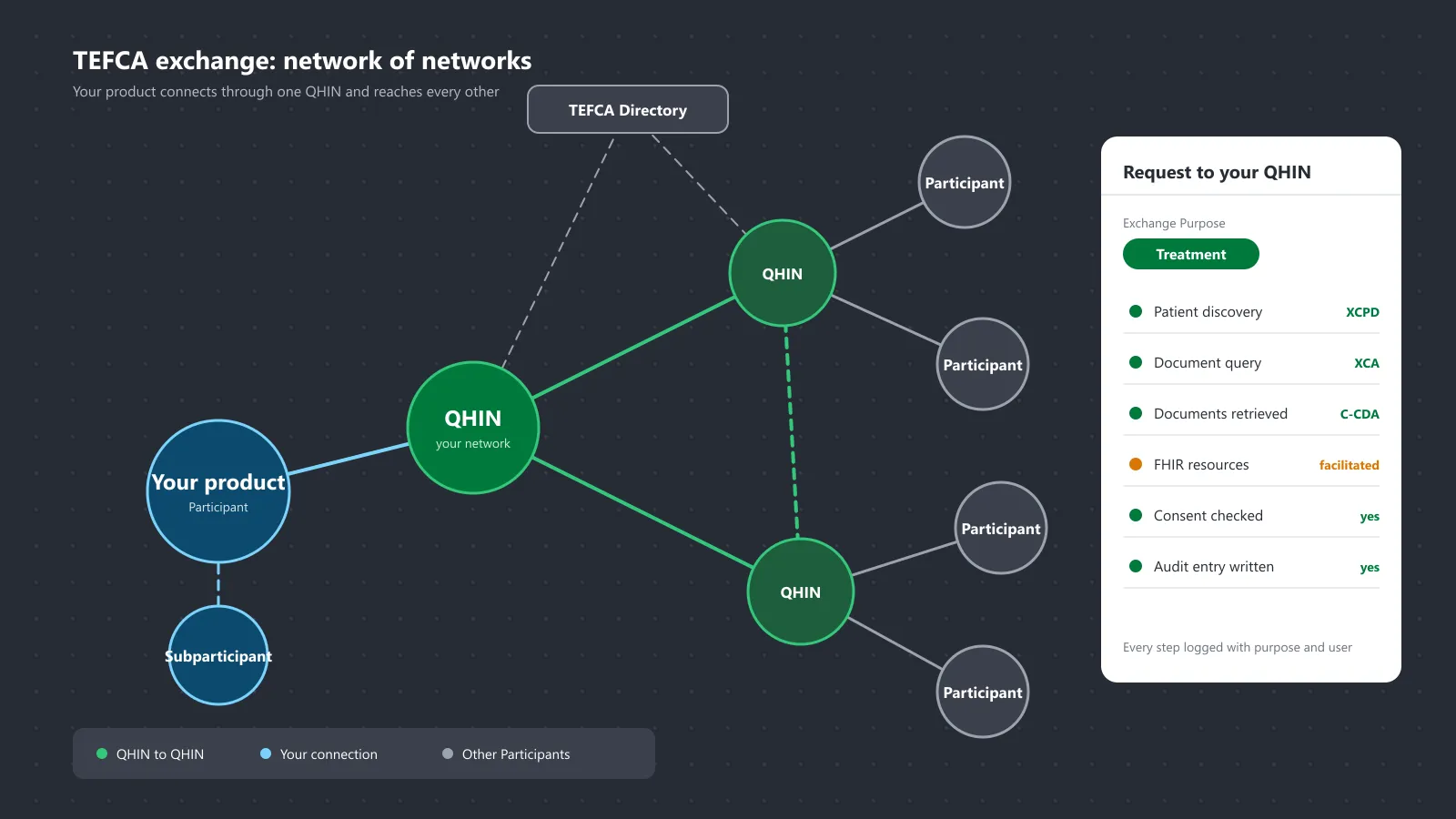
    A QHIN is a network that completed the RCE's onboarding and signed the Common Agreement. QHINs connect to each other, so a request from one QHIN reaches patients held by any other.

    A Participant signs an agreement with a QHIN to exchange through it. A Subparticipant connects through a Participant. Health systems, HIEs, payers and health tech vendors can sit at either level, and the contract terms flow down from the Common Agreement.

    Decision table

    Which TEFCA connection path fits your product?

    There are three practical ways to reach TEFCA exchange. The right one depends on your volume, your contracts and how much of the network plumbing you want to own.

    PathWho it suitsWhat we buildTrade-off
    Participant of a QHINHealth systems, HIEs, payers and vendors with many customersIHE XCPD and XCA or FHIR interfaces to the QHIN, directory entries, consent and auditMost control and the most obligations to respond
    Subparticipant through a ParticipantStartups and single products that serve a Participant's customersIntegration with the Participant's gateway, purpose tagging, record reconciliationFaster to start, dependent on the Participant's terms
    QHIN API platformTeams that want records as an API call, not a network projectClient against the QHIN's API, patient matching, consent flows, retrieval into your data modelSimplest build, platform fees and limits apply

    Some QHINs offer their network as a developer API. Our Health Gorilla QHIN integration page covers that route in detail.

    How does a request travel through TEFCA?

    Your product asks its QHIN for a patient's records for a stated Exchange Purpose. The QHIN finds the patient across other QHINs, Participants return documents or FHIR resources, and every step is logged.

    TEFCA integration mockup by Agnotic: a network map with your product connected to a QHIN, other QHINs, Participants and Subparticipants, and a request card showing the Exchange Purpose, patient discovery, document retrieval and audit steps

    Reference architecture

    What do we build for a TEFCA connection?

    Three layers: the exchange interfaces, the operational controls the Common Agreement expects, and the part that makes retrieved records usable in your product.

    01

    Exchange interfaces

    • IHE XCPD patient discovery and XCA document query and retrieve to the QHIN gateway
    • C-CDA parsing for retrieved documents, FHIR R4 where the QHIN supports facilitated FHIR
    • Responder endpoints so you can answer Treatment and other required requests
    • Certificates, mutual TLS and SAML assertions carrying the Exchange Purpose

    02

    Operational controls

    • Purpose tagging on every outbound request and enforcement on inbound ones
    • Consent and Individual Access Services flows, including identity verification for individuals
    • Audit log of every query, response and document access
    • Security incident reporting path to the QHIN within the agreed timeframes
    03

    Record reconciliation

    • Patient matching and de-duplication across documents from many sources
    • Normalisation of problems, medications, allergies and results into your model
    • Provenance kept on every element so a clinician can see where it came from
    • Retention and minimum necessary rules applied before data reaches your product
    How we work

    How do you build a TEFCA connection?

    Onboarding with a QHIN and engineering run as parallel tracks, so the connection is live when the paperwork is.

    1.

    Scoping call

    We confirm your Exchange Purposes, whether you will respond to requests, which path fits and what a fixed first release contains.

    Purpose first
    2.

    QHIN onboarding and test environment

    Participant or Subparticipant agreements, certificates and directory entries, with our build running against the QHIN's test environment and synthetic patients.

    Parallel track
    3.

    Fixed-scope first release

    Query and retrieve for one purpose, document parsing into your model, consent and audit, then conformance testing with the QHIN.

    Conformance tested
    4.

    Production and operations

    Go-live with monitoring of query volumes, failures and response times, a runbook for incidents, and a plan for Common Agreement and SOP updates.

    Monitored

    Failure points

    Where do TEFCA projects stall?

    The network works. Projects stall on contracts, identity and the volume of records that come back.

    Challenge

    Treating TEFCA as an API subscription

    Agnotic approach

    We map your obligations under the Common Agreement first, including the requests you must respond to, so legal and engineering scope the same thing.

    Challenge

    Too many documents, no usable record

    Agnotic approach

    Retrieved C-CDAs are parsed, de-duplicated and reconciled into one patient view with provenance, instead of a list of PDFs.

    Challenge

    Patient matching errors across networks

    Agnotic approach

    Demographic matching with configurable thresholds, a review queue for uncertain matches and no silent merges.

    Challenge

    Wrong or missing Exchange Purpose

    Agnotic approach

    Purpose is a required field in the integration layer, carried in the request assertion and checked on every inbound request.

    Challenge

    Individual Access Services without identity proofing

    Agnotic approach

    Identity verification and consent capture are built into the individual access flow before any query is sent.

    Challenge

    No plan for SOP and version changes

    Agnotic approach

    The RCE updates SOPs and the Common Agreement. We keep the exchange layer separate from your product so updates do not mean a rewrite.

    Scope drivers

    What drives TEFCA integration cost?

    No two TEFCA projects cost the same. These are the factors that move the effort, and we size each one on the scoping call.

    Initiator only or responder too

    Querying for records is one build. Responding to Treatment requests adds endpoints, availability targets and more testing.

    Exchange Purposes in scope

    Treatment alone is simplest. Individual Access Services adds identity proofing and consent; Payment and Operations add policy checks.

    IHE, FHIR or both

    Document exchange over XCPD and XCA is the baseline today. Facilitated FHIR is growing and may be worth building in parallel.

    Record reconciliation depth

    Showing documents is quick. Turning them into reconciled problems, medications and results in your data model is the bulk of the work.

    Connection path and fees

    Participant, Subparticipant and QHIN API paths carry different contracts and platform fees, which we help you compare but do not set.

    Your existing interoperability stack

    Teams with FHIR and C-CDA handling already in place reuse it. Startups building their first record pipeline need it designed alongside.

    Who connects

    Who needs TEFCA connectivity?

    The same network, used by different parts of healthcare.

    Health tech startups

    Care navigation, second opinion and chronic care products that need outside records for Treatment.

    Hospitals and health systems

    Records from unaffiliated providers at intake, and responding to Treatment requests from others.

    Payers

    Payment and Health Care Operations exchange with providers without point-to-point contracts.

    Patient apps

    Individual Access Services so people can pull their own records into one place.

    HIEs and networks

    Connecting an existing exchange to the national network as a Participant.

    Public health agencies

    Public Health queries and reporting through a QHIN.

    Privacy and security

    How do we handle consent, privacy and security under TEFCA?

    HIPAA still applies to every party, and the Common Agreement adds its own privacy, security and consent requirements on top. We treat them as engineering decisions.

    Business associate agreements

    Agnotic signs a BAA before any PHI is shared, and we build and test against synthetic patients in the QHIN's test environment.

    Consent and individual access

    Consent is captured and stored with the request it authorises, and individual access flows verify identity before a query is sent.

    Minimum necessary by purpose

    The Exchange Purpose decides what is requested and what is returned, and the integration layer enforces it on both sides.

    Audit and incident reporting

    Every query and document access is logged with purpose and user, and the incident process reaches the QHIN inside the agreed timeframes.

    Compliance-First Healthcare App Development Services Backed by Global Standards

    01HIPAA logo

    HIPAA

    Health Insurance Portability and Accountability Act

    Protect PHI with privacy-first architecture, encrypted storage and transmission, strict access controls, and traceable audit logs.

    02GDPR logo

    GDPR

    General Data Protection Regulation

    Implement lawful consent flows, data minimization, retention controls, and secure processing for sensitive health data.

    03FHIR logo

    FHIR

    Fast Healthcare Interoperability Resources

    Enable standardized health data exchange across apps, care teams, and systems through standards-based FHIR APIs.

    04HL7 logo

    HL7

    Health Level Seven International

    Support enterprise-grade interoperability with HL7-based integrations for records, events, and clinical messaging workflows.

    05HITRUST logo

    HITRUST

    Health Information Trust Alliance

    Align security programs to healthcare-specific control and risk management practices trusted by providers and ecosystem partners.

    06HITECH logo

    HITECH

    Health Information Technology for Economic and Clinical Health Act

    Design with breach notification readiness, digital record safeguards, and operational controls that support regulated care programs.

    07SaMD logo

    SaMD

    FDA Software as a Medical Device

    Plan software quality, traceability, and documentation pathways for products that may require SaMD review and submission.

    08MDR (EU) logo

    MDR (EU)

    Medical Device Regulation (European Union)

    Prepare EU market-ready processes for risk classification, evidence tracking, and lifecycle governance under MDR expectations.

    09SAMHSA logo

    SAMHSA

    Substance Abuse and Mental Health Services Administration

    Apply confidentiality controls and consent-aware sharing models for behavioral and mental health data experiences.

    Standards in scope

    Standards used in TEFCA exchange

    IHE XCPDIHE XCAC-CDAFHIR R4US CoreHIPAA
    Facts and sources

    Which facts shape TEFCA work?

    Short facts we design around, each linked to its primary source.

    • The Trusted Exchange Framework is a set of non-binding principles for health information exchange, and the Common Agreement is the legal contract that Qualified Health Information Networks sign to exchange data under TEFCA. Both were called for by the 21st Century Cures Act of 2016.

      Source: Recognized Coordinating Entity, Common Agreement
    • ONC chose The Sequoia Project as the Recognized Coordinating Entity (RCE) that supports the implementation of the Trusted Exchange Framework and Common Agreement.

      Source: The Sequoia Project, RCE
    • QHINs are the central connection points of TEFCA and together form its network of networks; every TEFCA request must state the Exchange Purpose it is made for.

      Source: The Sequoia Project (RCE), TEFCA and RCE resources
    • Under the TEFCA manner exception, an actor that fulfils a request for electronic health information only through TEFCA is not information blocking, provided both the actor and the requestor are part of TEFCA and the requestor can exchange that way.

      Source: 45 CFR 171.403 (eCFR)
    • HL7 FHIR is a standard published by HL7 International for exchanging health data through RESTful APIs built on defined resources such as Patient, Observation and MedicationRequest.

      Source: HL7 International (hl7.org/fhir)

    Frequently Asked Questions

    It depends on scope and on QHIN onboarding, which runs on the QHIN's timetable. We agree a fixed first release on the scoping call, usually query and retrieve for one Exchange Purpose, and run onboarding in parallel with the build.