



Health insurance software is not one application. A health plan runs a core administration system that holds members, plans and provider contracts, and around it sit enrollment, claims, utilization management, portals for members and providers, and a growing set of required APIs.
This post explains how those pieces fit, what each one must do, where X12 and FHIR standards apply, and how to decide which parts to buy and which to build. It ends with failure points, a worked example, owners, testing and best practices for payer software projects.
What is health insurance software development?
Building or extending software for a health plan?
Our payer core page covers the administration, claims and data systems we build for health plans.
Health insurance software development is the work of building the systems a health plan runs on: core administration for members, benefits and provider contracts, enrollment, claims adjudication and payment, member and provider portals, and the standard X12 and FHIR interfaces regulators require. Agnotic Technologies builds and extends these systems for payers.
HIPAA adopts ASC X12 standards for electronic transactions, including health care claims (837), payment and remittance advice (835), eligibility inquiries (270/271) and prior authorization requests (278).
Which systems make up payer software?
A payer's software splits into three layers: channels that members, providers and employers use, workflow services that do the daily work, and the core administration system that holds the records everything else depends on.
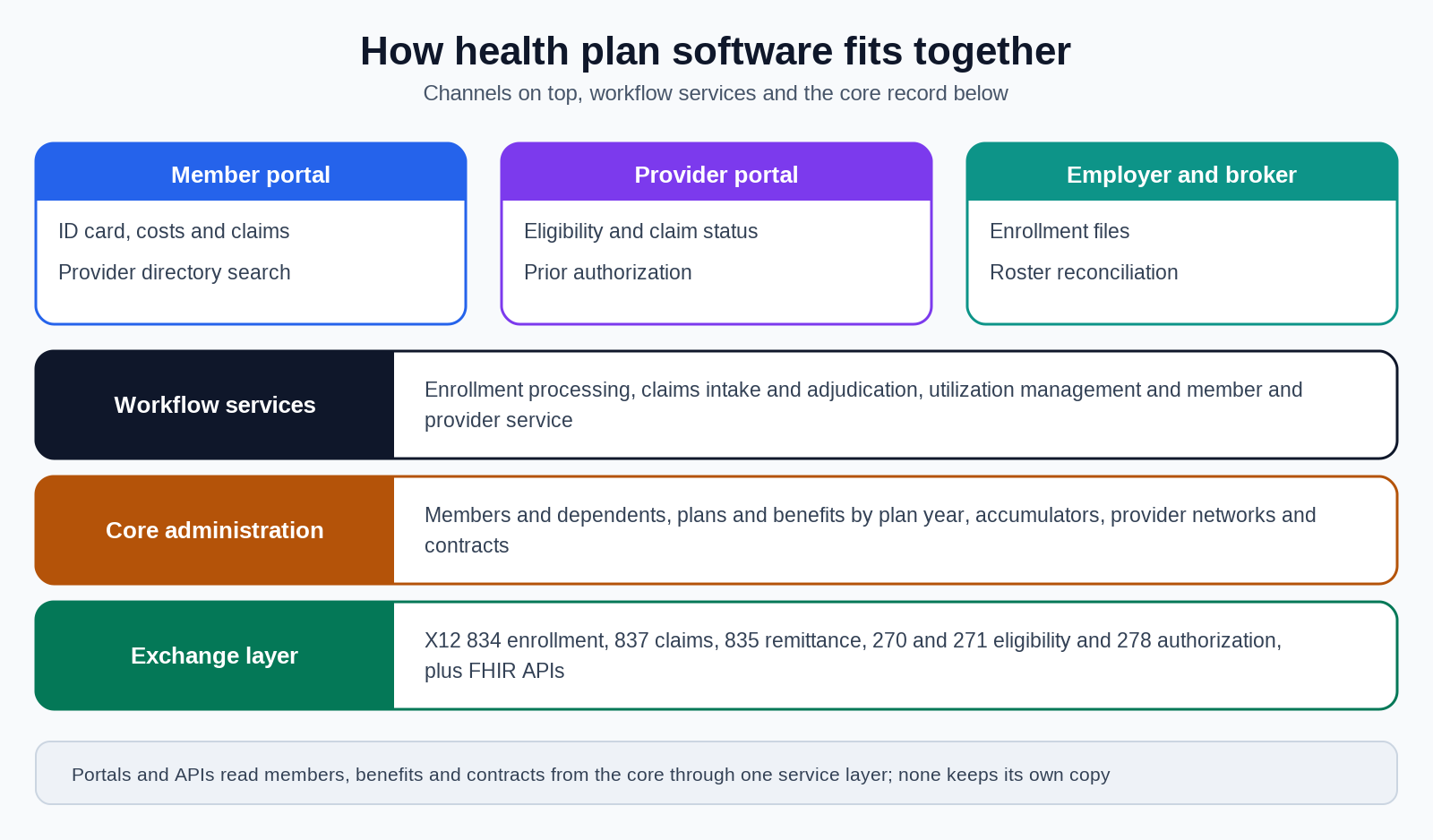
Most projects touch one layer at a time. Knowing which layer a change belongs to tells you which records it reads and which teams it affects.
Why does the core administration system come first?
Every other system asks the core the same questions: is this person a member today, which plan and benefits apply, how much of the deductible is used, and what does the contract with this provider say. If those answers are wrong, every downstream system is wrong too.
- Members: subscribers, dependents, coverage dates and identifiers.
- Plans and benefits: covered services, cost sharing and limits by plan year.
- Accumulators: deductibles and out-of-pocket amounts used so far.
- Provider contracts: networks, fee schedules and payment rules.
How does enrollment work in payer software?
Enrollment turns employer, exchange or government files into member records with the right coverage dates. Most of the work is in validating changes, handling retroactive updates and reconciling with the sponsor.
HIPAA defines the enrollment and disenrollment transaction as the sponsor of coverage sending subscriber enrollment information to a health plan to establish or end coverage, and adopts the X12 834 Benefit Enrollment and Maintenance standard, version 005010X220, for it.
- Validation: reject or hold records with missing or conflicting data.
- Effective dates: apply additions, changes and terminations on the right day.
- Retroactive changes: adjust claims already paid under the old coverage.
- Reconciliation: compare the plan's roster with the sponsor's on a set schedule.
What does a claims system need to do?
A claims system receives claims, checks them, decides what is owed under the member's benefits and the provider's contract, and pays with a remittance. Each step needs clear rules and a queue for claims a person must review.
- Intake: X12 837 claims through a clearinghouse, plus paper claims converted to data.
- Edits: format, eligibility, duplicate and coding checks before adjudication.
- Adjudication: benefits, accumulators, authorizations and contract pricing applied.
- Payment: X12 835 remittance and payment, with adjustment codes explaining each difference.
Keep every rule versioned with its effective date. A claim must be decided with the rules that applied on its date of service, not the rules in force when it arrives.
What should a member portal offer?
A member portal should answer the questions members otherwise call about: am I covered, what will this cost, where is my claim and which providers are in network. Build those first and measure call reasons to decide what comes next.
- Coverage: digital ID card, plan details and dependents.
- Costs: deductible and out-of-pocket progress from the accumulators.
- Claims: status and explanation of benefits in plain language.
- Providers: a directory search that reflects the current network.
What should a provider portal offer?
Providers need fast answers on eligibility, claims and authorizations, and a way to keep their own directory details current. Every question answered in the portal is one fewer phone call for both sides.
- Eligibility and benefits: checked for a member and a service before the visit.
- Claim status: where each claim is and why it was adjusted.
- Prior authorization: submission, attachments and decision status.
- Directory updates: addresses, specialties and whether new patients are accepted.
Which APIs must a health plan offer?
Plans regulated by CMS must offer FHIR APIs to members, providers and other payers, in addition to the X12 transactions HIPAA requires. These APIs read from the same core records as the portals, so the data must agree.
CMS-0057-F requires impacted payers to build a FHIR-based Prior Authorization API, along with Provider Access and Payer-to-Payer APIs, with compliance dates generally beginning January 1, 2027.
Should a payer build or buy each part?
Most plans buy the core administration system and build around it, because the core is large and heavily regulated. Custom work pays off where the plan's members, providers or products differ from what packaged software assumes.
- Usually bought: core administration and claims adjudication engines.
- Often built: portals, care programs, analytics and integrations with partners.
- Built when needed: rules or products that packaged systems cannot express.
- Always owned: the data model of members, providers and contracts used across systems.
How should payer software handle privacy and access?
A plan holds sensitive data on every member, so access must follow role and relationship. A provider should see only the members they treat, a broker only the groups they serve, and a member only their own household's records where the plan allows it.
- Dependents: rules for what a subscriber may see about adult dependents.
- Proxies: caregivers and representatives with documented, limited access.
- Staff: service and claims roles scoped to the work in their queue.
- Logging: every view and export recorded with the user and reason.
Sensitive services, such as behavioral health claims, may need extra rules in portals and explanation of benefits mailings.
Where do payer software projects fail?
Failures usually come from data that two systems hold differently, not from the screens.
- Two member records: the portal and the core disagree on coverage.
- Rules without dates: claims decided with rules that did not apply on the service date.
- Stale directory: provider data in the portal that no longer matches contracts.
- Retro changes ignored: enrollment updates that never reach paid claims.
- APIs bolted on: FHIR endpoints that read a copy of data and drift from the core.
A worked example: a member portal over an existing core
A regional plan wanted a member portal without replacing its core administration system. The team built a service layer that read coverage, accumulators and claims from the core through defined interfaces and never stored a second copy of membership.
Testing exposed a timing problem: accumulators in the core updated overnight, so members saw yesterday's deductible. The portal labeled the figure with its last update time, and the plan added an intraday update for claims paid that day.
The same service layer later fed the plan's FHIR APIs, so the portal and the APIs showed members the same answers.
Who owns what?
Payer software crosses operations, compliance, IT and network teams.
- Product and operations: benefit rules, claim policies and queue design.
- Enrollment and eligibility team: sponsor files, reconciliation and retro changes.
- Network management: provider contracts and directory accuracy.
- Compliance: HIPAA transactions, CMS API duties and privacy.
- IT and engineering: integrations, portals, APIs and the shared data model.
How do you test payer software?
Test with members and claims that exercise real benefit rules, not only happy paths. A small library of test members with known coverage, accumulators and contracts catches most errors before release.
- Benefit scenarios: deductibles, limits and cost sharing at plan year boundaries.
- Enrollment cases: additions, terminations and retroactive changes.
- X12 validation: 834, 837 and 835 files checked against the implementation guides.
- Parallel runs: new and old systems deciding the same claims, with differences reviewed.
What are health insurance software development best practices?
Treat the core records as the single source, version every benefit and payment rule by effective date, and make enrollment changes, including retroactive ones, flow through to claims and portals.
Build portals and APIs on one service layer, test with a library of known members and claims, and run new claims logic in parallel before it decides real payments.
How Agnotic can help
Agnotic builds software for health plans: integrations with core administration systems, enrollment processing, claims workflows, member and provider portals and FHIR APIs, all reading from one consistent view of members, benefits and contracts.
Plan claims automation with Agnotic
Our claims processing automation page covers how we build claims intake, edits and adjudication support.
Related reading on Agnotic
Payer systems, claims and eligibility.


