



Healthcare founders often reach the same point: the prototype works, a first customer is interested, and suddenly there are questions about security reviews, EHR integration, data handling and whether the product is a medical device. Someone has to own those answers, and that someone is usually a CTO.
This post explains when a healthcare startup needs a CTO, what the role must own that a general CTO might not, how a technical cofounder, a fractional CTO and a full-time hire compare, how to assess candidates, what a new CTO should deliver first, and the mistakes founders make.
When should a healthcare startup hire a CTO?
Need technical leadership before you can hire full-time?
Our fractional CTO service gives healthcare startups senior technical leadership for the stage they are at.
A healthcare startup should bring in a CTO when technical decisions start to carry regulatory, security or customer risk: before handling patient data, integrating with an EHR, facing a health system's security review or raising money on the product. Many start with a fractional CTO and hire full-time later. Agnotic Technologies provides fractional CTOs for healthcare startups.
Before that point, a strong senior engineer or a development partner may be enough. After it, decisions made without technical leadership are expensive to reverse.
What does a healthcare CTO own that a general CTO might not?
A healthcare CTO owns the usual architecture, team and delivery decisions, plus the technical side of regulation and customer trust. These duties arrive early, often with the first pilot.
The HIPAA Security Rule requires an accurate and thorough risk analysis of the potential risks and vulnerabilities to the confidentiality, integrity and availability of ePHI.
- Security and privacy: the risk analysis, controls and answers to customer security reviews.
- Regulatory scope: whether any feature makes the product a medical device.
- Interoperability: the EHR and payer integration strategy.
- Vendors: which services may hold patient data, under which agreements.
FDA's guidance on device software functions focuses oversight on software that meets the definition of a medical device and could put patient safety at risk if it does not work as intended.
What does the startup need at each point?
The leadership a startup needs changes as it moves from idea to pilots to growth. Match the role to the next problem, not the eventual company.
- Before patient data: product and architecture choices that will not trap you later.
- First pilot: security answers, an integration plan and a team that can deliver.
- Several customers: hiring, delivery process and reliable operations.
- Fundraising: a technical story investors can check, with risks named honestly.
Cofounder, fractional or full-time CTO: how do they compare?
Each option fits a different stage and budget. A technical cofounder shares the risk and the equity, a fractional CTO brings senior experience for part of the week, and a full-time hire gives daily leadership once there is a team to lead.
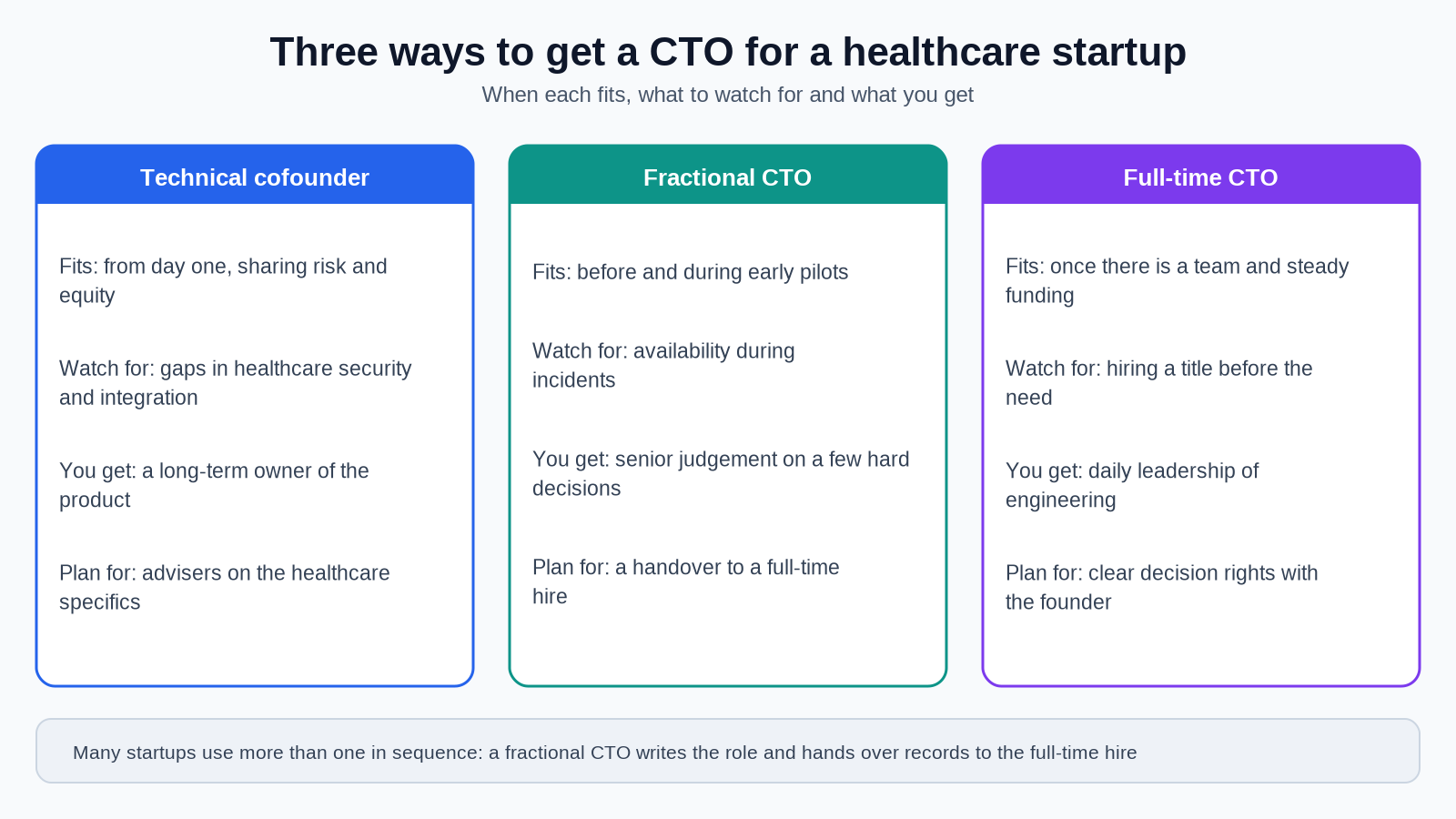
- Technical cofounder: fits from day one; watch for a skills gap in healthcare specifics.
- Fractional CTO: fits before and during early pilots; watch for availability during incidents.
- Full-time CTO: fits once there is a team and steady funding; watch for hiring too early.
When does a fractional CTO make sense?
A fractional CTO makes sense when you need senior judgement on a few hard decisions but not a full-time leader yet. Typical work includes the first architecture, the security baseline, vendor choices, the first engineering hires and investor technical due diligence.
Set clear hours, response expectations for incidents and a written list of decisions the fractional CTO owns. Plan from the start how the role will hand over to a full-time hire.
How do you assess a healthcare CTO candidate?
Assess how the candidate makes decisions under healthcare constraints, not only their technical depth. Ask them to walk through a past architecture and explain the trade-offs they made for privacy, integration and cost.
- Architecture: a system they designed, what they would change and why.
- Healthcare: a security review, integration or regulatory question they handled.
- Team: engineers they hired, and how they judged them.
- Communication: explaining a technical risk to a non-technical board.
Speak to engineers who worked for them, not only to founders. Engineers will tell you how decisions were actually made.
What should a new CTO deliver first?
A new CTO's first job is to make the current state visible and the next decisions explicit. Ask for written outputs, not just a plan in their head.
- Architecture record: the current system and the main decisions to make.
- Security baseline: the risk analysis and the gaps that block pilots.
- Vendor review: services that touch patient data and their agreements.
- Hiring plan: the roles to fill next and how to test for them.
A HIPAA covered entity may share protected health information with a business associate, such as a software vendor, only under a business associate agreement that commits the vendor to safeguard it.
Should the CTO write code?
In the earliest stage, usually yes: a CTO who still builds keeps decisions grounded and earns the trust of the first engineers. As the team grows, coding time should shrink in favor of architecture, hiring, security and customer work.
Agree the expected balance when you hire, and revisit it as the team grows, so neither side is surprised.
Decision rights and reporting
Agree what the CTO decides alone, what needs the founder and what goes to the board. Unclear decision rights cause more CTO departures than technical disagreements.
For a fractional CTO, add who acts when they are unavailable. A security incident on a day they are not working must still have an owner.
How do you move from a fractional to a full-time CTO?
Plan the move before it is urgent. The fractional CTO can write the role, help interview candidates and hand over architecture, vendor and security records.
Overlap the two for a period agreed in advance, so the new CTO meets customers and partners with someone who knows the history.
Where do startups go wrong hiring a CTO?
The common mistakes come from hiring for the wrong stage or the wrong skills.
- Hiring a title: a big-company CTO who has never built from nothing.
- No healthcare depth: security reviews and integrations learned on the first customer.
- Too late: patient data handled for months without a risk analysis.
- Unclear role: CTO and founder both deciding the same things.
- No handover plan: knowledge leaves with a contractor or fractional lead.
A worked example: a remote monitoring startup's first CTO
A remote monitoring startup had a working prototype built by contractors and a health system asking for a security review before a pilot. The founders had no one to answer it.
They engaged a fractional CTO, who wrote the risk analysis, mapped every service touching patient data, confirmed the agreements needed and answered the review. The CTO also flagged one planned alerting feature for regulatory review.
As the pilot grew, the fractional CTO wrote the full-time role and helped interview. The new CTO started with an architecture record, a security baseline and a vendor list already in place.
Who owns what?
Technical leadership in a healthcare startup is shared with the founder, clinical and compliance leads.
- Founder or CEO: vision, funding and the final call on priorities.
- CTO: architecture, security, vendors, engineering team and delivery.
- Clinical lead: clinical workflow, safety and intended use.
- Compliance advisor: privacy policies and regulatory questions.
How do you know the CTO arrangement is working?
Judge by decisions made and risks reduced, not by hours logged.
- Security reviews passed without last-minute rework.
- Engineering hires who stay and perform.
- Releases delivered as planned, with few incidents.
- Investor technical due diligence answered from existing records.
What are best practices for hiring a healthcare startup CTO?
Bring in technical leadership before patient data, EHR integration or security reviews arrive, and hire for the next stage rather than the eventual company.
Test candidates on healthcare decisions they have made, agree decision rights in writing, ask for records rather than plans, and plan the handover from fractional to full-time from the start.
How Agnotic can help
Agnotic provides fractional CTOs for healthcare startups: architecture records, security baselines and risk analyses, vendor reviews, integration strategy, engineering hiring support and a planned handover to a full-time CTO when the company is ready.
Compare fractional and full-time CTOs with Agnotic
Our fractional versus full-time CTO page sets out how the two models differ in practice.
Related reading on Agnotic
Healthcare startups, MVPs and compliance.


