


Redefining clinical trials is less about a new study design on paper and more about the software that lets visits, consent and outcomes happen where the participant already is. Decentralized elements, electronic informed consent and electronic clinical outcome assessments change who collects data, when it arrives and how investigators supervise it.
This guide is for clinical operations leaders, sponsors, CROs and the teams building trial software. It covers what FDA means by a decentralized clinical trial, how eConsent and eCOA fit the same stack, what must stay under investigator control, and the operations software that makes a hybrid study runnable.
What does it mean to redefine clinical trials with software?
Building DCT, eConsent or eCOA into a study?
Agnotic builds clinical trial management software for clients, connecting eConsent, eCOA, site operations and data capture under one study plan.
Redefining clinical trials with software means moving visits, consent and outcomes off a single site calendar so participants can complete parts of the study at home, at a local clinic or on a device. FDA treats a decentralized clinical trial as a trial that includes those remote elements, not as a separate regulatory class.
The change is operational. Startup still needs a protocol, ethics review and trained investigators. What changes is the stack: eConsent instead of a paper packet, eCOA instead of a clipboard, remote visits instead of every assessment at the site, and a control room that shows which tasks are late.
How do DCT, eConsent and eCOA connect?
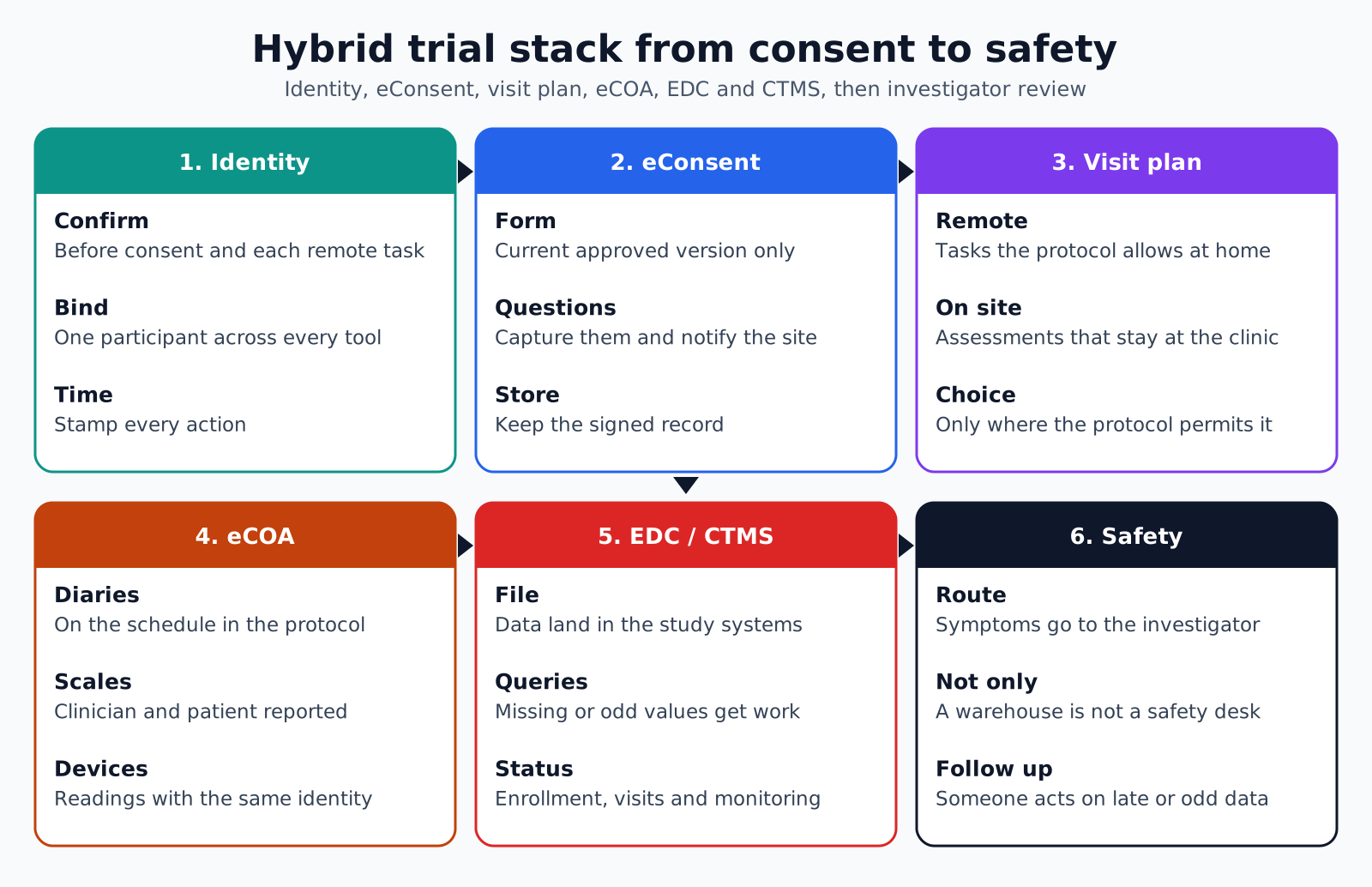
A hybrid study usually runs as one chain: the participant reviews and signs eConsent, completes scheduled eCOA and remote visits, and those records land in the EDC and the CTMS so monitors and investigators can act. Each hop needs identity, timestamps and a path back to a person when data are missing or look wrong.
- 1. Identity: Confirm the participant before consent, each remote visit and each questionnaire.
- 2. eConsent: Present the current approved form, capture questions, store the signed record and notify the site.
- 3. Visit plan: Show which tasks are remote, which are on site and which the participant may choose, as the protocol specifies.
- 4. eCOA: Collect diaries, clinician scales and device readings on the schedule in the protocol.
- 5. EDC and CTMS: File the data, raise queries and update enrollment, visit and monitoring status.
- 6. Safety: Route concerning symptoms or device alerts to the investigator, not only into a warehouse.
What does FDA mean by a decentralized clinical trial?
FDA's September 2024 final guidance, Conducting Clinical Trials With Decentralized Elements, defines a decentralized clinical trial as a trial that includes decentralized elements, where trial-related activities occur at locations other than traditional clinical trial sites. Those elements can include telehealth visits, in-home visits with remote trial personnel, or visits with local health care providers.
FDA's drug, biologic and device centers issued the guidance together. The agency's existing requirements for investigations still apply. Software does not create a lighter pathway; it has to support the same investigator responsibilities, protocol fidelity and data reliability in a more distributed setting.
- Protocol clarity: Specify which visits are on site, which are remote and which the participant may choose, to limit bias.
- Variability: Give specific instructions for activities done by local clinicians or by participants at home.
- Oversight: Investigators remain responsible for the trial and for the people they delegate work to.
- Review: Investigators should review data from remote staff and local clinicians and follow up on missing or concerning values.
How should eConsent work in a remote or hybrid study?
Electronic informed consent may use text, graphics, audio or video to present study information and to document consent, as long as the process meets FDA and HHS informed consent rules. FDA's eConsent questions-and-answers guidance says the information, the process and the documentation must satisfy 21 CFR parts 11, 50 and 56, and 45 CFR part 46 where those rules apply.
- Comprehension: The participant must have a chance to ask questions and to consider whether to join, not only to click through screens.
- Identity: The system must have a method to verify who is signing.
- Copy: The participant must receive an electronic equivalent of a copy of the consent.
- Amendments: When the form changes, the system should present the new text and recapture consent when required.
- Part 11: Electronic records and signatures used for FDA-regulated investigations must be attributable, timestamped and protected from silent change.
Remote consent is useful only when a coordinator or investigator can still join the session. A form that nobody walks through is a signed PDF, not a consent process.
What does eCOA change in day-to-day operations?
Electronic clinical outcome assessments collect questionnaires, clinician scales and sometimes device readings directly from the participant or the clinician, on a schedule the protocol defines. FDA's guidance on digital health technologies for remote data acquisition treats these tools as part of the investigation: consent must describe what is collected, who can see it and what the participant should do if a reading looks urgent.
- Schedule: Windows, reminders and lockouts that match the protocol, not a generic daily ping.
- Attribution: Each completed form tied to a known participant and, for clinician scales, a known rater.
- Missingness: Alerts when a form is late, so the site can call while the window is still open.
- Safety: A path from a concerning score to the investigator, not only a row in a dashboard.
- Versioning: The exact instrument version used at each time point, stored with the record.
eCOA is not the same as EDC. EDC holds the case report form the sponsor analyzes. eCOA is a source. The interface between them needs the same edit checks, queries and audit trail as any other source-to-EDC flow.
What must stay under investigator control?
Investigators remain responsible for the conduct of the trial and for protecting participants, including when they delegate activities to local clinicians or remote staff. Software that hides those delegations, or that lets data land without review, fights the guidance.
- Delegation log: Who may perform each remote or local activity, with training recorded.
- Data review: A queue of remote results and local-clinician entries for the investigator to accept or query.
- Safety follow-up: Contact paths when a diary, device or telehealth visit raises a concern.
- Protocol deviations: A way to record when a remote visit or home test did not follow the instructions.
Which trial operations software does a hybrid study need?
A hybrid study needs a CTMS that understands remote and on-site visits, plus connected eConsent, eCOA, EDC and safety tools. Buying five products that do not share participant identity is how hybrid studies stall.
- CTMS: Sites, enrollment, visit mix, monitoring and payments, including remote visits.
- eConsent: Current form, identity check, questions, signed copy and recapture on amendments.
- eCOA: Participant and clinician instruments, windows, reminders and safety flags.
- EDC: eCRFs, queries and lock, fed by eCOA and site source without retyping.
- Safety: Serious adverse event intake that can start from a remote visit or a device alert.
Where hybrid trial software goes wrong
- Visit ambiguity: The system cannot tell a coordinator which visits are remote, so sites default to bringing everyone in.
- Consent drift: An old form stays live after an amendment.
- Orphan eCOA: Diaries collect for weeks without landing in EDC or reaching the investigator.
- Identity gaps: A family member completes a diary, or a local clinician is not on the delegation log.
- No safety path: A high symptom score sits in a report until the next monitoring visit.
How Agnotic can help
Hybrid studies fail at the joins. Agnotic Technologies builds clinical trial management software for clients that connects eConsent, eCOA, remote visit tracking and EDC, with investigator review queues and Part 11 audit trails.
Agnotic also maps the protocol's visit mix into the system so coordinators see the next remote or on-site task, and so safety signals from diaries and devices reach a named investigator.
Run hybrid studies without losing the thread
Explore clinical trial management solutions, or read more practical guides from our engineers.
Related reading on Agnotic
Continue with study startup cycle time, trial data management, interoperability and the wearable sensors used for remote data.


