

01
Digital shift log
Downtime, handover notes and abnormalities recorded at the line.


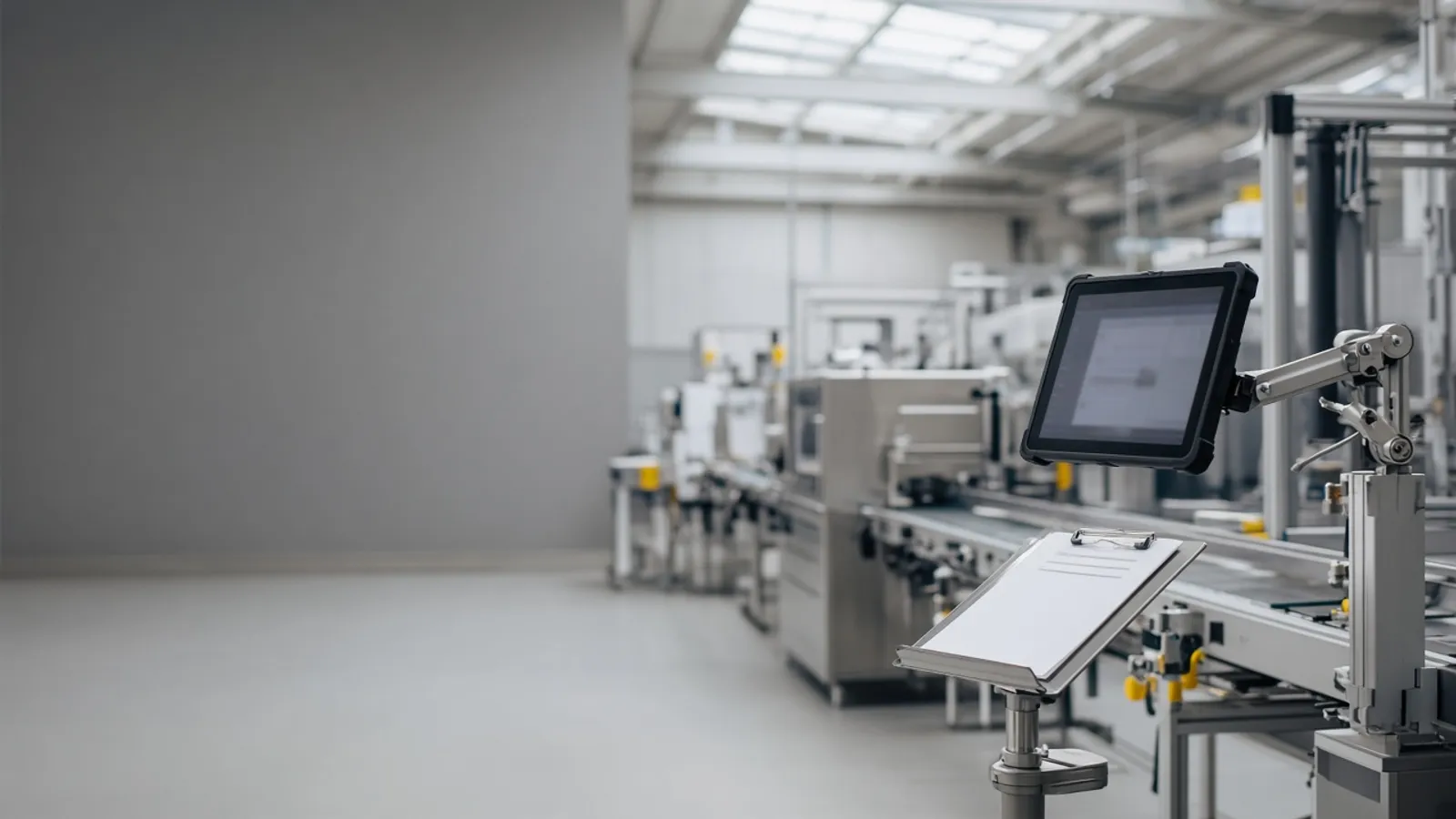
Travelers, logbooks and check sheets are still on paper, and the ERP learns what happened a shift later. Agnotic Technologies works with plant teams to move shop floor paper to digital, connect machines to the systems that need their data, and roll out the change one line at a time.
Trusted by global innovators








Manufacturing digital transformation services help a plant replace paper records, spreadsheets and manual data entry with connected software that operators, supervisors and managers use every shift. A partner maps how work and data move through the plant today, picks the first problem worth fixing, builds the digital forms, machine connections and ERP or MES integrations it needs, and rolls the change out one line at a time while production keeps running. Agnotic Technologies provides digital transformation consulting for manufacturers and then builds the software itself, so the plan and the code come from the same team.
The software is rarely the reason. Programs stall for the same few reasons, and each one can be planned for.
A plant-wide platform is chosen before anyone fixes one real problem on one line.
Operators get a screen that is slower than the paper it replaced, so they keep the paper.
Machine data is collected, but nobody owns acting on it.
Digital and paper records run side by side for months because nobody switches the paper off.
IT and the plant team work from different priorities and different lists.
Every line is customized, so the second line costs as much as the first.
Start where paper or retyping causes the most visible loss today, usually one record such as the shift log, the traveler or the inspection sheet, on one line. The table matches common plant symptoms to a first project.
| What the plant sees | Likely first project | What it needs from the plant |
|---|---|---|
| Downtime reasons written on paper and argued about later | A digital downtime and shift log on the line | A tablet at the station and agreed reason codes |
| Check sheets typed into Excel at the end of the week | Digital inspection forms with photos and spec limits | The current check sheets and specification limits |
| Paper travelers lost between operations | A digital traveler with a barcode scan at each step | Routings and work order numbers from the ERP |
| Production counts keyed into the ERP by hand | Machine counts collected from PLCs or counters | Access to the machine controller or a sensor |
| A planning spreadsheet only one person can edit | A shared planning screen fed by ERP orders | The planner's rules and the ERP order data |
| Maintenance requests passed on by word of mouth | Digital work requests linked to the CMMS | The asset list and the CMMS interface |
A good partner does three jobs: helps you choose the first problem and how to measure it, builds the software and the connections, and makes sure the floor actually uses it. Agnotic Technologies does all three with your plant team.
We walk the line with operators and supervisors, map where data is written down or retyped, and agree one first project with a measure everyone accepts.
We build the forms, screens and machine connections, and integrate with your ERP, MES or CMMS through the interfaces they offer.
We train on the floor, run the new process beside the old one until the records match, then switch the paper off and hand over the code and documentation.
Software for the station, the line and the office, built to work with the systems you already run.
Your current paper forms rebuilt for tablets, with limits checked as values are entered.
Work orders that move with the part, scanned at each operation, with status visible to planning.
Abnormalities, handovers and downtime reasons recorded once and searchable later.
Counts, states and readings collected from PLCs, counters and sensors.
Output, downtime and quality for the current shift on a screen at the line.
Orders in, confirmations and counts out, through the interfaces your systems offer.
Photos of legacy paper forms read into fields for a supervisor to confirm during the changeover.
Logins by role and line, and a record of who entered or changed each value.
Move one record on one line at a time, run digital and paper side by side for a short period you agree in advance, and switch the paper off only when the two match. These steps keep production running throughout.
Choose the form that causes the most retyping or argument, and the line with the most willing supervisor.
The first digital form mirrors the paper fields so operators recognize it. Improvements come after it is in use.
Devices go to the station, the form works offline, and the supervisor signs off each shift's records.
Digital and paper records are compared, and anything that slows operators down is fixed before going further.
Paper forms are removed from the station on an agreed date, and the old sheets are scanned and archived.
The same form and integration are reused, and only what differs on the new line is changed.
We connect to what you already run rather than replace it.
Measures agreed before the first release, so the program is judged on results on the floor, not on screens delivered.
Paper forms removed from stations, by line.
Values that now flow to the ERP or MES without rekeying.
How long a downtime event or count takes to reach the people who act on it.
Shifts that complete the record digitally, by line and crew.
Small, visible first releases that prove the approach before it spreads.
Downtime, handover notes and abnormalities recorded at the line.
First-off, in-process and final checks with limits and photos.
Barcode scans replace stamps and signatures on paper routers.
Counts from machines instead of tally sheets.
A planning spreadsheet replaced by a screen fed from ERP orders.
Gauge due dates and certificates moved out of a binder.
Where data comes from and where it needs to go.
We build secure, scalable products designed for privacy, interoperability, and regulatory readiness from day one across every sector we serve.

Adhering to the international gold standard for managing information security risks.

Ensuring consistent quality in software delivery and operational process optimization.
We combine deep technical expertise with industry-specific knowledge to deliver solutions that aren't just functional, but transformational.
We implement rigorous security protocols and compliance standards (HIPAA, GDPR, SOC2) across all industrial solutions to protect sensitive data.
Our architectures are built to handle massive data loads and user bases, keeping performance steady whether you're serving ten or ten million.
Using our suite of internal tools and proven frameworks, we cut setup work so your first release reaches users sooner.
Beyond simple wrappers, we build deep-learning integrations and predictive analytics directly into the core of your industry-specific workflows.
We start with one record on one line. The size of each step depends on scope, which we agree on the scoping call.
We hear where paper and retyping hurt most and which systems the plant runs.
We walk the line with operators and supervisors and map where data is written, copied and lost.
One record, one line and one measure, agreed with the plant manager.
Forms, devices and integrations for that record, piloted on one shift.
Paper switched off on the first line, then the same pattern on the next.
Standards and rules that shape how plant records move from paper to software, each linked to its primary source.
ISA describes ISA-95, also known as ANSI/ISA-95 or IEC 62264, as an international set of standards for integrating logistics systems with manufacturing control systems, organizing technology and business processes into layers and outlining how an enterprise can set up interfaces between those layers.
Source: ISA, ISA-95 Series of StandardsNIST IR 8183 Revision 1 sets out a Manufacturing Profile of the NIST Cybersecurity Framework Version 1.1: a voluntary, risk-based roadmap for reducing cybersecurity risk to manufacturing systems that is meant to enhance, not replace, the standards a manufacturer already follows.
Source: NIST IR 8183 Rev. 1 (csrc.nist.gov)For FDA-regulated manufacturers, 21 CFR 11.1(a) sets the criteria under which FDA considers electronic records and electronic signatures to be trustworthy, reliable and generally equivalent to paper records and handwritten signatures executed on paper.
Source: 21 CFR 11.1 (eCFR)21 CFR 11.10 requires controls for closed systems that include validation to ensure accuracy and the ability to discern invalid or altered records, and secure, computer-generated, time-stamped audit trails of operator entries and actions.
Source: 21 CFR 11.10 (eCFR)We don't just build products; we forge lasting partnerships. See how we've helped industry leaders transform their vision into technical reality.
“I can clearly see how Agnotic has a unique way of handling end-to-end development. They are always active on quick chat and provide support quickly.”

Aaron Phelan
Founder, Benchmark
This page covers where to start and how to roll out. These pages cover the systems a digital plant usually adds.
The manufacturing hub: MES, machine monitoring, predictive maintenance and IIoT platforms.
Digital nonconformance reports linked to corrective actions and effectiveness checks.
Gauge registers, calibration due dates and certificates moved out of spreadsheets.
Planning and tracking workbooks rebuilt as web apps the whole plant can use.
Work orders, routings and production records run on the floor in real time.
Plant software built around your own lines, records and systems.
The technical patterns behind this platform translate naturally into adjacent verticals.
Showing 10 of 19 industries