



Emergency department triage happens in minutes, with incomplete information and a waiting room that keeps filling. Nurses sort patients by how urgently they need care, and the hardest cases are the ones that look stable at the door but are not.
This post looks at artificial intelligence for in-person emergency department triage: what a triage model can predict, which data it can use at arrival, how it fits the nurse's workflow, the rules that limit it, how to validate it on local patients, where projects fail and how to measure whether it helps.
How can artificial intelligence help emergency department triage?
Considering AI support for triage?
Our patient triage AI page covers the triage support tools we build for care teams.
Artificial intelligence for emergency department triage gives the triage nurse a second opinion at the door: a model reads arrival data and history, suggests an acuity level or risk flag with its reasons, and highlights patients who may be under-triaged. The nurse still assigns the level. Agnotic Technologies builds this kind of decision support for hospitals.
The Emergency Severity Index is a five-level emergency department triage acuity scale, and for patients judged stable it uses a prediction of the resources needed to reach a disposition to separate acuity further.
What can a triage model predict?
A triage model predicts outcomes that help the nurse sort patients, not a diagnosis. Common targets are the likely acuity level, the chance of admission or intensive care, and the risk of a critical event soon after arrival.
- Acuity suggestion: the level the model would assign, with its main reasons.
- Admission likelihood: useful for early bed requests.
- Critical outcome risk: patients who may deteriorate while waiting.
- Under-triage flag: cases where the assigned level looks low against the data.
Which data can a triage model use at the door?
Only data that exists at the moment of triage. A model trained with later information, such as lab results or the final diagnosis, looks accurate in testing and fails at the front desk.
- Arrival data: age, arrival mode and time.
- Vital signs: the first set taken at triage.
- Chief complaint: the nurse's free text or coded complaint.
- History: prior conditions, recent visits and medications from the EHR.
Free-text complaints vary by nurse and by site, so the model must handle abbreviations, misspellings and local phrasing.
How does AI fit into the triage workflow?
The suggestion must appear inside the triage screen the nurse already uses, at the moment the level is chosen. A separate application or a score that arrives after the level is set will be ignored.
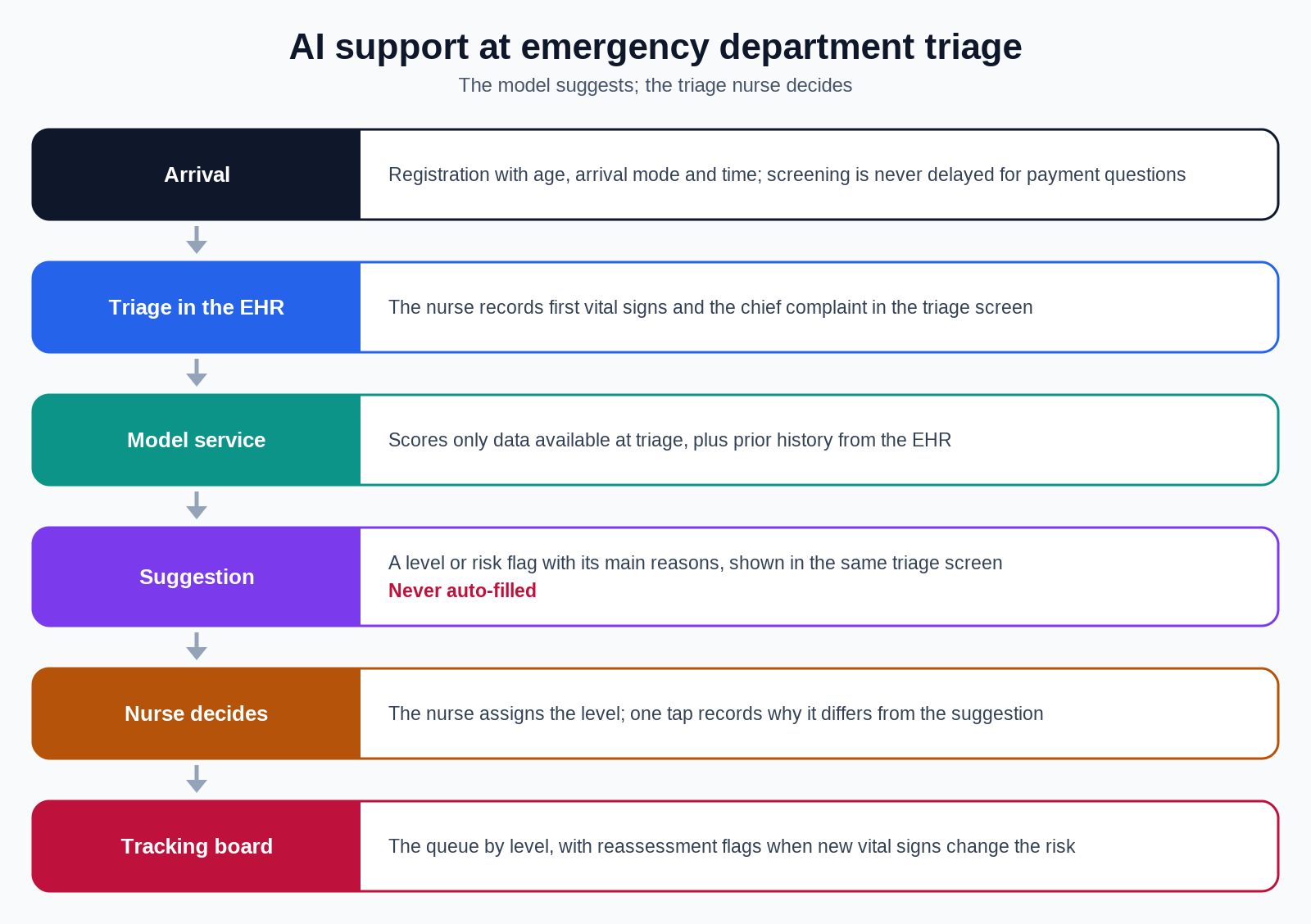
Record what the model suggested, what the nurse chose and why they differed. That record is the main source for later validation and for improving the model.
Which rules shape ED triage software?
Triage AI works inside the duty every emergency department already has to screen patients, and it may fall under FDA oversight depending on what it does.
Under EMTALA rules, a hospital emergency department must give anyone who comes to it an appropriate medical screening examination by qualified personnel to determine whether an emergency medical condition exists, and may not delay that examination to ask about payment or insurance.
A triage tool must never delay or replace that screening, and it should not show insurance or payment data at the triage step.
FDA's Clinical Decision Support Software guidance explains which decision support functions meet the non-device criteria in section 520(o)(1)(E) of the FD&C Act and which remain device software functions.
How should the suggestion be shown to the nurse?
Show the suggestion with its reasons, not just a number. A nurse can weigh a flag that says the heart rate and age raise the risk; a bare score invites either blind trust or dismissal.
- Reasons: the few inputs that drove the suggestion.
- No auto-fill: the nurse selects the level; the model never sets it.
- Disagreement: one tap to record why the nurse chose differently.
- Missing data: a clear note when inputs were absent.
Waiting room reassessment
Triage is not a single moment. Patients wait, and some get worse, so a model that rescores when new vital signs are recorded can flag patients who need to be seen sooner.
Keep these flags few and specific, route them to the nurse responsible for the waiting room, and track how often they lead to a change in level.
What about children and other special groups?
Children need their own handling, because normal vital signs change with age and a value that is fine for an adult can be alarming in an infant. Train and validate pediatric suggestions separately, or switch them off where pediatric data is thin.
- Age-based vital sign ranges: built into the features, not left to the model to learn.
- Pregnancy: recorded at triage where relevant, since it changes risk.
- Language: complaint text in other languages, or entered through an interpreter.
- Repeat visitors: frequent attenders whose risk is easy to underrate.
Name these groups in the validation plan, so results for each are reported rather than averaged away.
How do you validate an ED triage model?
Validate on your own patients, at your own sites, before anyone sees a suggestion. A model built elsewhere may not match your population, complaint wording or triage habits.
- Silent mode: the model scores live patients without showing results.
- Under-triage: how often critical patients would have been flagged.
- Subgroups: results by age, sex, language and other groups the hospital names.
- Agreement: how often the suggestion matched experienced triage nurses.
Agree in advance with emergency physicians and nursing leaders which results would stop the rollout.
How should the model be maintained?
Emergency departments change: new complaint lists, new triage staff, seasonal illness and changes in who arrives. Each can shift the data the model sees.
Monitor input patterns and suggestion rates by week, review a sample of disagreements with nursing leaders, and revalidate after any change to the triage form or the EHR build.
Where do ED triage AI projects fail?
Most failures come from data timing and workflow, not from the model type.
- Leaked data: training features that do not exist at triage time.
- Wrong screen: suggestions shown somewhere nurses do not look.
- Alert overload: too many flags, so all are ignored.
- Imported model: validated elsewhere, never on local patients.
- No feedback loop: disagreements never reviewed or used.
A worked example: silent mode in a community hospital ED
A community hospital wanted help spotting patients who looked stable at triage but later needed intensive care. The team trained a model on arrival data, vital signs, complaint text and EHR history only.
In silent mode, the model flagged many of the later critical patients but also produced too many flags overall. Nursing leaders chose a higher threshold, accepting fewer flags so each one would be read.
The live version showed one flag with reasons in the triage screen and recorded every disagreement. Monthly review of those records led to a change in how chest pain complaints were handled, and nurses began to treat the flag as a prompt to look again rather than an order.
Who owns what?
Triage AI belongs to the emergency department, with support from informatics and engineering.
- Emergency nursing leadership: thresholds, workflow and training.
- Emergency physicians: clinical validation and review of missed cases.
- Clinical informatics: triage screen design and EHR build.
- Engineering: data pipeline, model service and monitoring.
- Compliance: FDA status review, EMTALA alignment and privacy.
How do you measure whether triage AI helps?
Measure patient safety and nurse workload, not only model accuracy.
- Under-triage of critical patients before and after go-live.
- Time from arrival to provider for the highest acuity levels.
- Flags per shift and the share acted on.
- Nurse agreement and the reasons for disagreement.
What are ED triage AI best practices?
Use only data available at triage, put the suggestion and its reasons in the triage screen, keep the nurse as the decision maker, and record every disagreement.
Validate in silent mode on local patients, check subgroups, keep flags few, never delay screening, and review the model whenever the triage form, EHR build or patient mix changes.
How Agnotic can help
Agnotic builds triage decision support for emergency departments: data pipelines that respect triage timing, models validated in silent mode, suggestions with reasons in the triage screen, disagreement capture and monitoring for drift.
Plan hospital capacity tools with Agnotic
Our hospital resource management page covers AI that helps hospitals plan beds, staff and flow.
Related reading on Agnotic
Clinical decision support and alerts.


