



A regional health information exchange connects hospitals, clinics, labs and other organizations so a clinician can see what happened to a patient elsewhere. From the outside it looks like one big database. Inside, it is a set of services that match patients, remember where records sit, apply consent rules and move data in several ways.
This post explains those services for teams building, replacing or connecting to regional HIE software: the patient index, the record locator, consent, query exchange, push exchange and event notifications, plus the operational work that keeps an exchange trusted by its members.
What is health information exchange software?
Building or connecting to an HIE?
Our health information exchange integration page covers patient matching, document exchange and notification feeds we build.
Health information exchange software is the platform a regional exchange runs to receive data from member organizations, match each patient across them, track where records are held, apply consent rules, and deliver records by query, push or notification. Agnotic Technologies builds and connects these services for exchanges and their members.
Every one of those services can fail independently, and members notice each failure differently.
What are the parts of an HIE platform?
An HIE platform has three shared services at its core, a patient index, a record locator and consent rules, surrounded by the ways data comes in and goes out. Members send admissions, results and documents; clinicians and systems receive data by query, push or notification.
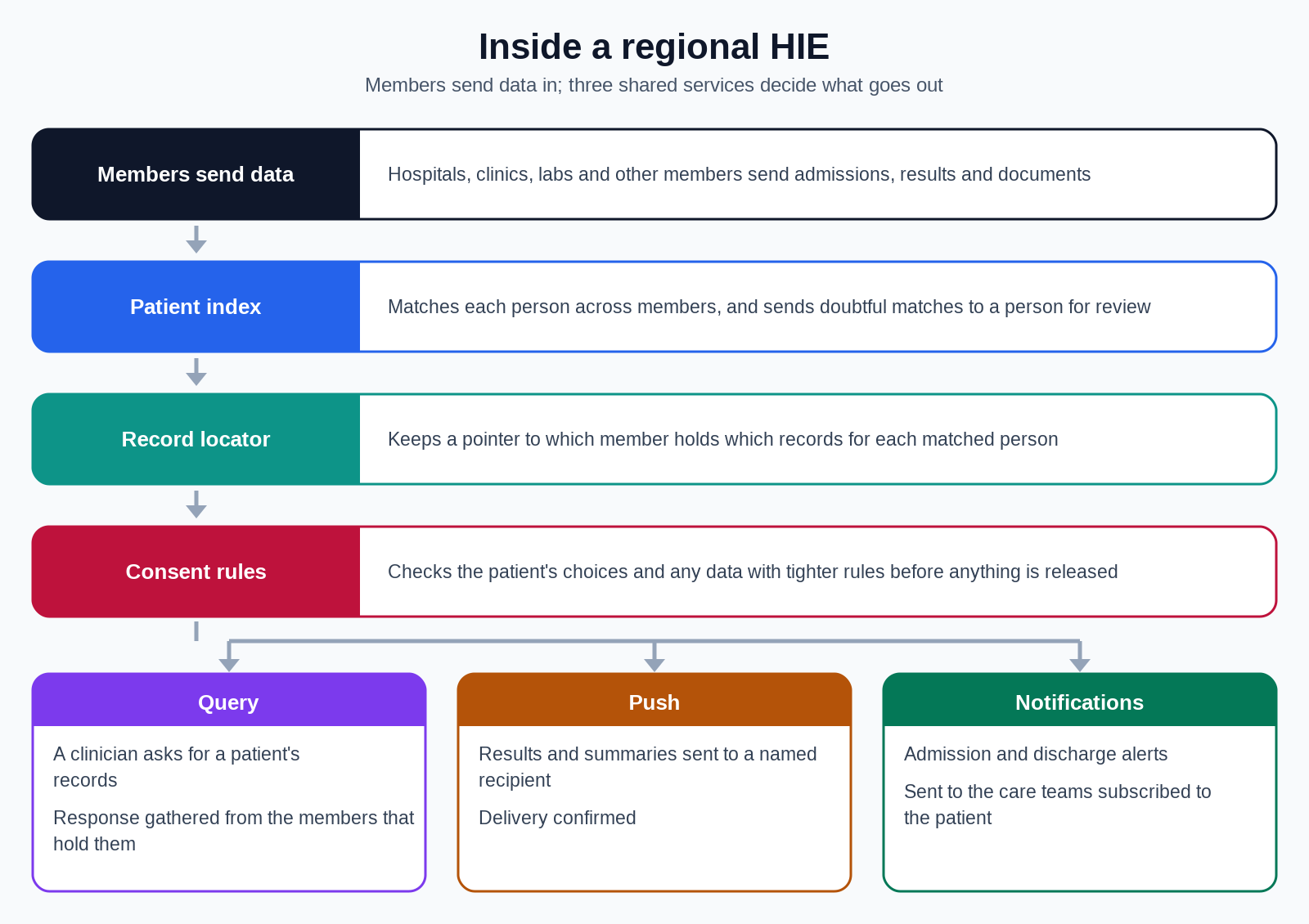
Some exchanges store full copies of records centrally, others keep only pointers and fetch from members at query time, and many mix both. The choice changes storage, speed and what happens when a member's system is down.
How does the patient index match people?
The patient index matches people by comparing demographics from each member, such as name, date of birth, sex, address and phone, and assigning a shared identifier when records agree closely enough. Records that fall between clear match and clear non-match go to a person for review.
- Thresholds: separate scores for automatic links and for review, tuned on real data.
- Review queue: staffed, with a target time, because unresolved cases block exchange.
- Unlinking: a way to split two people merged by mistake, and to correct every system that received the merged record.
- Monitoring: duplicate and overlay rates per member, since one member's data quality affects everyone.
What does the record locator do?
The record locator keeps a list of which members hold records for each matched person, and for what dates and types. When a query arrives, it tells the exchange where to look instead of asking every member every time.
Keep the locator current from members' admission and document events. A stale locator means queries return incomplete records, and clinicians stop trusting the exchange quickly once they find a gap.
How should consent work in an exchange?
Consent should be recorded once, applied at release time and visible to members. Exchanges use different models, such as opt-out or opt-in, and some data carries tighter rules regardless of the general choice.
42 CFR Part 2 restricts the use and disclosure of substance use disorder patient records maintained by federally assisted Part 2 programs, separately from the HIPAA Privacy Rule.
- Patient choice: recorded with date, scope and who captured it.
- Sensitive data: tagged at intake so release rules can filter it.
- Break-glass: emergency access, logged and reviewed afterwards.
- Patient view: a way for patients to see and change their choice.
How does query exchange work?
Query exchange lets a clinician or system ask for a patient's records at the point of care. The exchange matches the patient, checks consent, gathers documents or data from where the locator says they sit and returns a combined response.
Design for partial responses. A member that does not answer in time should not stop the rest, and the clinician should see which sources responded and which did not.
How does push exchange work?
Push exchange sends specific records to a named recipient without a query, such as a discharge summary to the primary care practice or a lab result to the ordering clinic. It replaces fax and courier for many routine handoffs.
Delivery confirmation matters as much as sending. The exchange should know whether the recipient system accepted the message, and tell the sender when it did not.
Event notifications
Event notifications alert care teams when their patients are admitted, discharged or seen in an emergency department. They are often the most used service an exchange offers, because they prompt action.
Members subscribe to lists of patients they are responsible for. Keep those lists current, or alerts go to practices that no longer care for the patient and stop being read.
How do members connect to the exchange?
Members usually connect through their EHR's existing interfaces: HL7 v2 messages for admissions and results, clinical documents for summaries, and increasingly HL7 FHIR APIs for queries. The exchange should accept what members already send rather than ask each one for a new build.
- Onboarding kit: message specifications, test patients and a checklist each member completes.
- Test environment: a copy of the exchange where members prove their feeds before going live.
- Mapping: local codes for sites, departments and document types translated once, in the exchange.
- Go-live check: sample messages traced through matching, the locator and release before switching on.
How do you test an HIE before members rely on it?
Test with messy data and failing members, not with a clean demo. Load realistic duplicate and near-duplicate patients, switch off a member during a query, and send a message from a member whose feed has been quiet for a day.
Then check what clinicians see in each case: which sources answered, which did not and whether the patient was the right person.
Which rules shape HIE software?
Privacy and security rules apply to every exchange, consent laws vary by state and data type, and information blocking rules affect how exchanges handle requests for data.
The information blocking regulations restrict practices by health care providers, certified health IT developers and health information networks that interfere with access, exchange or use of electronic health information.
In practice, write down for each service which requests it fulfills, how fast and with what exceptions, so a refusal can be explained by a documented rule rather than a technical limit.
What goes wrong with HIE platforms?
HIE platforms lose member trust through data quality and silence more often than through outages. These problems tend to appear first.
- Overlays: two patients merged, with results shown in the wrong chart.
- Stale locator: queries miss records a member holds.
- Silent feeds: a member's interface stops and nobody notices for days.
- Unread alerts: notifications sent to outdated subscriber lists.
- Consent drift: choices recorded at one member but not applied across the exchange.
A worked example: discharge alerts for primary care
An exchange wants primary care practices to know within hours when their patients leave hospital. Hospitals already send admission and discharge messages, and practices upload their patient panels each month.
The patient index matches panel patients to hospital records. On each discharge event, the exchange checks consent and sends an alert with a link to the discharge summary when it arrives.
The exchange monitors each hospital feed for silence and each practice's panel for staleness, and reports both to members every month.
Who owns what in an exchange?
The exchange owns the shared services; members own the quality of the data they send and the use of what they receive. Agreements should say both.
- Exchange operations: patient index review queue, feed monitoring and member support.
- Privacy officer: consent model, sensitive data rules and access reviews.
- Members: interface health on their side, data quality and subscriber lists.
- Engineering: the services, interfaces and the logs that answer access questions.
How do you measure an exchange's health?
Measure what members experience: whether records are found, whether alerts arrive and whether data is right.
- Query completeness: responses that included all members holding records.
- Feed health: hours since last message per member feed.
- Matching: review queue size and age, and overlays reported.
- Alert delivery: alerts accepted by recipient systems.
What are health information exchange software best practices?
Staff the patient index review queue, keep the record locator current from events, apply consent at release time, return partial query results clearly, confirm push deliveries, keep subscriber lists fresh and watch every feed for silence.
Report data quality back to each member, because the exchange is only as good as what members send.
How Agnotic can help
Agnotic builds HIE services and member connections: patient matching and review tools, record locators, consent enforcement, query and push interfaces, event notifications and the monitoring that keeps them trusted.
Plan your exchange with Agnotic
We design interoperability programs from member interfaces to shared services.
Related reading on Agnotic
National exchange, matching and integration.


