



A single non-emergency medical transportation trip passes protected health information through more hands than most clinical visits: the health plan or state agency, a broker's call center, a transportation provider's dispatcher, a driver's phone, sometimes a facility's front desk, and finally a claims system. Each one needs some of the information. None needs all of it.
This guide explains how HIPAA applies to NEMT software and how to build a platform that shares only what each party needs, protects data on drivers' devices, keeps an audit trail of every trip, and holds up when a health plan or state agency reviews it. It is written for brokers, transportation providers and the teams building software for them.
What does HIPAA compliance in NEMT software mean?
Building or fixing an NEMT platform?
Agnotic builds HIPAA-ready software for NEMT brokers and providers, from booking and dispatch to driver apps and claims.
HIPAA compliance in NEMT software means the booking, dispatch, driver and billing systems protect the health information that travels with each trip: limiting who sees what, securing it on servers and phones, logging access, and backing every vendor with the right agreement. Most NEMT companies hold this data for a health plan or state agency, so the obligations follow them.
The specific risk in NEMT is spread. A trip record holds a member's name, address, appointment location and often mobility or medical needs, and it is copied across call centers, dispatch screens and drivers' phones that sit outside any clinic. The software has to shrink that spread, not just encrypt it.
Why does NEMT carry health information at all?
NEMT exists because Medicaid requires it, and the trip is tied to a medical appointment, so health information comes with it. Under 42 CFR 431.53, a state's Medicaid plan must specify that the agency will ensure necessary transportation for beneficiaries to and from providers, and describe the methods it will use.
Medicaid.gov notes that the Consolidated Appropriations Act, 2021 also added this assurance of transportation to the Medicaid statute, where it had previously rested on the regulation alone. States meet it through brokers, managed care plans and transportation providers, which is why so many organizations end up holding Medicaid member data.
- Member identity: Name, Medicaid or plan ID, date of birth and phone number.
- Trip details: Pickup address, destination provider and appointment time, which can reveal the type of care.
- Needs: Wheelchair, stretcher, oxygen, escort or other assistance.
- Eligibility and authorization: Coverage status and any prior approval for the trip.
- Billing: Trip confirmation, mileage and claim data sent back to the payer.
Who is a covered entity and who is a business associate in NEMT?
Usually the health plan or state Medicaid agency is the covered entity, and brokers and their technology vendors act on its behalf as business associates. Transportation providers may be business associates or subcontractors of the broker, depending on the contract structure.
- Health plan or state agency: Covered entity that holds the member relationship.
- Broker: Business associate that books, schedules and manages trips for the plan.
- Transportation provider: Often a subcontractor of the broker, with its own agreement covering the data it receives.
- Software and hosting vendors: Business associates or subcontractors of whoever hires them.
- Drivers: Workforce or contractors of the transportation provider, bound by its policies and training.
Map these roles for every contract before building access rules. The software should reflect who is allowed to receive what under each agreement, not one generic view for every user.
What should each party in a trip be able to see?
Each party should see only the information its step needs. HIPAA's minimum necessary standard, 45 CFR 164.502(b), requires reasonable efforts to limit protected health information to the minimum necessary for the intended purpose, and an NEMT trip has a natural set of purposes at each step.
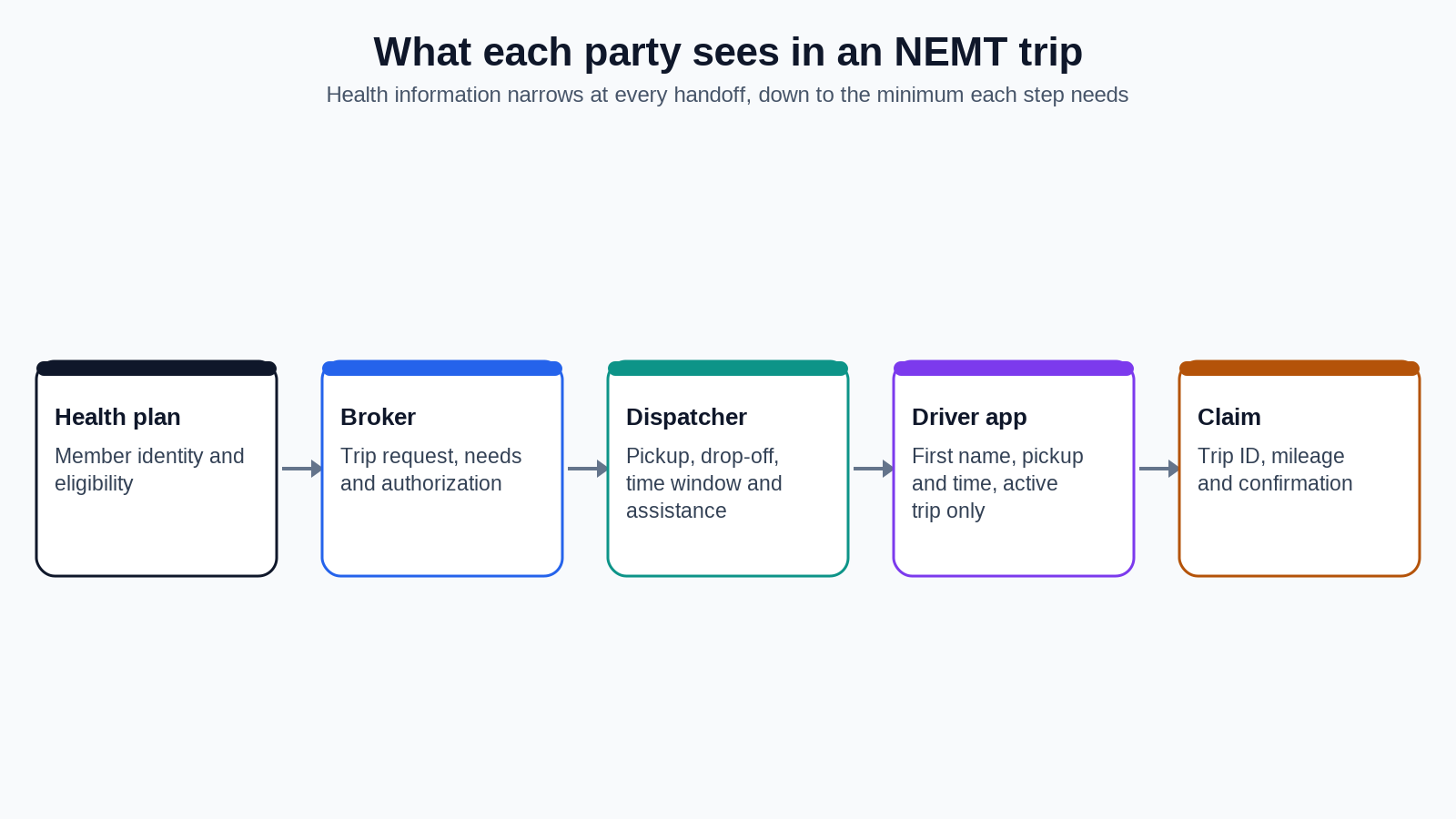
- Broker call center: Member identity, eligibility, trip request and needs, to book the ride.
- Dispatcher: Pickup and drop-off, time window and assistance needs, to assign a vehicle.
- Driver: First name or initials, pickup address, time, assistance needs and a contact number, for that trip only.
- Facility contact: Arrival confirmation, without diagnosis or other health details.
- Billing: Trip identifiers, mileage and confirmation needed for the claim.
The destination is the subtle field. A dialysis center or a behavioral health clinic as the drop-off reveals care type, so show drivers the address they need without the provider's specialty or name where possible.
How should driver apps protect health information?
Driver apps should treat the phone as an untrusted place: show each trip only while it is active, store as little as possible on the device, and remove it when the trip ends.
- Time-limited trips: Trip details appear shortly before pickup and disappear after drop-off.
- No local copies: Avoid caching manifests or exporting trip lists to the phone's storage.
- Masked calling: Connect drivers and members through masked numbers instead of showing personal phone numbers.
- Strong sign-in: Unique driver accounts with device passcodes and remote sign-out.
- Lost devices: The ability to revoke a device's access immediately.
Paper manifests and messaging apps are the common leaks. A driver who prints the day's list or texts a dispatcher a member's address has moved PHI outside every control, so the app must make the safe way the easy way.
What should the platform log and audit?
Log every view, change and export of trip and member data, by user, time and record, and review the logs on a schedule. Health plans and state agencies increasingly ask for this evidence in audits.
- Access events: Who opened which member and trip records.
- Changes: Edits to addresses, needs, times and status, with before and after values.
- Exports: Every report or file that leaves the platform.
- Driver events: Trip acceptance, arrival, pickup and drop-off with time and location.
- Unusual activity: Many records opened by one user, or access outside working hours.
Which security controls does an NEMT platform need?
An NEMT platform needs the same core controls as any system holding PHI, applied to a larger and more mobile set of users.
- 1. Risk analysis: Assess risks across call center, dispatch, mobile and integration paths.
- 2. Role-based access: Separate roles for agents, dispatchers, drivers, provider admins and billers, scoped by contract.
- 3. Encryption: Data encrypted in transit and at rest, including mobile app storage.
- 4. Secure integrations: Authenticated, logged connections to plans, states and claims clearinghouses.
- 5. Incident response: A plan for lost phones, misdirected trips and breaches, tested before it is needed.
How do vendor agreements fit into NEMT compliance?
Every organization that touches member data needs a written agreement that matches what it receives. The chain usually runs from the plan to the broker, from the broker to transportation providers and software vendors, and from them to their own subcontractors.
Keep an inventory of each agreement, the data it allows and the systems that carry that data. When a transportation provider leaves the network, the inventory tells you which accounts to disable and which data to recover or destroy.
What are the common HIPAA mistakes in NEMT software?
The common mistakes come from operational shortcuts that feel harmless under pressure. These are the ones we see most often.
- Full manifests for drivers: Every trip of the day with names and destinations on one sheet or screen.
- Shared logins: Dispatch accounts shared across a shift, so access cannot be traced.
- Texting trip details: Addresses and appointment details sent through personal messaging apps.
- Over-broad provider portals: Transportation providers seeing members from other providers' trips.
- No offboarding: Drivers and providers who leave keep app access.
What are HIPAA compliance best practices for NEMT software?
The practices that hold up keep data narrow, short-lived and traceable at every step of the trip.
- Minimum necessary by step: Each role sees only its part of the trip.
- Short-lived mobile data: Trip details expire on the device after drop-off.
- Masked contact: No personal phone numbers exchanged.
- Full audit: Every view, change and export logged and reviewed.
- Agreements mapped to access: Contract terms reflected in system permissions.
How Agnotic can help
Agnotic Technologies builds HIPAA-ready NEMT software: booking and eligibility, dispatch with role- and contract-scoped access, driver apps that show trips only when active and clear them afterwards, masked calling, audit logging and secure integrations with plans and clearinghouses. We design access around your contract chain and help prepare the technical evidence plans and states ask for.
For existing platforms, we review how trip data flows to drivers and providers and close the widest gaps first, which are usually manifests, shared logins and messaging.
Protect every trip, end to end
Plan HIPAA-ready NEMT software with our engineers, or read more compliance articles in the hub.
Related reading on Agnotic
See how NEMT platforms are built and billed, why dispatch breaks, how audit trails work and how role-based access is designed.


