

01
One measure side by side
A measure still on hybrid run digitally next to its current result.



Every hybrid season, a plan's quality team chases charts for results that often already sit in a provider's EHR, an HIE or a registry. NCQA is moving HEDIS to electronic clinical data and digital measures. Agnotic Technologies builds the data feeds, measure logic and audit trail a health plan needs to report that way.
Trusted by global innovators











Digital HEDIS is the move from claims plus hybrid medical record review to HEDIS measures reported from electronic clinical data and written as computable FHIR and CQL specifications. Agnotic Technologies builds the software a health plan needs for it: clinical data feeds mapped to QI-Core, measure logic in CQL, ECDS reporting and the audit trail behind each result.
The measures are moving to digital. The data plumbing in most plans has not moved with them.
Chart retrieval vendors, provider offices and abstractors work the same sample every year, by hand.
Lab results and screenings arrive as supplemental files in many layouts, each with its own validation history.
EHR data from provider APIs or an HIE lands in a data lake but never reaches the measure engine in a usable model.
Measure logic runs as a black box, so analysts cannot explain why a member counts as a numerator miss.
The auditor asks where each data element came from, and the answer is spread across email threads.
Nobody has compared ECDS results with hybrid results for the same measure before the hybrid option ends.
The original element of this page: each source a digital measure can read, its NCQA ECDS category, how we map it, the checks before use and the evidence we keep for the audit.
| Data source | NCQA ECDS category | How we map it | Checks before use | Audit evidence kept |
|---|---|---|---|---|
| Claims and encounters | Administrative | Warehouse tables mapped to QI-Core Encounter, Condition and Procedure profiles | Totals reconciled to the claims system for the period | Claim identifiers, load dates and reconciliation reports |
| Eligibility and member rosters | Administrative | Member and coverage records keyed to the enterprise member ID | Enrollment segments checked against measure continuity rules | Roster versions by load date |
| Provider EHR data over FHIR | EHR or personal health record | US Core resources from provider APIs mapped to QI-Core | Codes checked against measure value sets; dates within the measurement period | Source organization, retrieval time and the original resource |
| HIE and immunization registry feeds | HIE or clinical registry | HL7 v2 or FHIR messages normalized to QI-Core | Duplicate and late record checks across feeds | Feed, message identifier and receipt time |
| Care and case management records | Case management system | Assessments and screenings mapped to QI-Core Observation | Who recorded it and whether the instrument is the one the measure names | System, recorder and timestamp |
Three rules keep the transition safe while the current reporting cycle runs.
Digital results run next to the hybrid and administrative results for the same members, so differences are explained before anything is retired.
Every data element keeps its source, its original form and its load date, so the audit trail exists before the auditor asks.
Measure logic runs in CQL on QI-Core data, and analysts can see for any member which data placed them in or out of each population.
The data and measure layers behind digital HEDIS. Stars dashboards, HCC gap detection and care gap analytics are covered on our payer analytics and AI page.
Provider FHIR APIs, HIE feeds, registries and files received, logged and queued for mapping.
Source data normalized to QI-Core profiles, with the original record kept beside it.
Codes validated against the value sets each measure uses, with unmapped codes sent for review.
Measure packages run in a CQL engine against QI-Core data, versioned by measurement year.
Why each member is in or out of the denominator, numerator and exclusions, with the evidence.
Intake, validation and approval for each provider or aggregator source before its data counts.
Digital, hybrid and administrative results compared by measure and member.
Da Vinci DEQM Gaps in Care reports shared with provider groups over FHIR.
The pipeline we build for digital HEDIS, with the evidence each stage leaves for the audit.
FHIR API pulls, HIE and registry feeds and supplemental files land with their source, receipt time and original payload.
Records are mapped to QI-Core profiles built on US Core, and the mapping version is stored with each record.
Codes are validated against the measure value sets; records with unknown codes are held for review instead of dropped.
CQL measure logic runs for the measurement year, producing member-level results for each population.
Digital results are compared with hybrid and administrative results, then shaped for the plan's HEDIS submission process.
Open gaps go back to provider groups as DEQM Gaps in Care reports, so they can act before the year closes.
The standards we build on, chosen to match NCQA's digital measure direction.
Views we build for quality, data and compliance teams.
Measures whose digital results match or explain the hybrid results.
Members met by each ECDS data source category.
Numerator hits that only chart review found, traced to a missing feed.
Care gap reports delivered and acknowledged.
A HIPAA-ready maternal health platform enabling remote patient monitoring, care coordination, and personalized engagement from pre-pregnancy through postpartum.
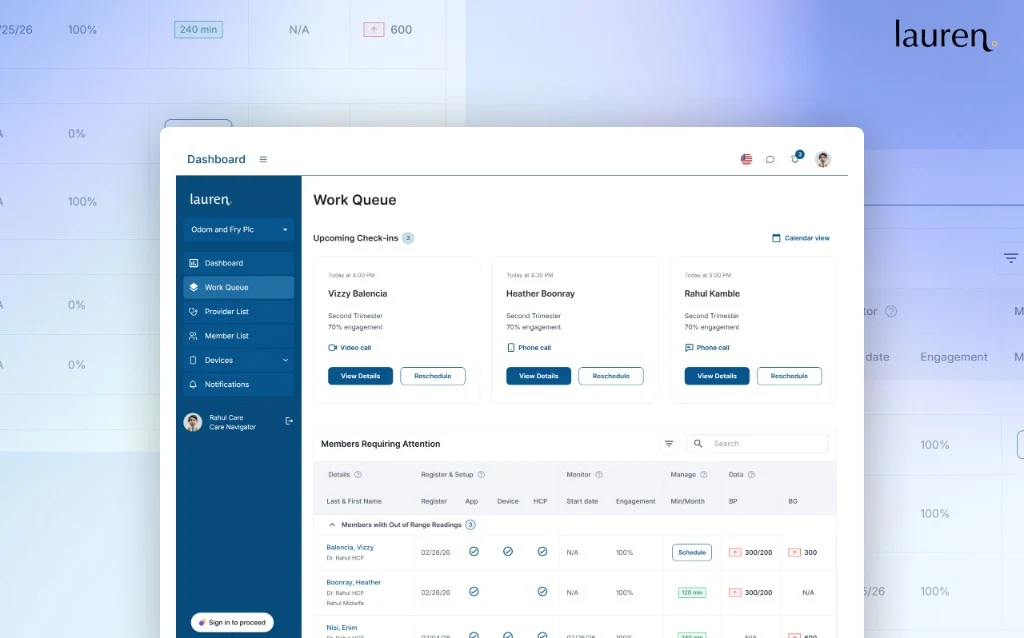
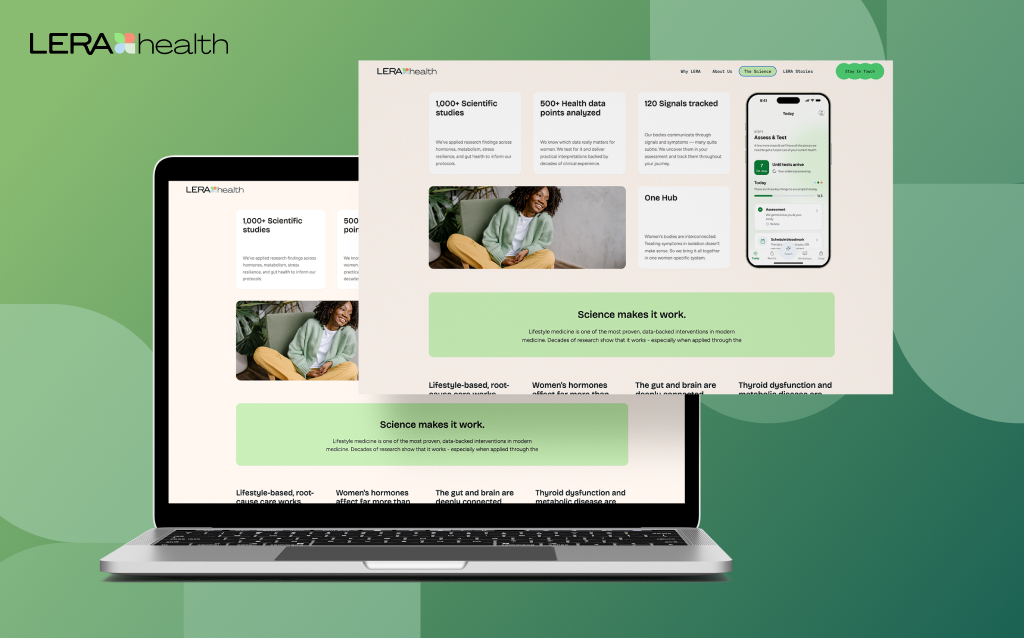
A women’s health product experience focused on guided care journeys, education, and compliance-aware workflows to support long-term engagement.
First releases we scope, each tied to the current measurement year.
A measure still on hybrid run digitally next to its current result.
A FHIR feed from one high-volume provider group, mapped and validated.
One governed path for provider and aggregator files, replacing many layouts.
Analysts see why a member is a numerator miss, with the evidence.
DEQM reports to provider groups during the year.
A first digital pipeline sized for a regional or new plan.
The systems a digital measure pipeline reads from and reports to.
Before a plan lets go of chart review for a measure, we run both methods and check these four areas. The gaps found here become the next data feeds to build.
We build secure, scalable products designed for privacy, interoperability, and regulatory readiness from day one across every sector we serve.

Protect PHI with privacy-first architecture, encrypted storage and transmission, and strict access controls.

Enabling standardized health data exchange through standards-based API mappings.

Supporting enterprise-grade interoperability for clinical messaging and record workflows.
We combine deep technical expertise with industry-specific knowledge to deliver solutions that aren't just functional, but transformational.
We implement rigorous security protocols and compliance standards (HIPAA, GDPR, SOC2) across all industrial solutions to protect sensitive data.
Our architectures are built to handle massive data loads and user bases, keeping performance steady whether you're serving ten or ten million.
Using our suite of internal tools and proven frameworks, we cut setup work so your first release reaches users sooner.
Beyond simple wrappers, we build deep-learning integrations and predictive analytics directly into the core of your industry-specific workflows.
We start with one measure and the data the plan already holds. Timing follows the measurement year, and we agree a fixed first release on the scoping call.
Measures, current vendors, data sources and the reporting calendar.
The data source table filled in for the plan, with gaps marked.
One measure running digitally next to its current result.
New provider and HIE feeds, then more measures on the same pipeline.
Measurement year updates and audit support under change control.
Short facts we design around, each linked to its primary source. NCQA dates were read on ncqa.org on 22 October 2026.
NCQA reports that eight HEDIS measures still allowed hybrid reporting as of measurement year 2025, and that its planned transition removes the hybrid method by measurement year 2029, an endpoint it kept when it refined measure pathways in January 2026.
Source: NCQA, HEDIS Electronic Clinical Data Systems (ECDS) Reporting, Hybrid Transition (read 22 October 2026)NCQA groups data sources for HEDIS ECDS reporting into four categories: EHR or personal health record, HIE or clinical registry, case management system, and administrative data.
Source: NCQA, HEDIS Electronic Clinical Data Systems (ECDS) Reporting, Types of ECDS DataHL7 Clinical Quality Language (CQL) is a high-level, domain-specific language for clinical quality measure and decision support authors, with a machine-readable form called Expression Logical Model (ELM).
Source: HL7, Clinical Quality Language Specification v2.0.0The HL7 QI-Core Implementation Guide defines FHIR profiles that derive from base FHIR resources and US Core for quality improvement work; QI-Core STU 7 (version 7.0.2) aligns with US Core STU 7.
Source: HL7, QI-Core Implementation Guide v7.0.2The HL7 Da Vinci Data Exchange for Quality Measures (DEQM) Implementation Guide, version 5.0.0, gives guidance for exchanging individual, summary and subject list measure reports, and Gaps in Care reports, over FHIR.
Source: HL7, Da Vinci DEQM Implementation Guide v5.0.0 (STU5)We don't just build products; we forge lasting partnerships. See how we've helped industry leaders transform their vision into technical reality.
“I can clearly see how Agnotic has a unique way of handling end-to-end development. They are always active on quick chat and provide support quickly.”

Aaron Phelan
Founder, Benchmark
“Agnotic combines deep technical expertise with strong domain knowledge. They understand the business context, anticipate challenges, and make collaboration smooth and effective.”

John Pasmore
Founder, Latimer
“Agnotic is the best technical team we evaluated. Their engineering excellence made our work dramatically easier and allowed us to stay focused on what matters most for maternal care outcomes. They took full ownership of the technical execution, and we are always happy to continue working together.”

Kim Smith
Founder, My Lauren
This page covers digital measure data and logic. These pages cover the work next to it.
Stars and HEDIS tracking, HCC gap detection and care gap outreach.
Core, member and provider systems, including CMS-0057-F APIs.
Software for government program health plans.
Connecting to HIE feeds for clinical data.
The resource model QI-Core and DEQM build on.
When each data model fits an analytics build.
Explore other production-grade engineering platforms we deliver across healthcare.
The technical patterns behind this platform translate naturally into adjacent verticals.