

Hospital utilization review
Case management and the UR committee.
- UR plan, committee and determinations
- Admission and continued stay review queues
- Status decisions and required notices
- Physician advisor escalation


A case manager decides inpatient or observation status with a clock running, while a payer reviews the same stay from the other side. Agnotic Technologies builds utilization management software for both: the hospital's utilization review plan and queues, the plan's review records, and one review history that holds up in an appeal.
Trusted by global innovators











Utilization management software records whether hospital admissions, continued stays and services are medically necessary, and who decided. Agnotic Technologies builds it for hospital utilization review teams and health plans: review queues under the hospital UR plan, inpatient or observation status decisions, physician advisor escalation, committee records and one review history for appeals.
The hospital and the plan review the same stay with different rules and different records.
Case management and the UR committee.
Concurrent review of the hospital's stay.
Review work done for several plans or hospitals.
Most of the losses are records that exist somewhere but not where the reviewer or the appeal needs them.
Case managers screen admissions from a printed census, so a patient who should have been inpatient sits in observation until someone notices.
The physician's reasons for expecting a stay over two midnights are buried in free text, and nobody can find them when a reviewer asks.
Outlier stays that the UR committee must review are found after discharge.
Physician advisor referrals happen by phone and leave no record of the question, the answer or the time.
The hospital and the payer each keep their own version of the same stay, and the appeal is built from screenshots.
Days at risk are counted in a spreadsheet at month end, too late to change anything.
Three design rules carry through every utilization management build.
Each step stores the criteria reference, the clinical facts used, the reviewer, the time and the outcome. Nothing is overwritten, so the history can be replayed in an appeal.
The physician's expectation and the factors behind it sit in structured fields next to the order, where a reviewer can find them.
Authorization numbers, approved days and peer to peer outcomes are stored against the same stay, so the denial and the appeal see one history.
Hospital-side modules first, with the payer data each one needs. Prior authorization request exchange is covered on our prior authorization automation page.
New admissions and observation patients screened against criteria, ordered by time since arrival.
Structured capture of the admitting physician's expectation and its factors, with order checks before status changes.
Next review dates, approved days and outlier flags for the UR committee, per patient.
Referrals with the question, the response time and the outcome recorded.
Cases for committee review, practitioner consultation, one or two member determinations and notices.
Observation notices and not medically necessary notices, with delivery time and signature or refusal.
Avoidable and denied days with reasons, by unit, payer and physician.
Authorizations, approved days, peer to peer results and denials linked to the stay and the claim.
We connect to the EHR and the payer channels you already use.
The original element of this page: each review step with the hospital user, the payer user, the rule that applies and the record each side must keep. Criteria licensing and the Medicare Advantage UM committee rules are compared on our licensed vs internal UM criteria page.
| Review step | Hospital user | Payer user | Rule that applies | Record each side keeps |
|---|---|---|---|---|
| Admission review | UR nurse or case manager | Plan concurrent review nurse | 42 CFR 482.30(c) for the hospital; the plan's UM policies for the payer | Criteria used, clinical facts, reviewer and time |
| Status decision | Admitting physician, supported by case management | Plan reviewer of the inpatient request | 42 CFR 412.3 two-midnight expectation for Medicare Part A | Order, documented expectation and its reasons |
| Observation notice | Registration or case management | None | 42 CFR 489.20(y) for Medicare outpatients in observation over 24 hours | Notice delivered, time, signature or refusal |
| Continued stay review | Case manager; UR committee for outlier stays | Plan concurrent review nurse | 42 CFR 482.30(c) and (e) | Review dates, approved days and days at risk |
| Physician advisor or peer to peer | Physician advisor and attending physician | Plan medical director | Hospital UR plan; plan UM policies | Question, discussion, outcome and time |
| Not medically necessary determination | UR committee members | Plan physician reviewer | 42 CFR 482.30(d): consult the practitioner, notice within 2 days | Who decided, the consultation and notices sent |
| Denial and appeal | Denials and appeals team | Plan appeals unit | Payer contract and program appeal rules | Full review history linked to the claim |
Views we build for case management, physician advisors and the UR committee.
New admissions and observation patients waiting for a first review.
Reviews due today, by unit and reviewer.
Avoidable and denied days, with reasons.
Physician advisor questions without an answer.
A HIPAA-ready maternal health platform enabling remote patient monitoring, care coordination, and personalized engagement from pre-pregnancy through postpartum.
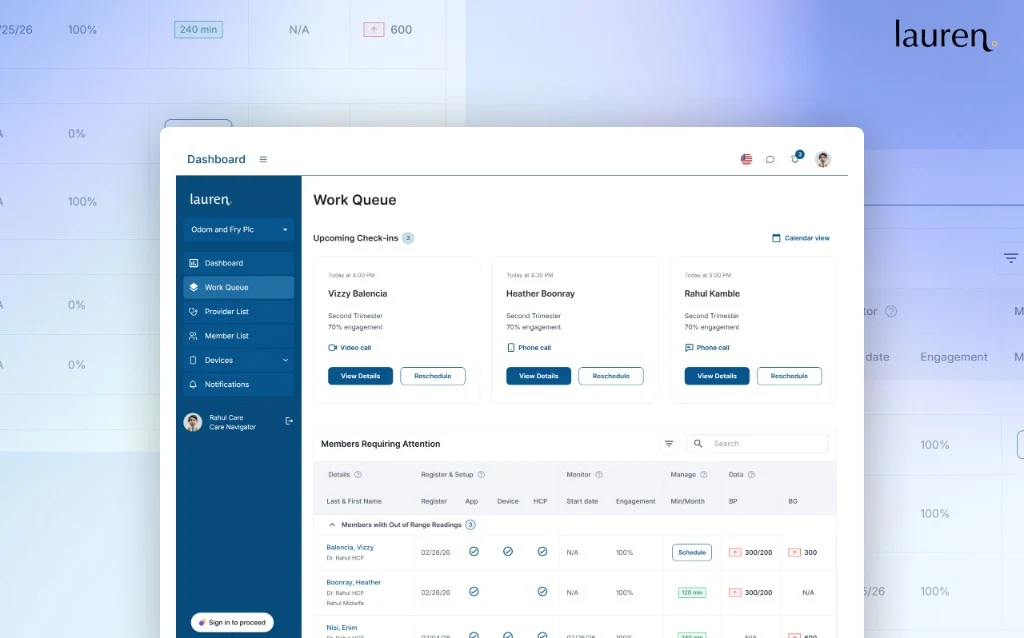

A women’s health product experience focused on guided care journeys, education, and compliance-aware workflows to support long-term engagement.
First releases we scope, each small enough to prove in one hospital.
Every new admission and observation patient screened the same day.
Notices due, delivered and refused, by patient and time.
Committee cases, determinations and notices out of email.
Avoidable and denied days counted daily instead of at month end.
The payer's side of the stay, linked to the hospital's record where both sides agree.
A review platform for a delegated UM vendor serving several clients.
The systems a UM build reads from and writes to.
We build secure, scalable products designed for privacy, interoperability, and regulatory readiness from day one across every sector we serve.

Protect PHI with privacy-first architecture, encrypted storage and transmission, and strict access controls.

Enabling standardized health data exchange through standards-based API mappings.
We combine deep technical expertise with industry-specific knowledge to deliver solutions that aren't just functional, but transformational.
We implement rigorous security protocols and compliance standards (HIPAA, GDPR, SOC2) across all industrial solutions to protect sensitive data.
Our architectures are built to handle massive data loads and user bases, keeping performance steady whether you're serving ten or ten million.
Using our suite of internal tools and proven frameworks, we cut setup work so your first release reaches users sooner.
Beyond simple wrappers, we build deep-learning integrations and predictive analytics directly into the core of your industry-specific workflows.
We start with one hospital and one review step. Timing depends on EHR access and criteria licensing, and we agree a fixed first release on the scoping call.
Review types in scope, criteria source, EHR access and payer channels.
The two-sided table filled in with case management, physician advisors and finance.
Admission review and status decision support live for one hospital.
Review scheduling, outlier flags and the committee workspace added.
Authorizations and denials linked in, then support under change control.
Short facts we design around, each linked to its primary source.
A hospital's utilization review committee must have two or more practitioners, at least two of them doctors of medicine or osteopathy, and no reviewer may have a direct financial interest in the hospital or have been professionally involved in the patient's care.
Source: 42 CFR 482.30(b) (eCFR)Before deciding that an admission or continued stay is not medically necessary, the UR committee must consult the responsible practitioner, and it must give written notice to the hospital, the patient and the practitioner no later than 2 days after the determination.
Source: 42 CFR 482.30(d) (eCFR)In a hospital paid under the inpatient prospective payment system, the UR committee must review cases it reasonably assumes to be outliers because of an extended length of stay, and must make each periodic review no later than 7 days after the day the UR plan requires.
Source: 42 CFR 482.30(e) (eCFR)For Medicare Part A, an inpatient admission is generally appropriate when the admitting physician expects the patient to need hospital care that crosses two midnights, and the factors behind that expectation must be documented in the medical record.
Source: 42 CFR 412.3(d)(1) (eCFR)A hospital must give a standardized written notice to a Medicare beneficiary who receives observation services as an outpatient for more than 24 hours, no later than 36 hours after observation services begin.
Source: 42 CFR 489.20(y) (eCFR)We don't just build products; we forge lasting partnerships. See how we've helped industry leaders transform their vision into technical reality.
“I can clearly see how Agnotic has a unique way of handling end-to-end development. They are always active on quick chat and provide support quickly.”

Aaron Phelan
Founder, Benchmark
“Agnotic combines deep technical expertise with strong domain knowledge. They understand the business context, anticipate challenges, and make collaboration smooth and effective.”

John Pasmore
Founder, Latimer
“Agnotic is the best technical team we evaluated. Their engineering excellence made our work dramatically easier and allowed us to stay focused on what matters most for maternal care outcomes. They took full ownership of the technical execution, and we are always happy to continue working together.”

Kim Smith
Founder, My Lauren
This page covers hospital utilization review and the shared review record. These pages cover the work around it.
The payer UM workbench, reviewer routing, appeals and grievances.
How criteria handling differs, and what the MA UM committee approves.
FHIR prior authorization APIs, X12 278 and CMS-0057-F.
Care plans and transitions after the stay.
Discharge readiness and post-acute placement.
Explore other production-grade engineering platforms we deliver across healthcare.
The technical patterns behind this platform translate naturally into adjacent verticals.