

Member services
The call center and the digital service channels.
- Benefits, claim status and ID card questions
- Cases opened from calls, chat and portal messages
- Callbacks and follow-ups that do not get lost



Member and provider service, appeals and grievances, prior authorization and utilization management each run on their own tools, and the member's case falls between them. Agnotic Technologies builds payer operations software that gives service, clinical and appeals teams one case record, routed work and reporting that matches the rules you are measured against.
Trusted by global innovators











Payer operations software is the set of tools a health plan's service, clinical and appeals teams use to handle member and provider contacts, prior authorization and utilization management, appeals and grievances, and the reporting those workflows require. Agnotic Technologies builds payer operations software for health plans and TPAs around one case record, connected to the core administration system.
Four teams, four sets of rules, one member. The tools should share the record even when the teams do not share a floor.
The call center and the digital service channels.
The teams that support the network.
Clinical teams that decide prior authorization and concurrent review.
Teams that handle complaints and reconsiderations.
The same failure points show up in plans of every size.
No single case: a member calls three times and speaks to three people with three records.
Deadlines tracked by hand: appeal and authorization timeframes live in spreadsheets, and misses are found at audit.
Fax in, retype out: requests arrive as images and someone types them into the system of record.
Reporting after the fact: measures assembled monthly from exports instead of from the workflow itself.
One case record is the design decision the rest of payer operations software depends on.
Each case type carries its regulatory timeframe, extension rules and required notices.
Cases reference the member, provider, claim or authorization in the core, never a copy of it.
Calls, documents, decisions and letters attach to the case with who, what and when.
Service staff see what their role needs; clinical detail is limited to reviewers.
Tools for each operations team, all working on the same case record.
Member and provider views with coverage, claims, authorizations and case history, plus scripts for common contacts.
Case types, routing, service levels, tasks and escalations for every operations team.
Fax and portal capture into structured requests, plus FHIR intake through Da Vinci PAS.
Clinical criteria, reviewer assignment, decisions and notices with a full audit trail.
Intake, classification, deadline tracking, decision letters and reporting.
Queues, timeliness and outcomes from workflow events, by team and case type.
The standards, channels and platforms behind the payer operations tools we build.
Failure points we design against in payer operations work, the workflow each belongs to and the design that removes it.
| Workflow | Failure point | What we build instead |
|---|---|---|
| Member service | The agent cannot see claims, authorizations and prior contacts on one screen | A service desk that reads the core, the authorization system and the case history into one member view |
| Provider service | Claim status questions answered by looking each claim up by hand | Provider self-service for eligibility and claim status, with a case opened only when self-service cannot answer |
| Prior authorization | Fax requests retyped, then lost between intake and clinical review | Document capture into a structured request, FHIR intake where providers support it, and one queue for reviewers |
| Utilization management | Reviewer routing by email, with no record of who held the request when | Rules-based routing by service type and licensure, with every handoff timestamped |
| Appeals and grievances | Deadlines and extensions tracked in spreadsheets | Case types with regulatory clocks, reminders before deadlines and extension records |
| Correspondence | Decision letters written by hand with inconsistent reasons | Letter templates filled from the case record, with the reviewer's reason captured as data |
| Reporting | Monthly measures built from exports | Reporting from the workflow events themselves, including the prior authorization measures payers must report |
Measures we build reporting around, agreed with your operations leads before launch.
By case type: standard and expedited authorizations, appeals and grievances.
Member and provider contacts closed on the first interaction.
Prior authorization requests received through the portal or API instead of fax.
A signal for the rules and criteria upstream.
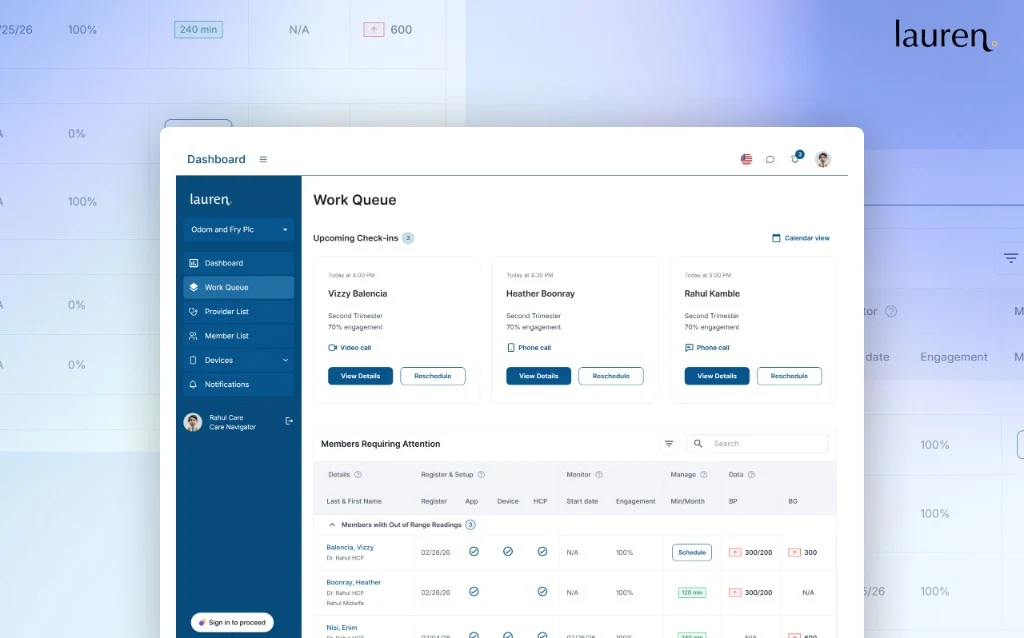
A HIPAA-ready maternal health platform enabling remote patient monitoring, care coordination, and personalized engagement from pre-pregnancy through postpartum.
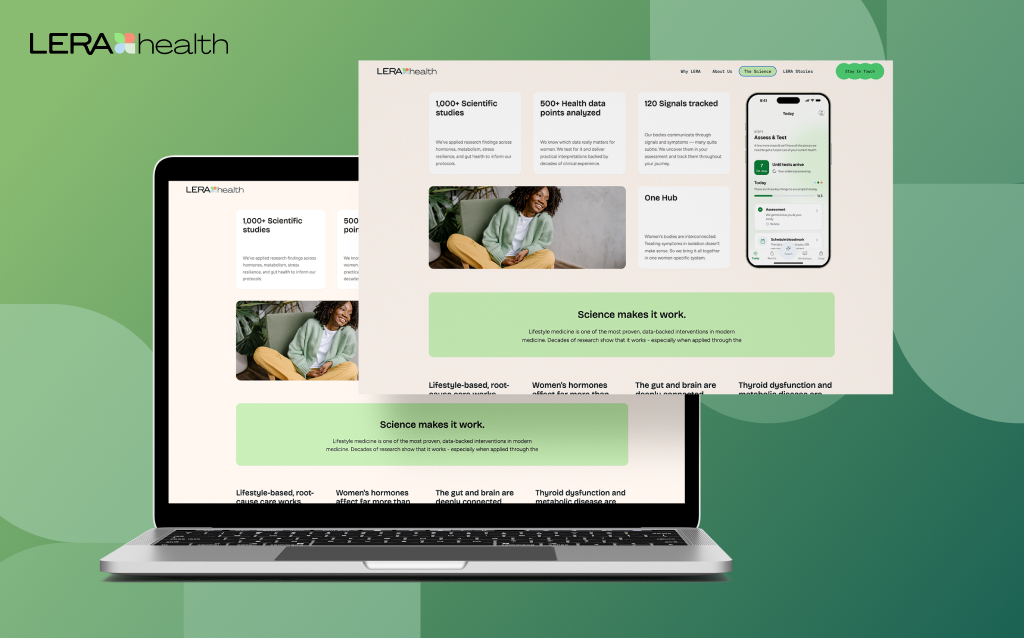
A women’s health product experience focused on guided care journeys, education, and compliance-aware workflows to support long-term engagement.
Payer types with their own rules, timeframes and notices.
Grievances, organization determinations and appeals with their own timeframes and notices.
State-specific service levels, fair hearing coordination and reporting.
Internal appeals and external review under federal rules.
Payer operations for startups: service and case tools built before the call center grows.
Authorization operations run on behalf of several plans with separate rules.
Coverage determinations and appeals for drug benefits.
The systems a case reads from and writes to between intake and closure.
We build secure, scalable products designed for privacy, interoperability, and regulatory readiness from day one across every sector we serve.

Protect PHI with privacy-first architecture, encrypted storage and transmission, and strict access controls.

Enabling standardized health data exchange through standards-based API mappings.
We combine deep technical expertise with industry-specific knowledge to deliver solutions that aren't just functional, but transformational.
We implement rigorous security protocols and compliance standards (HIPAA, GDPR, SOC2) across all industrial solutions to protect sensitive data.
Our architectures are built to handle massive data loads and user bases, keeping performance steady whether you're serving ten or ten million.
Using our suite of internal tools and proven frameworks, we reduce development cycles and get your product to market 40% faster.
Beyond simple wrappers, we build deep-learning integrations and predictive analytics directly into the core of your industry-specific workflows.
How to build payer operations tools one team at a time. Timing depends on scope and is agreed on the scoping call.
We agree which team and which case type come first, and which systems the tools must read.
We walk each case type from intake to closure with the people who do it, noting every handoff and deadline.
One team's workflow on the case record, connected to the core, with reporting from day one.
Each further team joins the same case record, so member and provider history is shared.
New case types, regulatory changes and reporting under agreed support terms.
Short facts behind operations workflows, each linked to its primary source.
Under the CMS Interoperability and Prior Authorization Final Rule (CMS-0057-F), Medicare Advantage, Medicaid and CHIP payers must decide prior authorization requests within 72 hours for expedited requests and 7 calendar days for standard requests, starting in 2026.
Source: Federal Register, February 8, 2024 (CMS-0057-F)A Medicare Advantage organization must establish meaningful grievance procedures and meet the requirements for organization determinations and appeals set out in 42 CFR Part 422 Subpart M.
Source: 42 CFR Part 422 Subpart M (eCFR)Group health plans and health insurance issuers must provide an internal claims and appeals process and an external review process under 45 CFR 147.136, which generally does not apply to grandfathered plans.
Source: 45 CFR 147.136 (eCFR)The HIPAA Privacy Rule's minimum necessary standard requires covered entities to limit uses and disclosures of protected health information to the minimum needed for the purpose.
Source: 45 CFR 164.502(b) (eCFR)We don't just build products; we forge lasting partnerships. See how we've helped industry leaders transform their vision into technical reality.
“I can clearly see how Agnotic has a unique way of handling end-to-end development. They are always active on quick chat and provide support quickly.”

Aaron Phelan
Founder, Benchmark
“Agnotic combines deep technical expertise with strong domain knowledge. They understand the business context, anticipate challenges, and make collaboration smooth and effective.”

John Pasmore
Founder, Latimer
“Agnotic is the best technical team we evaluated. Their engineering excellence made our work dramatically easier and allowed us to stay focused on what matters most for maternal care outcomes. They took full ownership of the technical execution, and we are always happy to continue working together.”

Kim Smith
Founder, My Lauren
Detailed pages for the automation and platforms that operations tools draw on.
AI agents that gather documentation and route requests for review.
Our payer page: CMS-0057-F APIs, prior authorization, member and provider portals.
Fax and PDF capture into structured data for intake.
Call handling for routine member and provider questions.
Routing, tasks and escalations across operations teams.
The provider side of appeals, useful when designing your dispute workflow.
Our healthcare industry page, with every service and audience we build for.
The safeguards we build into every system that holds member data.
Explore other production-grade engineering platforms we deliver across healthcare.
The technical patterns behind this platform translate naturally into adjacent verticals.