



Healthcare teams accumulate interfaces the way hospitals accumulate forms. A payer wants HL7 FHIR. A lab still sends HL7 v2. An internal team asks for a private JSON API because the FHIR resource does not match the screen they are building. A year later nobody can say which of those is allowed to see medications.
An API strategy is the decision record for that mess: which partners exist, which interface each one may call, how versions retire, and what SMART on FHIR scopes mean in your authorization server. This guide is for product and integration leads who are choosing exposure, not for someone wiring a single feed on Friday.
What is an API strategy for healthcare?
Choosing FHIR, HL7 v2, and partner access?
Agnotic designs healthcare API programs and builds FHIR and SMART on FHIR access for the partners you intend to support.
An API strategy for healthcare decides which partners may call which interface, whether that interface is HL7 FHIR, HL7 v2, or a private API, and how versions, scopes, and credentials change over time. It is a product decision about exposure and control, not a catalog of endpoints.
Write it as a one-page map before you publish a developer portal. The map names the partner tiers, the interface each tier is allowed to use, the data classes in play, and the team that approves a new app. Without that page, every integration becomes a special case, and special cases are how a break-glass credential ends up in a vendor's production config.
When should the interface be FHIR, HL7 v2, or private?
Use HL7 FHIR when a partner must read or write clinical data in a standard you can test and replace. Use HL7 v2 when a system already speaks ADT, orders, or results and the cost of a FHIR facade is not justified yet. Use a private API only for workflow that no standard covers, and keep it behind the same gateway.
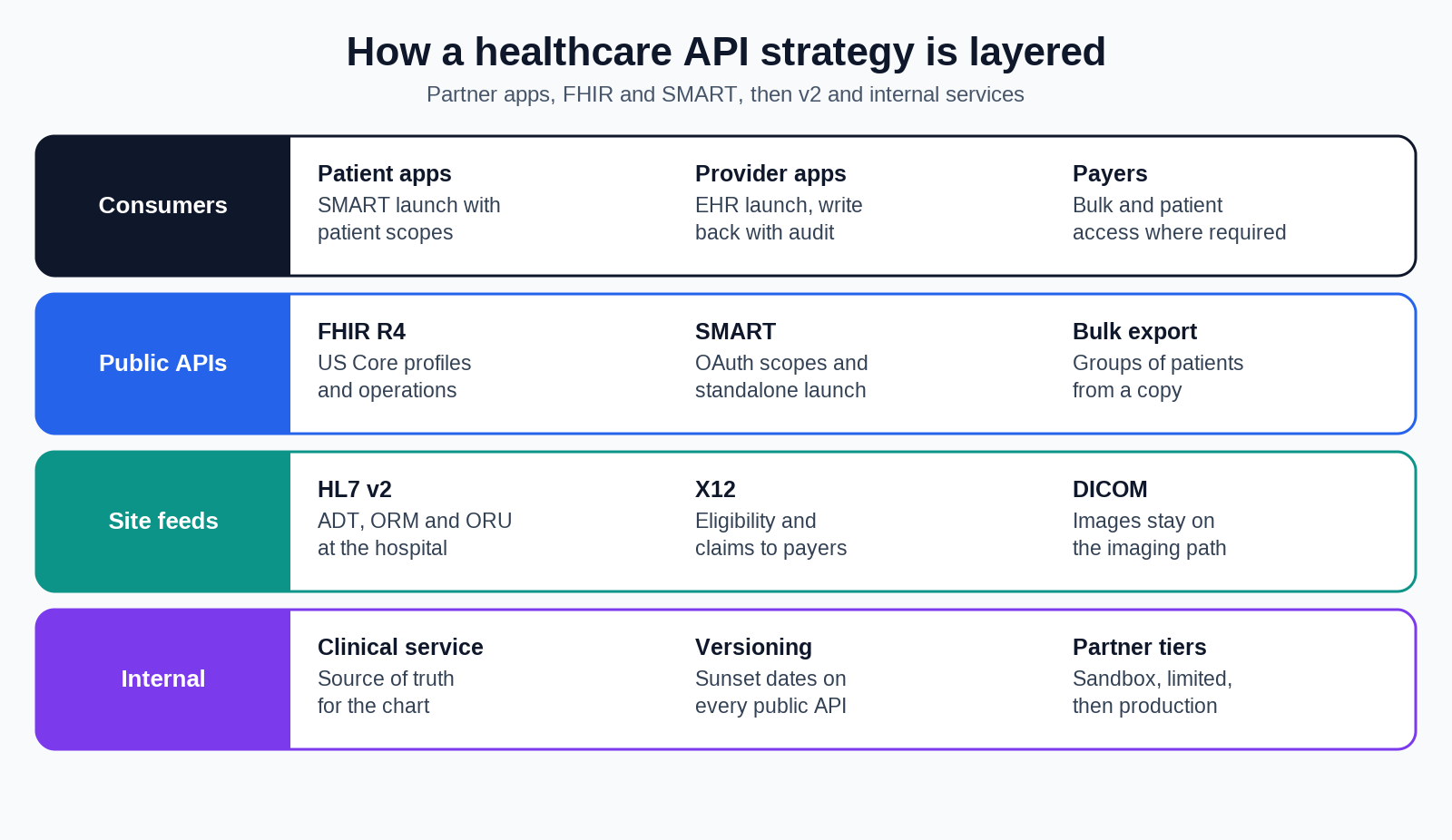
- HL7 FHIR: patient access, provider apps, and new partners who can speak FHIR R4 and US Core.
- HL7 v2: labs, registration broadcasts, and ancillary systems that already emit ORM, ORU, or ADT.
- Private API: scheduling quirks, app-specific workflow, or a resource you have not profiled yet.
- Do not invent a fourth style: file drops are an interface too, and they need an owner and an alert.
A facade in front of HL7 v2 is a strategy choice, not a default. Build it when more than one partner needs the same clinical read and you are tired of mapping each feed by hand. Leave v2 in place when a single lab interface is stable and nobody else will call it. Document that choice so the next team does not 'modernize' a working feed with no consumer.
How should partner tiers limit exposure?
Tiers limit who may register, which data classes they may request, and whether they get patient-context access, user access, or system access. A tier is a contract the gateway enforces. A paragraph in a PDF is not a tier.
- Patient apps: patient-scoped SMART on FHIR access, launched standalone or from the portal, no bulk export.
- Provider apps: user scopes in an EHR launch, limited to the patients that user may open.
- Trusted systems: backend services for a named organization, with a client credential and a patient cohort you defined.
- Internal services: private APIs on the same network rules as everyone else, not a shared database login.
- No tier: a vendor who asked for a VPN and a SQL view. That is not an API strategy. It is a standing exception.
Put the tier on the app registration record: name, organization, tier, scopes granted, and the date access ends. Reviews that live in email do not survive the person who approved them.
How do you version a healthcare API without breaking feeds?
Version the contract, run two versions for a stated window, and refuse silent field changes. HL7 v2 sites already know this pain when a Z-segment appears. FHIR apps feel it when a profile tightens a cardinality.
- Name the version in the URL or the CapabilityStatement, and say which one new apps must use.
- Additive changes can ship inside a version. Removals and meaning changes need a new version.
- Give each live partner a date they must move, and a log of calls still hitting the old version.
- HL7 v2: version in MSH, and a change control note for every Z-segment you accept.
- Private APIs follow the same rule. 'Internal' is not an excuse to break a mobile app on Tuesday.
Publish a deprecation list where partners already look, next to the spec. If the only notice is a newsletter, assume the lab interface will still call the old shape after the date you picked.
What should SMART on FHIR scopes allow?
Scopes should name the actor and the resource, and they should be smaller than the app's marketing page. A patient app that can read the whole record because the scope list was copied from a sample is an authorization bug.
The SMART App Launch Implementation Guide connects third-party applications to EHR data so an app can launch inside or outside the EHR. It supports patient apps and provider apps, launched on their own or from a portal. The steps run from a one-time registration, through launch, discovery of the smart-configuration, an authorization code, an access token, and then FHIR API calls. Your strategy names which of those four launch paths you actually support. Supporting all four on day one is how unreviewed apps reach production.
- Patient standalone: the smallest read set the app can justify, plus a way for the patient to revoke.
- EHR launch for clinicians: user scopes that match the encounter they launched from.
- Backend services: system scopes for a cohort, not for every patient in the directory.
- Refresh: only for app profiles that can store a refresh token, and only as long as the rule you adopt allows.
- Write scopes: off until you have a conflict rule for who wins when the app and the EHR both edit the same fact.
What does standardized API certification require?
If the product must be certified health IT, the standardized API criterion is part of the plan. If it must only connect to someone else's certified EHR, you still design for the scopes and data classes that EHR will expose, but you do not pretend your app is the certified module.
45 CFR 170.315(g)(10) requires a certified Health IT Module to respond to requests for a single patient's data and for multiple patients' data, using the adopted standards, including the mandatory capabilities in the US Core Server CapabilityStatement, for data in the adopted USCDI standard. The certification companion material also requires the authorization server to revoke an application's access at the patient's direction within one hour, and to issue refresh tokens valid for at least three months to confidential apps and to native apps that can secure a refresh token. ONC's API resource guide notes that developers are not required by ONC itself to certify, including to criteria in the Base EHR definition at 45 CFR 170.102, while CMS and other programs require certified health IT to participate.
So the strategy question is narrow: does this product have to be the certified module, or does it have to be a good client of one? Patient apps are usually clients. An EHR replacement is the module. A middle layer that re-exposes FHIR to other apps may pick up certification duties you did not budget. Decide that before you publish a base URL.
Where do healthcare API programs fail after go-live?
They fail in operations: credentials that never expire, scopes that were widened for a demo, and HL7 v2 channels with no alert when the feed stops. The specification was fine. The running system was not watched.
- Orphan apps: a client id whose owner left, still holding a refresh token.
- Scope creep: a support ticket that added user/*.read and was never removed.
- Version drift: two FHIR versions in production and no report of who calls which.
- v2 silence: an ADT feed down for a day because nobody paged on a missing ACK.
- Patient revocation that takes a nightly job, not the hour the criterion describes, on a product you claim is certified.
- Logs that store the token or the clinical payload next to the status code.
Who owns an API once the first partner is live?
Name a product owner for the API program, not only an integration engineer for each feed. The owner approves tiers, versions, and scope changes. Engineering runs the gateway. Security reviews the app registration. Nobody else grants production.
Review the map quarterly: partners, versions still called, scopes that were not used, and feeds with no traffic. Retire what the log says is dead. A strategy that cannot delete an interface is a catalog, and catalogs are how the next special case gets a VPN.
How Agnotic can help
Agnotic Technologies helps healthcare teams write the API map and then build it: FHIR R4 and SMART on FHIR for the tiers you choose, HL7 v2 where a feed should stay, private APIs behind the same gateway, and the registration, scope, and version rules that keep a demo from becoming production access.
We also take over a pile of existing interfaces and sort them into tiers, so you can see what to keep, what to facade, and what to turn off.
Set the API map before the next partner asks
Plan FHIR, HL7 v2, and SMART on FHIR access with our engineers, or read the guides hub.
Related reading on Agnotic
A wider look at healthcare APIs, EHR API design, and SMART on FHIR scope details.


