



Amazon HealthLake is a FHIR store and analytics path on AWS. It is not an EHR, and it is not a finished interoperability project.
The useful question is which copy of health data you need in FHIR, who may query it, and how it stays reconciled with the system that still runs the workflow.
What is Amazon HealthLake used for?
Amazon HealthLake is used to store health data as FHIR and to query or analyze that copy. Agnotic Technologies uses it when a team needs a FHIR store for analytics, patient access or a new app, while the clinical workflow stays in the EHR.
AWS documents Amazon HealthLake as a HIPAA-eligible service that stores, transforms and analyzes health data using the FHIR standard.
Choosing a FHIR store on AWS?
Cloud managed services covers the hosting, access and support around the data store.
Which use cases fit?
Fit the jobs that need a FHIR-shaped copy, not the jobs that need the EHR's order entry. If the workflow is still a screen in the record, HealthLake is the wrong place to start.
- A patient or population copy for an app that reads FHIR.
- Analytics on a transformed copy, with access logged.
- A landing zone for data you will map into FHIR before anyone queries it.
- Not a fit: the only chart clinicians write in all day.
A good test is to name the consumer before the store. If you can say which app, report or partner will read the FHIR copy next quarter, and what it will do with the data, the use case is concrete enough to build. If not, the store will fill up and wait.
What do you still have to build?
Identity, consent, the map from your source formats, and the job that keeps the copy from drifting. HIPAA safeguards still apply because the data is still ePHI. Our HIPAA compliant AI app post covers the app side. This post is the store.
A HIPAA covered entity may share protected health information with a business associate, such as a software vendor, only under a business associate agreement that commits the vendor to safeguard it.
How should a team start?
One FHIR resource, one source system, one consumer. Prove a Patient or Observation round trip and an access log before you add a second feed. The FHIR integration post covers the standard. HealthLake is one place that standard can live.
How does HealthLake sit beside an EHR?
HealthLake sits beside the EHR as a downstream copy, not as a replacement for it. Clinicians keep writing orders and notes in Epic, Oracle Health (Cerner) or whichever record the site runs, and selected data flows out into the FHIR store for other consumers.
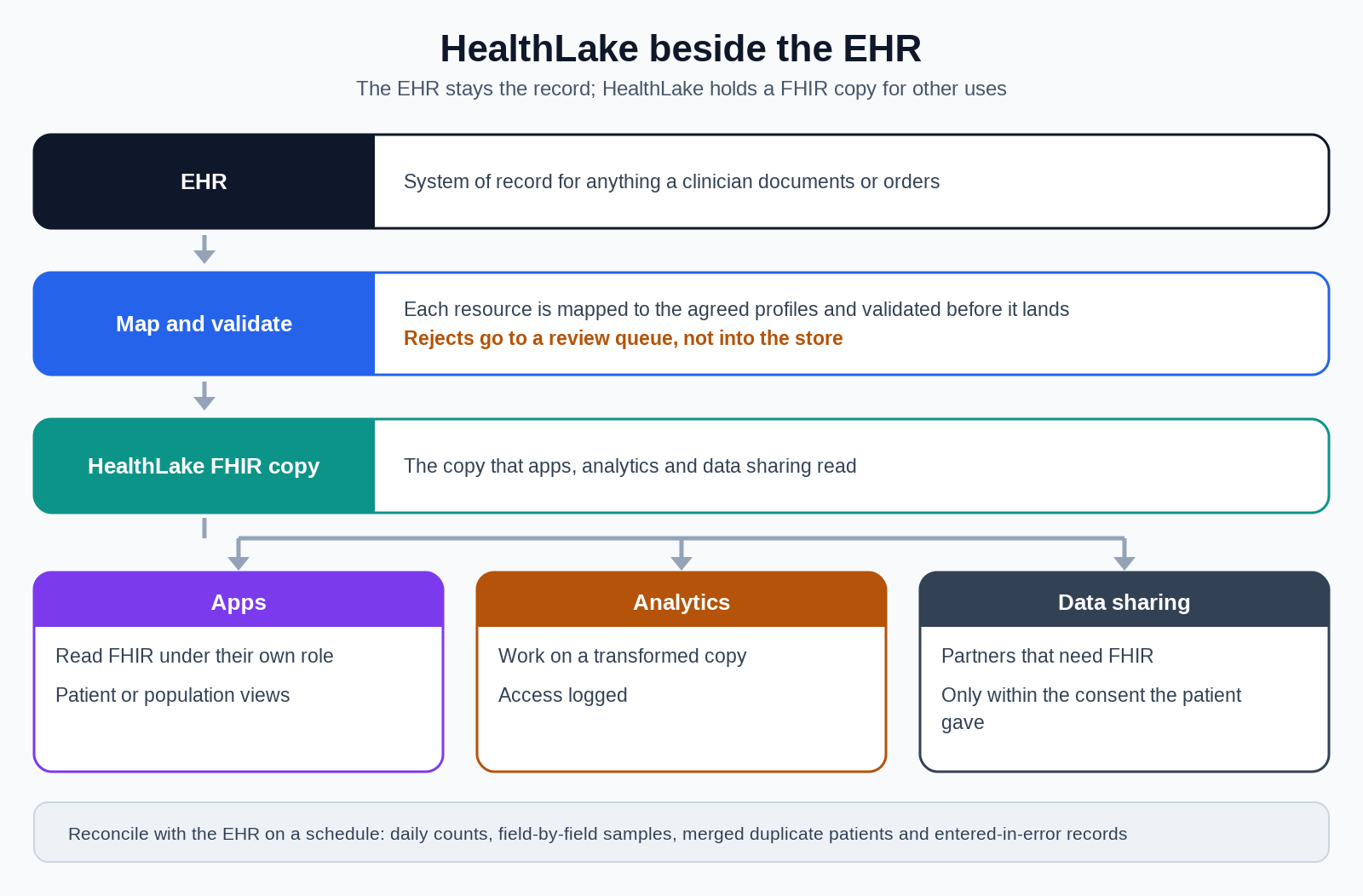
That direction matters for design. Treat the store as read-mostly for clinical data, and decide in writing whether any new data created by your app is ever sent back to the EHR, by which interface and with whose approval.
- System of record: the EHR, for anything a clinician documents or orders.
- FHIR copy: HealthLake, for apps, analytics and data sharing that need FHIR.
- App-owned data: questionnaires or device readings your product creates, stored with a clear plan for whether they return to the chart.
How does data get into the store?
Data gets into the store after you map it from the source format into FHIR resources. An EHR's FHIR API may supply some resources directly, while HL7 v2 feeds, flat files and older documents need a transformation step you build and test.
Plan two paths: an initial load of history and an ongoing feed of changes. The history load proves the mapping on real volume, and the ongoing feed is where most of the long-term work lives, because sources change their formats over time.
Validate resources before they land, not after. Rejected records should go to a review queue with the reason, so a mapping bug does not quietly drop a group of patients from the copy.
Which profiles should the copy follow?
For US data, the copy should follow the US Core profiles wherever a matching resource exists. That keeps the store usable by apps and partners that already expect those profiles, and it gives your validation step a clear target.
US Core is the HL7 FHIR implementation guide that profiles FHIR resources for the USCDI data classes used in the United States.
Where your product needs data that US Core does not cover, add extensions deliberately and document them. Unplanned extensions are hard to remove once several consumers read them.
How do you keep the copy reconciled?
Keep the copy reconciled with scheduled checks that compare it against the source: counts by resource type, samples of individual records and a list of recent merges and deletions. A FHIR copy that silently drifts is worse than no copy, because people trust it.
- Counts: patients, encounters and observations per day, compared with the source.
- Samples: a handful of records checked field by field after each mapping change.
- Merges: duplicate patients merged in the EHR, reflected in the copy.
- Deletions and corrections: entered-in-error records removed or marked in the copy.
Who should be able to query it?
Only the services and people with a stated purpose should be able to query the store, each with its own role and scope. A single shared credential for every app makes the access log useless, because it cannot say who read what.
Give analytics users a de-identified or limited view where the purpose allows it. Keep the identified data behind application roles, and review access grants on a schedule rather than only when someone leaves.
Consent and data sharing
A FHIR copy makes data easier to share, which is exactly why consent has to travel with it. If a patient opts out of a research use or a partner program, the store and every consumer that reads it must respect that choice.
Record consent as data the consumers can check, not as a note in a separate system. Test the opt-out path end to end: a patient withdraws, and the next query from the affected consumer no longer returns that patient's records.
How do you test the store before go-live?
Test the store with known patients whose source records you can inspect line by line. Load them, query them through the same path the app will use, and compare each field with the source.
- A patient with several encounters, including one marked entered in error.
- Two duplicate patients that the EHR later merged.
- Observations with unusual units or missing values.
- A patient who withdrew consent for a named use.
- A record with characters from more than one language in the name.
Repeat the test set after every mapping change and before every new consumer is connected. It is the cheapest way to catch a regression before a partner or an analyst does.
When is HealthLake the wrong choice?
HealthLake is the wrong choice when nothing in the plan needs a FHIR-shaped copy, or when the team needs behavior the managed service does not document. In those cases a direct EHR API call, a relational store or a self-run FHIR server may fit better.
- A small app that only reads a few fields live from one EHR's FHIR API.
- A workload that must run outside AWS or across several clouds.
- A product that depends on custom server behavior beyond what the service documents.
- A team with no plan to maintain the mapping and reconciliation jobs.
Managed store or self-run FHIR server
A managed store removes server upkeep, while a self-run FHIR server gives more control over versions, extensions and hosting. Neither removes the mapping, identity and reconciliation work, which is usually the larger share of the project.
Compare them on the features your consumers need, how upgrades are handled, where data must reside and who on your team will run the system. Ask for current pricing directly from the vendor or your cloud account team rather than relying on old estimates.
What are AWS HealthLake best practices?
AWS HealthLake best practices treat the store as a governed copy: keep the EHR as the system of record, validate against US Core before loading, reconcile on a schedule, and give every consumer its own role.
- Write down which data flows in, which consumers read it and whether anything flows back.
- Validate each resource before it lands, with a review queue for rejects.
- Run count, sample, merge and deletion checks against the source.
- Use separate roles per app and per analytics group.
- Confirm the business associate agreement covers the account before any ePHI arrives.
How Agnotic can help
Agnotic designs and builds FHIR data stores on AWS and elsewhere, including the source mapping, validation, reconciliation jobs and access model. We start with one resource and one source, prove the round trip, then add feeds once the checks are running.
Build a FHIR data store with Agnotic
We map your sources into FHIR, load the store and set up the checks that keep it accurate.
Related reading on Agnotic
FHIR integration, HIPAA for apps on top of the store, and FHIR servers.


