



Many Medicare Advantage plans hand parts of their work to delegated entities: medical groups and independent practice associations that manage utilization, pay claims or credential providers on the plan's behalf. The delegation is a contract. Making it work is a data problem, because the plan stays accountable for work done in someone else's systems.
This post covers the connectivity between plans and delegated entities: which data flows each way, how membership and rules reach the delegate, how authorization decisions, encounters and credentialing come back, and how the plan monitors performance from the data it receives.
What is connectivity for Medicare Advantage delegated entities?
Exchanging data with delegated groups across many systems?
Our payer operations page covers the data exchange and oversight tools we build for health plans.
Connectivity for Medicare Advantage delegated entities is the set of data exchanges between a plan and the groups it delegates work to: membership and rules sent out, and authorization decisions, encounters, claims and credentialing results sent back, with reports the plan uses for oversight. Agnotic Technologies builds these exchanges for plans and delegates.
Under 42 CFR 422.504(i), a Medicare Advantage organization keeps ultimate responsibility for complying with its CMS contract, whatever relationships it has with first tier, downstream and related entities.
Why is delegation a data problem?
Delegation is a data problem because the plan must prove it met its obligations for work it did not do itself. Every decision, payment and credential the delegate handles has to come back as data the plan can check and report.
When a Medicare Advantage organization delegates contract activities, each contract must specify the delegated activities and reporting responsibilities, provide for revocation or other remedies if performance is unsatisfactory, and require the organization to monitor performance on an ongoing basis.
Delegation agreements often describe reporting in a few lines. The connectivity work turns those lines into file layouts, schedules, validation rules and owners.
Which data flows between a plan and a delegate?
Data flows both ways: the plan sends who is covered and under which rules, and the delegate returns what it decided, paid and verified.
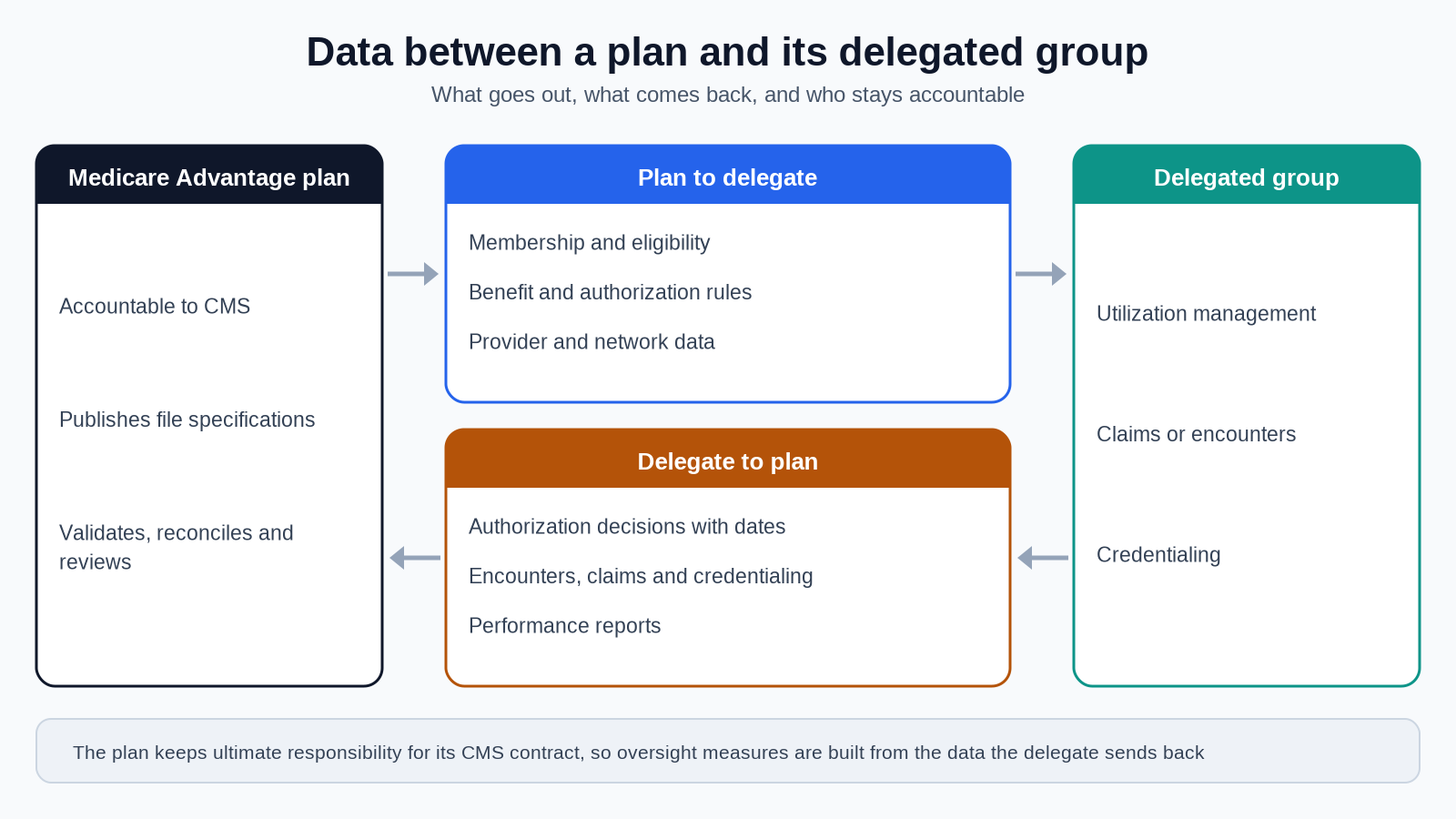
- Plan to delegate: membership and eligibility, benefit and authorization rules, provider and network data.
- Delegate to plan: authorization decisions, encounters and claims, credentialing results.
- Both ways: performance reports, corrections, audit samples and contact lists.
Which activities are delegated, and what data does each need?
Each delegated activity brings its own data needs, so list the activities in the agreement and design the flows from that list.
- Utilization management: membership, authorization rules in, decisions with dates and reasons out.
- Claims: membership, fee schedules and benefits in, paid claims and encounters out.
- Credentialing: provider rosters in, credentialing decisions and dates out.
- Care management: member lists and risk data in, contacts and care plans out.
How should membership reach the delegate?
Send membership as a regular full or change file that the delegate loads and confirms, with each member's plan, effective dates and assigned providers. The delegate should never decide coverage from an out-of-date list.
Reconcile both sides on a schedule: count members by plan and month, list mismatches, and resolve them before they become authorizations or claims for people who are not covered. Send retroactive changes, such as a backdated end of coverage, as their own records so the delegate can review affected cases.
How should authorization decisions come back?
Authorization decisions should come back with the request date, decision, decision date, reason and who made it, so the plan can check timeliness and quality for every case, not just samples.
Under the CMS Interoperability and Prior Authorization Final Rule (CMS-0057-F), Medicare Advantage, Medicaid and CHIP payers must decide prior authorization requests within 72 hours for expedited requests and 7 calendar days for standard requests, starting in 2026.
Delegates making decisions on the plan's behalf need to meet those timeframes, and the plan needs data detailed enough to show they did. Where possible, receive decisions as near-real-time records rather than a monthly file.
Encounters and claims data
Encounter and claims data from the delegate feeds the plan's reporting and payment processes, so completeness and accuracy matter more than speed of any single file.
Validate each file on arrival for format, required fields and member matches, return errors to the delegate quickly, and track corrected records until they are accepted. Compare volumes with past periods to spot missing data. A sudden drop from one delegate usually means a file failed or a code changed, not that members stopped receiving care.
Credentialing and provider data
When credentialing is delegated, the plan still needs the results: which providers were credentialed or recredentialed, when, and with what outcome. Provider directory data must also stay in step with the delegate's own records.
Receive credentialing results as structured records rather than documents, match them to the plan's provider records and flag any provider due for recredentialing who is missing from the file.
How should the plan monitor delegates?
The plan should monitor delegates from the data they send, with measures agreed in the delegation contract and reviewed on a fixed schedule.
- Timeliness: authorization decisions and claims paid within required timeframes.
- Completeness: encounters and claims received against expected volumes.
- Accuracy: errors and corrections by file and by field.
- Credentialing: providers credentialed on time, with exceptions explained.
How should corrections and disputes be handled?
Handle them through a defined cycle: the plan returns an error file with a reason for every rejected record, the delegate corrects and resends, and both sides track each record until it is accepted.
Keep a shared log of disputed records, such as a decision the plan believes was late, with the evidence each side holds. Disputes settled from data are faster than disputes settled from memory.
Onboarding a new delegate
Onboard each new delegate onto the published specifications rather than building a new interface. Walk through each file with the delegate's technical team, exchange test files, and fix every validation error before live data flows.
Run a parallel period in which the delegate sends live files while the plan checks them without relying on them, then sign off each flow separately.
Exchange methods and security
Most plan and delegate exchanges still run on secure file transfer, with APIs used where both sides support them. Choose by flow: files for bulk membership and encounters, APIs or messages for authorizations that need speed.
Protect each connection with encryption, named service accounts and logs of every file sent and received. Keep a business associate or equivalent agreement in place for each delegate that receives member data.
What goes wrong in delegated entity connectivity?
Problems usually come from loose specifications and missing reconciliation. These patterns recur.
- Vague layouts: file formats described in prose and read differently by each side.
- No reconciliation: membership drifts and nobody notices until claims fail.
- Monthly-only data: authorization problems found long after they happened.
- Manual reports: oversight built from spreadsheets the delegate assembles by hand.
- One-off builds: a new delegate needs a new interface instead of a standard one.
A worked example: a plan with several delegated groups
A Medicare Advantage plan delegated utilization management to several medical groups, each sending decisions in its own spreadsheet. Oversight staff spent most of their time cleaning files before they could review anything.
The plan published one file specification for decisions and one for credentialing, with validation rules and an error file returned on each load. Membership went out on a regular schedule with a reconciliation report back.
Oversight moved from cleaning data to reviewing exceptions, and new delegates joined using the same specifications.
Who owns what?
Each flow needs an owner at the plan and at the delegate.
- Plan delegation oversight: measures, reviews and corrective action.
- Plan data and integration team: specifications, validation and connections.
- Delegate operations: decisions, claims and credentialing work.
- Delegate IT: files, APIs and error corrections.
How do you measure the connections?
Measure the health of each flow as well as the delegate's performance.
- Files received on time, by flow and delegate.
- Records rejected on validation, and time to correction.
- Membership mismatches found at each reconciliation.
- Oversight measures available without manual preparation.
What are delegated entity connectivity best practices?
Publish one specification per flow with validation rules, reconcile membership on a schedule, receive authorization decisions with enough detail to check timeliness case by case, and take credentialing results as structured records.
Choose files or APIs by flow, secure and log every connection, build oversight measures from received data, and onboard each new delegate onto the same specifications.
How Agnotic can help
Agnotic builds the connectivity between plans and delegated entities: file specifications and validators, membership reconciliation, authorization and credentialing feeds, secure connections and oversight dashboards built from the data delegates send.
Connect your plan and its delegates with Agnotic
Our health plan page covers the data exchange, API and oversight systems we build for payers.
Related reading on Agnotic
Payer rules, contracts and data exchange.


