



Choosing prior authorization software is harder than it looks. Every vendor shows a clean demo with a request that sails through, and every one says it is ready for the new payer API rules. The differences show up later, in the cases the demo skipped: a payer with unusual rules, a missing note, an EHR that does not pass the data the product needs.
This guide is for health systems, practices and payers choosing a prior authorization product or deciding to build. It covers the three main options, the requirements to write down first, questions to ask about CMS-0057-F readiness, demo scripts, contract terms and how to run a pilot that shows real differences.
What should prior authorization software buyers evaluate?
Choosing how to handle prior authorization?
Our prior authorization AI page covers the request, tracking and payer connection work we build.
Prior authorization software buyers should evaluate how a product handles their own payers, services and EHR data, not a vendor's best case: rule coverage, payer API readiness, how requests are assembled and tracked, and what clinicians still do by hand. Agnotic Technologies helps teams compare options and builds where buying falls short.
Write requirements down before the first demo. Otherwise the vendor's feature list becomes the requirements.
Are you buying as a provider or as a payer?
The answer changes almost everything on the list. A provider needs software that assembles requests from the chart and tracks decisions, while a payer needs software that receives requests, applies its policies and returns decisions on time.
Some products serve one side only, and a few claim both. Ask which side the product's current customers are on, and which side its roadmap favors.
Should you buy, extend your platform or build?
Buy when a product already covers your main payers and services, extend your EHR or payer platform when its built-in tools cover most of the need, and build when your workflow, payer mix or data is unusual enough that neither fits.
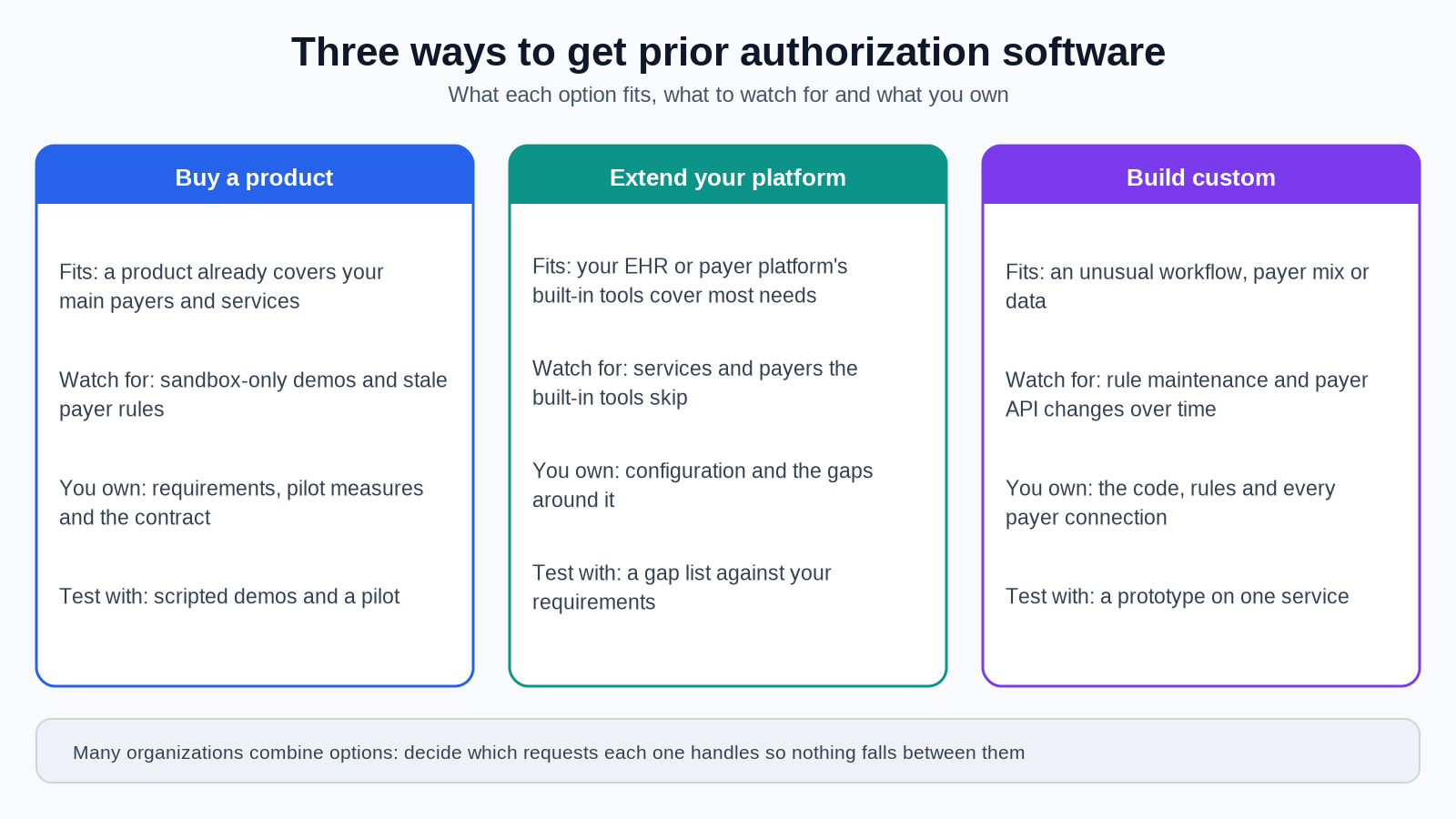
Many organizations mix them: a platform's built-in tools for common requests, plus custom work for the services and payers that cause most of the manual effort. Decide which requests each option will handle, so nothing falls between them.
Test each option in its own way: a product with scripted demos and a pilot, a platform with a gap list against your requirements, and a custom build with a prototype on one service.
Which requirements should you write down first?
Write down the services, payers and volumes that matter, the systems the product must connect to, and the steps that must stay with people. Rank each requirement as must-have or nice-to-have.
- Scope: the services and payers that generate most requests and most delays.
- Systems: EHR, scheduling, payer portals or APIs, document storage and billing.
- People: who submits, who reviews clinical criteria and who handles denials and peer reviews.
- Reporting: what leaders need to see each month.
- Security: hosting, access control, audit logs and the business associate agreement.
What should you ask about CMS-0057-F readiness?
Ask vendors exactly which CMS-0057-F APIs their product supports today, which are planned and when, and which payers they have tested against. A general claim of readiness says little.
CMS-0057-F requires impacted payers to build a FHIR-based Prior Authorization API, along with Provider Access and Payer-to-Payer APIs, with compliance dates generally beginning January 1, 2027.
Under the CMS Interoperability and Prior Authorization Final Rule (CMS-0057-F), Medicare Advantage, Medicaid and CHIP payers must decide prior authorization requests within 72 hours for expedited requests and 7 calendar days for standard requests, starting in 2026.
- Today: which HL7 FHIR implementation guides are in production, and with which payers.
- Fallback: how requests go to payers that are not ready, such as portals, fax or X12.
- Tracking: how decision deadlines are shown to staff and escalated.
- Payer side: for payer buyers, how decisions and reasons are returned and recorded for reporting.
How do you check EHR connectivity?
Check it by asking the vendor to show the product working against your EHR version with your data fields, not a sandbox. Most gaps appear when the product needs data the EHR does not send in a structured way.
Ask how the product launches from the chart, which data it reads and writes, how documents are attached and how the decision gets back into the record. Ask for a reference customer running the same EHR.
What should a vendor demo prove?
A demo should prove the product handles your hard cases, so give every vendor the same scripted scenarios in advance and score them on the same sheet.
- Common case: your highest volume service with your largest payer.
- Missing data: a request where a required note or result is absent.
- Unusual payer: a payer with its own rules and no API.
- Change: a request updated after submission, such as a new service code.
- Denial: the path from a denial to a peer review or appeal.
Rule content and who keeps it current
Payer rules change often, so ask who maintains the product's list of services that need authorization, where the rules come from and how quickly a change reaches customers. A product with stale rules sends requests nobody needs or misses ones that are required.
Ask whether your staff can add or correct rules themselves, whether changes are logged, and how the vendor tells customers about rule updates.
Security, contract and exit terms
Treat the contract as part of the evaluation. The product will hold clinical documents and payer decisions, and you need clear terms for protecting and returning that data.
A HIPAA covered entity may share protected health information with a business associate, such as a software vendor, only under a business associate agreement that commits the vendor to safeguard it.
- Data: who owns requests, documents and decision records, and in what format they are returned.
- Exit: how long data export takes and what it includes.
- Pricing: per request, per provider or per site, and what counts as a request.
- Service levels: uptime, support hours and response times written into the contract.
How should you run a pilot?
Run a pilot on a defined set of services and payers, with a baseline measured before it starts, and compare the same measures afterwards. Without a baseline, every pilot looks like a success.
Choose a department with steady volume, train a small group of users, agree the measures in writing and set a decision date. Include at least one difficult payer, so the pilot is not limited to the easy cases.
What are the red flags in an evaluation?
The warning signs are usually visible early if you look for them.
- Sandbox only: the vendor cannot show the product against your EHR or a real payer.
- Vague readiness: no list of supported APIs and tested payers.
- Hidden services work: rule maintenance or integration billed separately and never priced up front.
- No exit plan: export terms missing or unclear.
- Automation claims without measures: savings promised with no baseline or method.
A worked example: a health system chooses for imaging and surgery
A health system wanted to cut manual work on authorizations for imaging and planned surgery. It wrote requirements, ranked them, and invited three vendors to demo the same five scenarios against its EHR test environment.
One product handled imaging well but had weak rule coverage for its surgical payers; its EHR vendor's tool covered surgery requests but not the imaging workflow. The system piloted the product for imaging and extended the EHR tool for surgery, with custom work to bring both sets of decisions into one report.
Who should be on the evaluation team?
Include the people who will live with the result, not only those who sign the contract.
- Revenue cycle lead: owns the requirements and the decision.
- Authorization staff: score demos against the daily workflow.
- Clinicians: judge what the product asks of them.
- EHR and integration team: test connectivity and data flow.
- Privacy, security and legal: hosting, agreements and exit terms.
How do you know the choice worked?
Compare the pilot and rollout measures with the baseline you captured, by service and payer.
- Time from order to decision, and requests past their deadline.
- Staff time per request and requests handled without manual steps.
- Denials for missing or invalid authorization.
- Visits rescheduled because an authorization was not ready.
What are prior authorization software buying best practices?
Know whether you are buying as a provider or a payer, write and rank requirements first, give every vendor the same scripted scenarios on your own EHR, and ask for a precise list of supported payer APIs and tested payers.
Check who maintains rule content, put data ownership and exit terms in the contract, run a pilot against a measured baseline, and be ready to combine options rather than force one product to do everything.
How Agnotic can help
Agnotic helps health systems, practices and payers decide how to handle prior authorization, and builds what buying does not cover: EHR and payer API connections, rule management tools, decision tracking and reports that bring several tools together.
Build the prior authorization pieces you cannot buy with Agnotic
Our custom healthcare software team builds the integrations, tools and reports around the products you choose.
Related reading on Agnotic
Prior authorization, payers, eligibility and FHIR access.


