



Most denied claims were wrong before they were sent. The coverage had ended, the authorization was never requested, the code pair was bundled or the claim went out after the payer's deadline. Working those denials afterwards costs staff time that a check at the right moment would have saved.
This post groups the most common claim denial reasons by root cause and, for each group, names the software check that prevents it and where in the workflow that check should run: scheduling, registration, charge capture, coding or the claim scrubber before submission.
What are the most common claim denial reasons?
Too many claims coming back denied?
Our claims denial management page covers the AI agents we build to find and prevent denial patterns.
The most common claim denial reasons fall into a few groups: coverage and eligibility problems, missing prior authorization, registration errors, coding and bundling errors, unsupported medical necessity, duplicate claims and late filing. Agnotic Technologies builds the software checks that catch each group before a claim leaves the practice.
X12's Claim Adjustment Reason Codes describe why a claim or service line was paid differently than it was billed; code 27 covers expenses incurred after coverage ended, 197 an absent precertification or authorization, 50 a service not deemed a medical necessity, 18 an exact duplicate and 29 an expired filing time limit.
Why group denials by root cause?
Grouping denials by root cause shows which step in the workflow failed, which is what you need in order to fix it. A list of reason codes on its own tells you what the payer said, not who could have prevented it.
Map each reason code and remark code to a group and to the team that owns that step. A spike in one group then points straight at a front desk, a coding queue or a payer rule that changed.
Where does each check run?
Each check should run at the earliest step that has the information it needs: coverage at scheduling, demographics at registration, codes at charge capture, and payer rules in the scrubber just before submission.
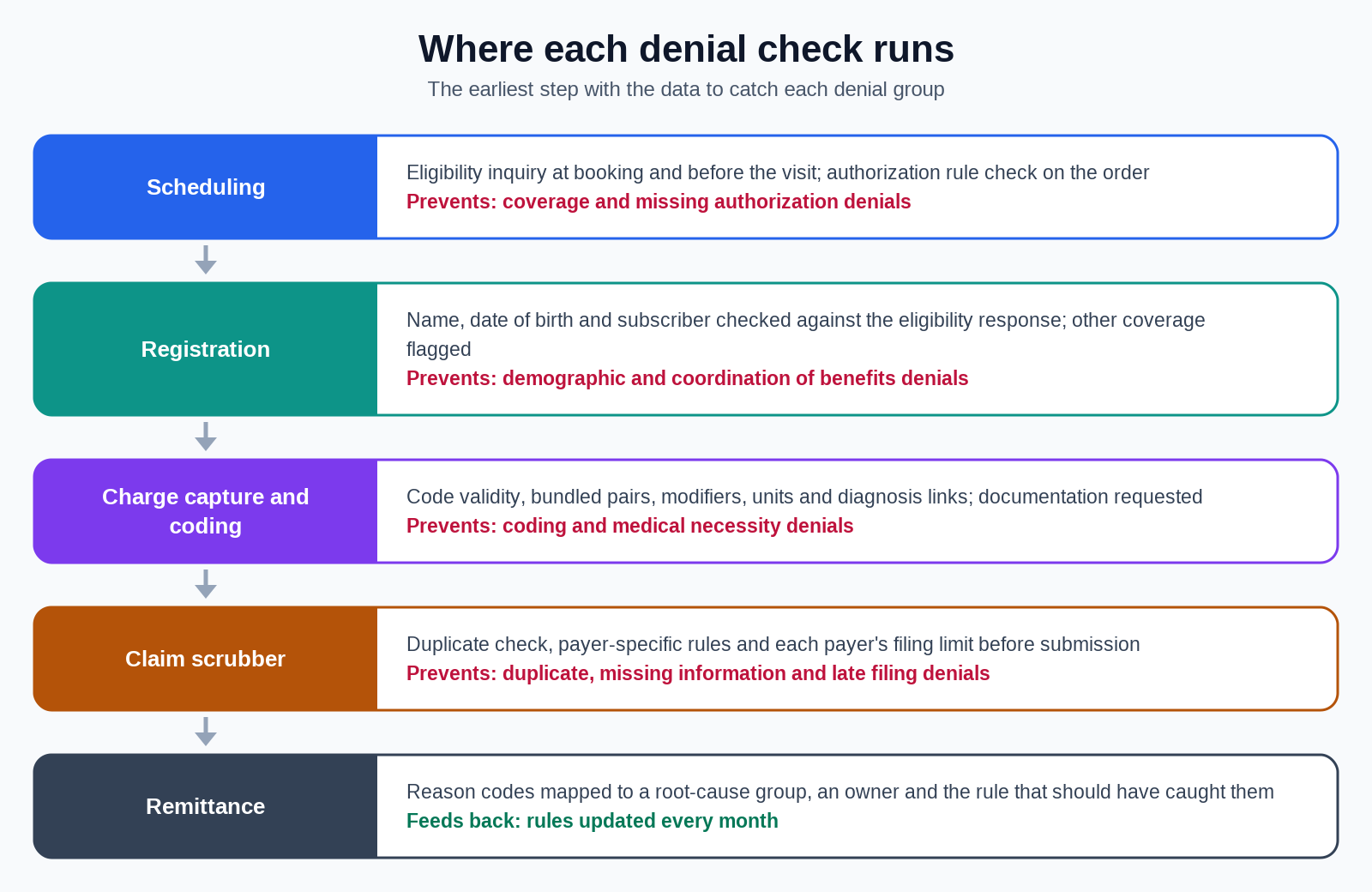
Denials that still get through come back as remittance reason codes. Feeding them back into the rules is what makes the checks better each month.
How do you prevent eligibility and coverage denials?
Prevent them by checking coverage electronically when the visit is booked and again shortly before the visit, and by stopping the claim if the plan on the claim does not match the last response.
HIPAA adopts ASC X12 standards for electronic transactions, including health care claims (837), payment and remittance advice (835), eligibility inquiries (270/271) and prior authorization requests (278).
- Booking check: send an eligibility inquiry when the appointment is made and store the response.
- Pre-visit check: repeat it a few days before the visit to catch terminated or changed coverage.
- Other coverage: flag responses that mention another payer, so coordination of benefits is settled before billing.
- Claim check: block a claim whose payer or member ID differs from the latest response.
How do you prevent missing authorization denials?
Prevent them by holding a list of services that each payer requires authorization for, checking every order or booking against it, and stopping the visit or claim when no approved authorization is on file.
- Rules: payer, plan, service code and place of service, kept current by an owner.
- Order check: flag the order when it is placed, not when the claim is built.
- Match: link each authorization number, approved units and dates to the visit.
- Expiry: warn when the visit date or units fall outside what was approved.
Registration and demographic errors
Registration errors are small mistakes with large effects: a misspelled name, a wrong date of birth or a subscriber recorded as the patient. Validate fields at entry and compare them with the eligibility response.
Flag mismatches between the name or date of birth on file and what the payer returned, require the subscriber's details when the patient is a dependent, and lock registration edits once a claim has been sent.
How do you prevent coding and bundling denials?
Prevent them with code edits at charge capture: checks for invalid or deleted codes, code pairs that payers bundle, missing or wrong modifiers, and diagnosis codes that do not support the procedure.
- Code validity: codes current for the date of service.
- Pair edits: procedure pairs that cannot be billed together without a modifier.
- Units: limits on units per day for each service.
- Link: each procedure tied to a diagnosis that supports it.
Show the coder the reason for each edit and the fix, rather than a bare error. An edit nobody understands gets overridden.
How do you prevent medical necessity denials?
Prevent them by checking the diagnosis and documentation against the payer's coverage policy before the service, when the order is placed, and by asking for missing documentation while the clinician still remembers the visit.
Keep coverage rules per payer and service, prompt the ordering clinician when the diagnosis on the order is not one the policy covers, and route claims that need records attached to a documentation queue before submission.
Duplicates and late filing
Duplicate and late claims are almost entirely preventable with checks in the claim scrubber. A duplicate check compares patient, date of service, provider and codes with claims already sent, and a filing check compares the date of service with each payer's deadline.
For Medicare services furnished on or after January 1, 2010, a claim must be filed no later than the close of the period ending one calendar year after the date of service, with limited exceptions.
Store each payer's filing limit as data, show claims approaching their limit on a worklist, and never resubmit a claim by sending it again from scratch when a corrected claim is what the payer expects.
Other denial groups to check for
A few smaller groups are worth their own checks once the main ones are in place.
- Provider enrollment: the rendering provider is not yet enrolled with the payer.
- Missing information: required fields blank or invalid on the claim.
- Non-covered services: services the plan excludes, which need a patient agreement before the visit.
- Payer-specific formats: attachments or fields a payer requires that others do not.
What goes wrong with denial prevention software?
Prevention tools often fail through stale rules and alert fatigue rather than missing features. These patterns recur.
- Stale rules: payer authorization lists and filing limits never updated.
- Late checks: everything runs in the scrubber, after the patient has left.
- Override by habit: edits so noisy that staff click past all of them.
- No feedback: remittance reason codes never mapped back to the rule that should have caught them.
- One owner for everything: billing blamed for errors made at scheduling.
A worked example: authorization denials in imaging
A multi-specialty group mapped recent remittance reason codes to root-cause groups and found that missing authorizations for imaging were the largest group it could prevent. The orders were placed in clinic and booked by a central team.
The team added a payer authorization rule list, a check when the order was signed and a hold on booking without an authorization number. The team then tracked that group every month, and the denials that remained traced to payers whose rules had changed.
Who owns what?
Each denial group belongs to the team that controls the step where it starts.
- Scheduling and front desk: eligibility, authorization holds and registration.
- Clinicians and documentation staff: diagnosis on orders and supporting notes.
- Coders: code edits, modifiers and diagnosis links.
- Billing: scrubber rules, filing limits, duplicates and resubmissions.
- Revenue cycle lead: mapping of reason codes to groups and monthly review.
How do you measure denial prevention?
Measure denials by root-cause group and payer, and compare them with how often each check fires and is overridden.
- Denial rate by group, payer and location, each month.
- Claims accepted on first submission.
- Checks fired, resolved and overridden, by rule.
- Claims near their filing limit and claims lost to it.
What are claim denial prevention best practices?
Map every remittance reason code to a root-cause group and an owner, run each check at the earliest step that has the data, and keep payer rules for authorization, coverage and filing limits as data with a named owner.
Explain every edit in plain words, review override rates, and feed each month's denials back into the rules so the same reason stops coming back.
How Agnotic can help
Agnotic builds denial prevention into billing workflows: eligibility checks at booking, authorization rule lists, code edits at charge capture, scrubber rules for duplicates and filing limits, and reason code mapping that feeds results back into the rules.
Build denial checks into your billing software with Agnotic
Our medical billing software page covers the claim, scrubbing and remittance systems we build.
Related reading on Agnotic
Denials, eligibility, authorization and claims integration.


