



Prior authorization automation is not a bot that decides medical necessity. It is the unglamorous work of finding out whether a payer wants a review, pulling what the chart already knows, asking a person only for the missing piece, and filing a request that comes back as approved, denied, or incomplete.
CMS-0057-F pushes impacted payers toward a FHIR Prior Authorization API. The HIPAA transaction for this conversation is still the X12 278 unless a specific enforcement policy says otherwise. This guide splits the work: what software can assemble, what Da Vinci PAS submits, and what a clinician still has to own. It does not promise faster approvals than a payer's policy allows.
What can prior authorization automation actually do?
Automating prior authorization in the chart?
Agnotic Technologies builds the prior authorization workflow: requirement check, documentation, submission, and the decision written back to the order.
Prior authorization automation assembles what the chart already knows, asks the payer whether a review is required, collects missing documentation, and submits a request the payer can answer. CMS-0057-F pushes impacted payers toward a FHIR Prior Authorization API. A clinician still owns the judgment the rule cannot make.
If the software cannot name the order, the coverage, and the payer, it is not ready to submit anything. Automation starts at that match. It ends when the decision is stored on the same order scheduling and billing will read. A PDF in a workqueue nobody checks is the old process with an extra login.
How do CRD, DTR, and PAS divide the work?
Coverage Requirements Discovery asks what the payer needs, Documentation Templates and Rules collects it, and Prior Authorization Support submits the request. They are three Da Vinci guides, not one button.
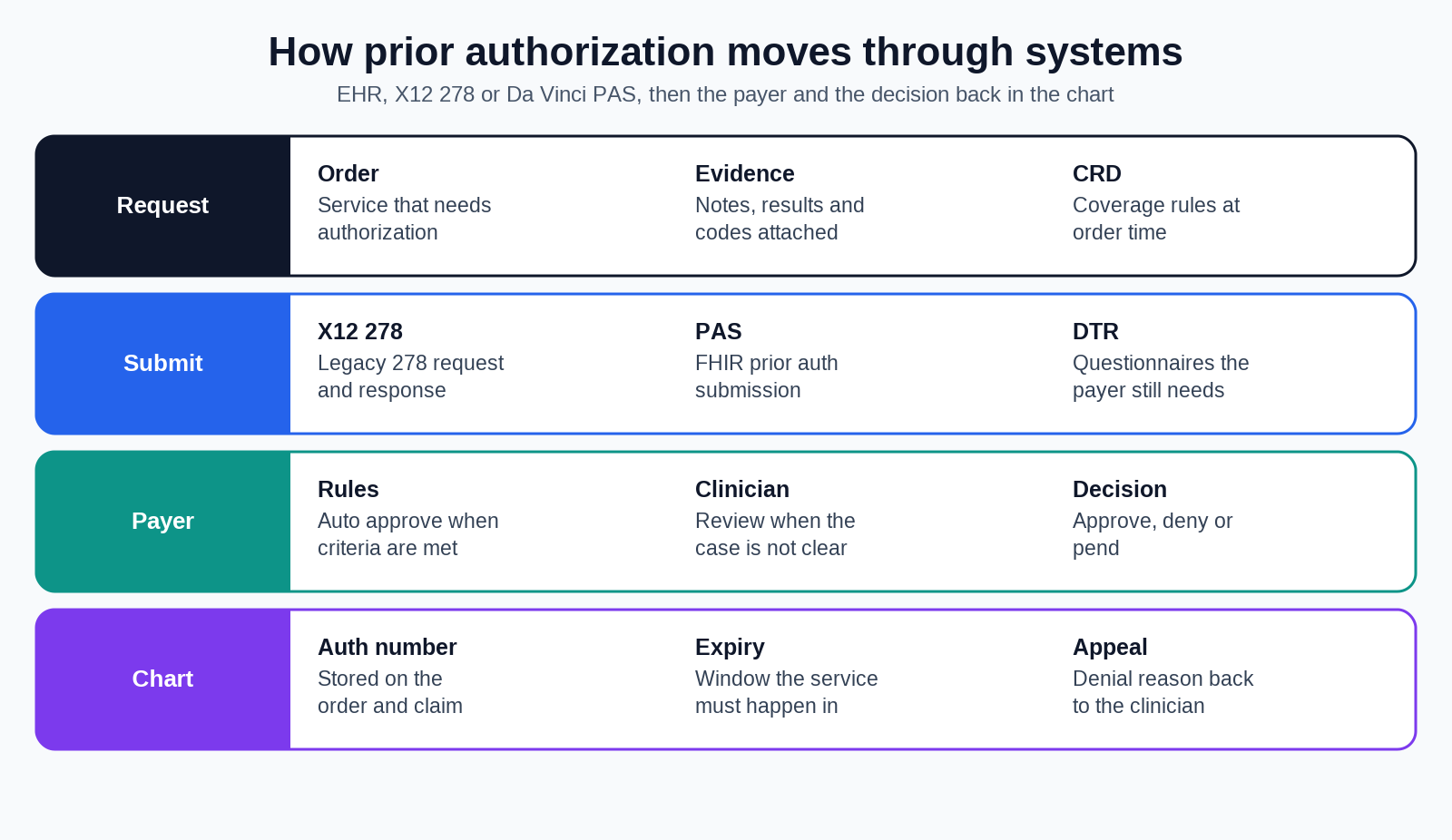
- CRD: While the clinician is still in the order, ask whether this payer requires prior authorization and what documentation is expected.
- DTR: Turn that answer into questions. Pre-fill from the chart. Show the clinician only the gaps.
- PAS: Submit a FHIR Bundle whose Claim is the prior authorization request. Receive a ClaimResponse.
- X12 278: The HIPAA transaction an intermediary may still send to a payer that has not taken a FHIR-only request.
- Write-back: Store the decision, the end date, and the reason on the order. Scheduling reads that, not the payer portal.
The Da Vinci PAS guide defines submission as a Claim $submit operation. The client sends a Bundle that contains a Claim, which FHIR uses for the prior authorization request, plus the patient, coverage, and supporting resources needed to populate the X12 278. The guide names the X12 transactions it supports: 005010X217 for the request and response, and 005010X215 for inquiry and response. Mapping details are published by X12, not inside the FHIR guide, because X12 licenses that material.
What does CMS-0057-F require, and of whom?
CMS-0057-F requires impacted payers to offer a Prior Authorization API. It does not require every provider to build one. A provider system still has to call the payer's API if electronic prior authorization is going to happen inside the chart.
CMS's fact sheet on the rule names the impacted payers: Medicare Advantage organizations, state Medicaid and CHIP fee-for-service programs, Medicaid managed care plans, CHIP managed care entities, and QHP issuers on the Federally Facilitated Exchanges. API requirements, including the Prior Authorization API, generally begin January 1, 2027, with the exact date depending on payer type. The API must be populated with covered items and services that require prior authorization, excluding drugs. It must identify the documentation needed, support a request and response, and return an approval with the date or circumstance when it ends, a denial with a specific reason, or a request for more information. The fact sheet names HL7 FHIR, US Core, and SMART App Launch as the technical standards, and the rule text ties them to the versions adopted at 45 CFR 170.215.
- Payer build: The API, the list of services that need auth, and a specific denial reason. That is the payer's obligation.
- Provider build: Call that API from the order, keep the auth number on the encounter, and do not drop the case when the payer is outside the rule.
- Drugs: The fact sheet excludes drugs from this API's item list. Pharmacy prior authorization stays a separate workflow.
- Patients: Impacted payers also add prior authorization information, excluding drugs, to the Patient Access API on the same general timeline.
Where does the X12 278 still matter?
The X12 278 remains the HIPAA standard for referral certification and authorization requests from dental, professional, and institutional providers. A FHIR request still has to land somewhere a payer's HIPAA transaction can accept, unless the enforcement policy CMS described applies to that implementation.
45 CFR 162.1302 sets the standards for the referral certification and authorization transaction: the ASC X12 278 for dental, professional, and institutional requests, and an NCPDP standard for retail pharmacy drugs. In the CMS-0057-F fact sheet, HHS says it will use enforcement discretion so that covered entities implementing an all-FHIR Prior Authorization API under the rule, without the X12 278 as part of that API, will not be enforced against under HIPAA Administrative Simplification for that gap. Covered entities may still use the X12 transaction, or a combination. Read that as a narrow discretion tied to this API, not as a repeal of the 278. An intermediary that converts PAS to a 278 is still a normal design when the payer requires it.
What should stay with a clinician?
A clinician still decides medical necessity, answers what the chart does not contain, and chooses what to do when the payer pends or denies. Software can assemble the file. It cannot own the clinical judgment.
- Necessity: The reason this patient needs this service, when it is not already a structured order field.
- Exceptions: Urgent cases, peer-to-peer review, and appeals. Those are conversations, even if the status is tracked in software.
- Incomplete data: A questionnaire item with no chart value is a question for a person, not a guess by a model.
- Denial handling: A specific reason, which the rule tells payers to send, is the start of an appeal. It is not an automatic resubmit.
- Drugs and carve-outs: Benefits the medical prior-auth API does not cover.
What has to be in the chart before a request can be assembled?
The order, the coverage, the performing provider, and the coded service have to exist before PAS can build a honest request. Missing any one of them, the automation should stop and show the gap.
- Coverage: Active coverage for this payer, not a card scanned onto a different patient.
- Service: A code the payer's 'requires auth' list can match. Free text will not.
- Diagnosis context: The conditions already on the chart that the questionnaire asks for. Do not create a diagnosis just to pass a form.
- Attachments: Imaging or notes the DTR questionnaire names, referenced, not pasted into a comment.
- Identity: The same FHIR Patient the order uses. A duplicate patient sends the auth to a chart scheduling will not open.
Where do automated prior authorization builds fail?
They fail when the happy path is the only path: synchronous approval, one payer, and a chart that already has every answer. Real queues are pending, partial, and payer-specific.
- Portal leftover: Staff keep a payer website because the write-back never stored the auth number on the order.
- Pended forever: The PAS guide expects a response, including inquiry for status. A build that cannot poll will hide the case.
- Wrong benefit: Medical prior auth is submitted for a drug, or the reverse.
- Double submit: A timeout retries and the payer now has two requests.
- Stale rules: CRD is skipped and the team hard-codes last year's documentation list.
- No clinician stop: The app submits with empty answers rather than blocking on a required gap.
The PAS specification describes a synchronous goal, on the order of a short round trip, and also defines inquiry, update, and cancel because many decisions are not instant. Build the pending state first. The instant approval is the easy demo.
Give every request a stable id before the first submit. If the call times out, inquire with that id instead of creating a second Claim. Write the payer's auth number, the end condition, and the denial reason onto the order as soon as they arrive, including when they arrive hours later through inquiry. Scheduling should be unable to move a case to 'ready' while that order is still pending or denied, unless a clinician explicitly overrides and the override is stored. Keep drug authorizations and payers outside CMS-0057-F on a visible exception list so staff do not treat a missing API response as a denial.
How do you measure the workflow without invented savings?
Measure counts you can audit: requests submitted electronically, requests still sent by fax or portal, decisions written back to the order, and cases waiting on a clinician because data was missing. Do not publish a percent saved you cannot tie to those counts.
- Submission rate: Electronic PAS or 278 versus portal and fax, by payer.
- Write-back rate: Decisions that appear on the order without a second typing step.
- Pend age: How long a request sits in 'more information' before a person answers.
- Duplicate rate: Source request ids that the payer received twice.
- Exclusion list: Drug auths and payers outside CMS-0057-F, tracked so they are not called failures of the API.
How Agnotic can help
Agnotic Technologies builds prior authorization into the clinical and billing workflow you already run. Agnotic connects CRD and DTR where the payer supports them, submits through Da Vinci PAS, maps to an X12 278 when the trading partner still requires it, and writes the decision back to the order. We leave the pending state, the idempotent request id, and the counts above. We do not replace the clinician's judgment on necessity or appeal.
For payer teams, we implement the Prior Authorization API CMS-0057-F describes: the service list, the documentation requirements, and a response that approves, denies with a reason, or asks for more information.
Design the prior authorization path
Review CRD, DTR, and PAS with an engineer, or read more revenue-cycle guides.
Related reading on Agnotic
Claims software, the billing process, FHIR implementation, and US Core.


