Teams say they 'support FHIR' and then discover they have implemented five resources, ignored search, and described the server with a PDF instead of a CapabilityStatement. The partner's app fails on the first query because the profile URL in meta.profile was never agreed.
FHIR components and resources are the parts you have to name before that happens. This guide is the map: what a resource is, what a profile adds, when a bundle or an operation is the right wrapper, and how US Core sits on FHIR R4. Individual resources such as Patient or Observation get their own deeper treatment elsewhere. Here the goal is to see the whole assembly.
What are FHIR components and resources?
Standing up a FHIR server?
Agnotic Technologies builds HL7 FHIR APIs, US Core profiles, and SMART on FHIR access so partners can see what the server actually supports.
FHIR components and resources are the parts you assemble to exchange health data: resources hold the data, profiles constrain them, bundles group them, operations run named actions, and a CapabilityStatement tells a partner what the server actually supports. A map of those parts is what keeps a FHIR project from mixing base resources with US Core rules.
HL7 FHIR R4 is the version most US exchange still targets, and HL7 publishes the R4 resource list as the catalog of types a server might offer. The catalog is grouped so implementers can see clinical resources, identification and workflow resources, financial resources, and the conformance resources that describe the server itself. You do not implement the catalog. You implement the slice a use case needs, and you declare that slice. Anything you return that the declaration does not mention will surprise the client, and anything you declare and do not return will fail certification tests and partner tests alike.
What does a FHIR resource actually contain?
A resource is one typed packet of data with an identity, a small set of common technical fields, and a body defined by that type. Patient, Encounter, Condition, Observation, and MedicationRequest are resources. 'The chart' is not a resource. It is a graph of them.
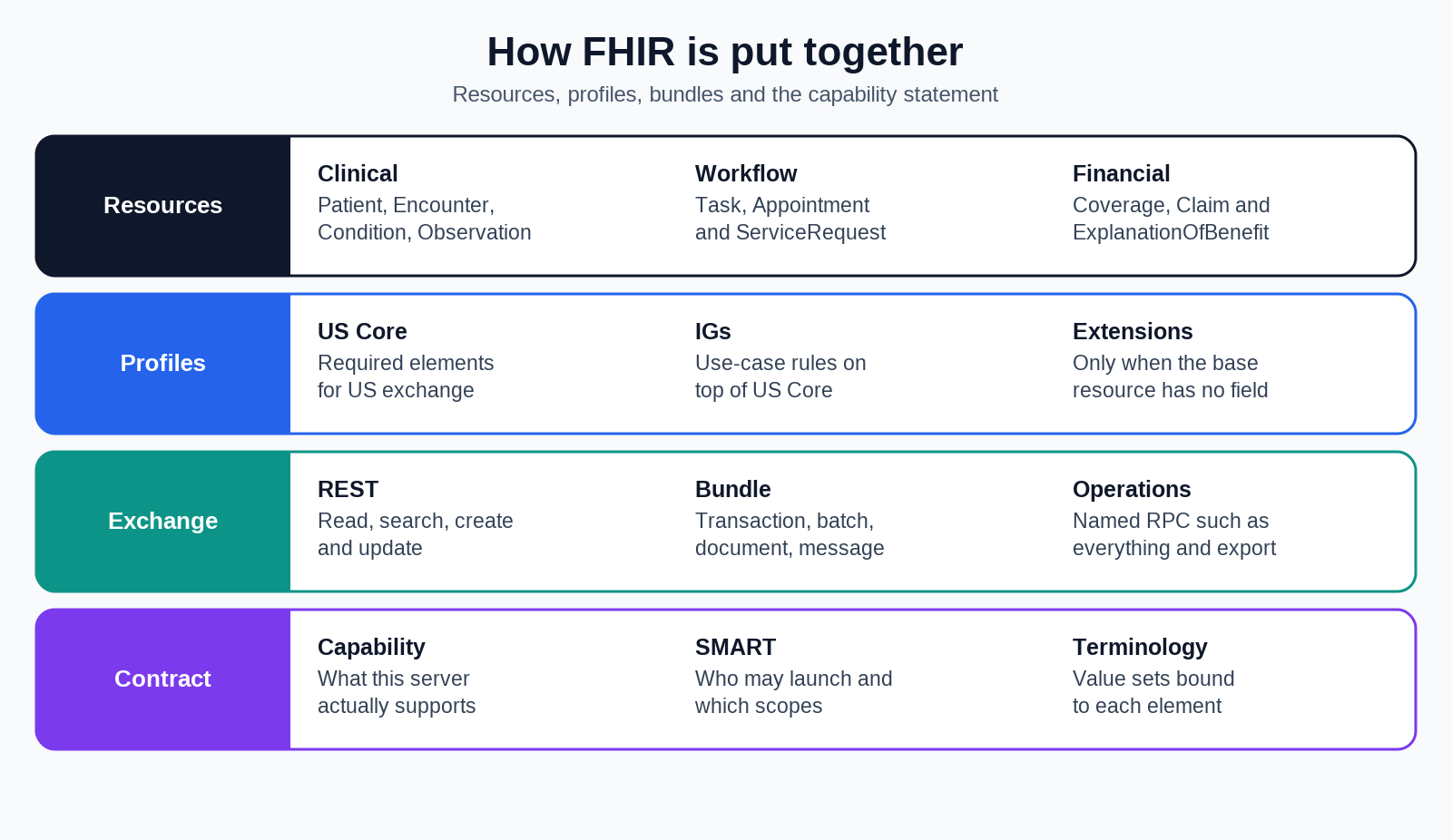
Every resource can carry an id, metadata such as last updated and a profile URL, and narrative text. The clinical body is different per type. An Observation holds a code, a value, and a subject. A Condition holds a code and a clinical status. References point at other resources by their ids. That graph is the chart you will reassemble. If you flatten everything into one custom resource because the graph feels inconvenient, you have left FHIR, and every partner library will fight you. Keep the types HL7 defined. Put local extras in an extension with a URL you published, not in a field you invented on Patient.
- Identity: A stable id for the resource on this server, plus the business identifiers inside the body.
- Meta: lastUpdated, version, and the profile URLs you claim the instance follows.
- Narrative: A human-readable summary. Do not hide the only copy of a result in the narrative alone.
- Body: The elements the resource type defines. Extra meaning goes in a published extension.
- References: Links by id to Patient, Encounter, and other resources. Names are not links.
How do profiles differ from base resources?
A base resource is the HL7 definition of a type. A profile is a StructureDefinition that constrains that type for a use case: required elements, tighter terminology, and slices of a repeating field. The instance is still that resource. The profile says which narrower shape you promise.
US Core is a set of profiles on FHIR R4, not a different data format. A US Core Patient is a Patient that meets the US Core constraints. If your server claims the profile, the instance should carry that claim in meta.profile and should actually populate the must-support elements. Claiming the profile and omitting a required identifier is a defect, not a documentation issue. Profiles also bind terminology. A Condition profile that expects SNOMED CT allows a local text-only code only as a fallback for legacy data, and most receivers cannot use it. When you need a constraint US Core does not have, write your own profile that starts from US Core or from the base resource, and publish the URL. Do not fork Patient quietly.
When do you use a bundle, an operation, or a search?
Use search to find resources that already exist. Use an operation when the server must compute something that is not a plain read or search. Use a bundle when several resources travel together as one unit: a search result, a transaction, a document, or a message.
These are different tools, and mixing them up is the usual design bug. A search for Observation returns a Bundle of type searchset. A transaction Bundle submits a set of creates and updates that succeed or fail together. A document Bundle is a snapshot with a Composition at the front. An operation, named with a dollar sign such as Patient/$everything, is for a defined behavior that search cannot express cleanly.
- Search: GET with parameters, response in a searchset Bundle. Use this to list a patient's labs.
- Read: GET by id when the client already knows the resource.
- Transaction: A Bundle that commits several writes together. Partial success is a batch, not a transaction.
- Document or message: A Bundle with a defined first resource when the exchange is a snapshot or a message.
- Operation: A named action, declared in the CapabilityStatement, when search and CRUD are the wrong shape.
What does a CapabilityStatement decide?
A CapabilityStatement decides what a partner is allowed to believe: which resources, which interactions, which search parameters, which operations, and which profiles the server actually implements. A slide that says 'FHIR R4' decides none of that.
CapabilityStatement is itself a resource on the FHIR R4 list, and servers expose it at the metadata endpoint. For each resource you support, it records the interactions (read, search, create, update) and the search parameters you honor. If US Core requires a search you do not support, you do not claim that profile's interaction. Partners and test suites read this resource. Humans should too, before a contract says the integration is done. Keep the statement generated from the same configuration that runs the server. A hand-edited CapabilityStatement that drifted from the code is worse than a short one that is true. SMART on FHIR security, such as the authorization endpoint and the scopes, belongs in this description as well, so an app can discover how to ask for access instead of hard-coding a URL from an email.
How does US Core sit on top of FHIR R4?
US Core sits on FHIR R4 as the US floor: a set of profiles, searches, and interactions that make patient data exchange predictable. It does not replace the R4 spec, and it does not implement itself because you returned JSON.
The US Core implementation guide states that it is based on FHIR R4 and that it defines the minimum constraints on resources, including which elements must be present and how they are used, plus the RESTful interactions for accessing patient data. You can support profiles alone, or profiles plus those interactions. Say which one you did. A server aimed at ONC certification and at USCDI exchange is expected to take US Core seriously: Patient plus the clinical resources you hold, must-support elements populated, and search parameters that match the guide. Resources outside US Core, such as a scheduling or financial type the guide does not profile, can still be offered as base FHIR R4. Label them that way in the CapabilityStatement so a client does not assume a US Core shape that does not exist.
- Base: FHIR R4 resource definitions and the REST rules in the HL7 spec.
- Floor: US Core profiles and the interactions the guide requires for the resources you claim.
- Claim: meta.profile on instances, and supportedProfile in the CapabilityStatement.
- Outside the floor: Other R4 resources are allowed. Do not pretend they are US Core.
- Version: Name the US Core version you tested. 'US Core' without a version is not a target.
Which components should a new server implement first?
Implement Patient, the one clinical resource your first app must read, search on those two, and a CapabilityStatement that tells the truth about both. Add write, operations, and more resources when a use case demands them, not when the resource list makes them look unfinished.
A first server that tries to expose every R4 type will expose them badly. Start with identity: Patient search by the identifiers your callers actually have. Then one clinical read, often Observation for labs and vitals or Condition for the problem list, with the US Core profile if that is the promise. Include the security discovery if apps will connect with SMART on FHIR. Prove it with a client that is not yours. Only then add Encounter, MedicationRequest, or a transaction Bundle. Operations such as $everything are a convenience for a client that wants a package, and they are a performance problem if you offer them before the single-resource reads are solid. Write the order down so stakeholders do not treat the R4 catalog as a backlog.
What mistakes mix the map up?
The mistakes are category errors: using a profile URL you do not meet, returning a Bundle where a client asked for one resource, inventing search parameters you did not declare, and treating SMART scopes as if they were resource definitions. Each one looks small in a demo and fails in a partner test.
Another mix-up is versioning. FHIR R4, R4B, R5, and R6 are not drop-in replacements, and US Core tracks R4. A client generated from R4 will not forgive an R5-only element. Pin R4 unless you have a written reason and a partner on that other version. Do not put C-CDA narrative in a Binary resource and call the server complete. Do not encode a claim adjudication as an Observation because Observation was already built. The map exists so each fact has a type. When no type fits, an extension or a clearly named operation is the honest path. A custom resource with a friendly name is a private standard.
How Agnotic can help
Agnotic Technologies builds the FHIR server and the client integrations for the product or the health system: the resource slice, the US Core profiles you actually populate, the CapabilityStatement generated from the running server, and SMART on FHIR so an app can be authorized for those resources and no others.
The work starts from the map, not from a sample Patient JSON. Agnotic writes down which components the first release includes, which FHIR R4 types stay out, and which partner will prove the declaration is true.
Declare what your server really does
Plan a FHIR build with our engineers, or read the FHIR guides.
Related reading on Agnotic
How to navigate the FHIR standards landscape, implementation guides, US Core, and which standard to choose.