Hospitals & health systems
Unifying admissions, beds, inventory, and billing across departments.


We build hospital management systems that run the operational spine of the facility (admissions, bed management, inventory, and billing) unified on one FHIR-native platform that talks to your clinical record.
Trusted by global innovators









A hospital management system (HMS) is the software that runs a hospital's operations: registration and admissions, bed and ward occupancy, pharmacy and supply inventory, and billing and claims. Agnotic Technologies builds custom hospital management systems for hospitals and health systems, connected to the EHR through HL7 v2 and HL7 FHIR so operational and clinical data stay in sync.
When admissions, beds, inventory and billing run on disconnected tools, patients wait for beds, supplies stock out and revenue leaks. We unify them on one FHIR-native core, so a bed assignment, a medication dispense and a charge are one connected flow.
What it is
A hospital management system is the platform that runs a facility's operations (admissions and patient flow, bed and ward management, inventory and pharmacy supply, and billing and claims) with administrative visibility across all of it.
We build HMS platforms that unify these modules on a FHIR-native core and integrate with the EHR via HL7 v2 and FHIR, so operational and clinical data stay in sync.
A unified HMS architecture connecting admissions, bed and ward management, inventory, and billing on a FHIR-native core wired to the EHR.
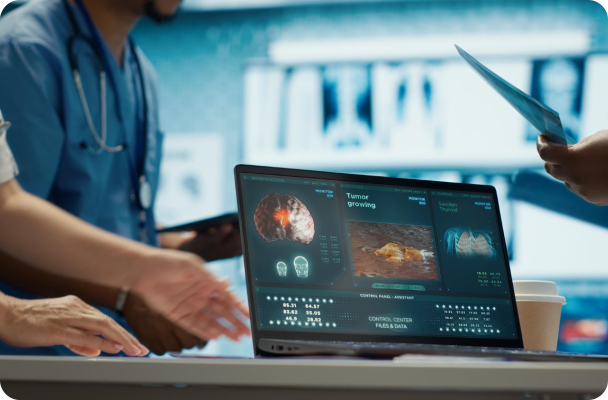
The operational modules a hospital runs on, connected to the clinical record instead of siloed.
Registration, ADT (admission-discharge-transfer) tracking via HL7 v2, and end-to-end patient flow from the front desk to discharge, with real-time census visibility for administrators.
Live bed and ward occupancy, transfer and turnover tracking, and capacity dashboards so charge nurses and bed managers can place patients quickly and cut boarding time.
Hospital inventory management software for pharmacy, consumables and assets, with par-level reordering, lot and expiry tracking, and charge capture on dispensed items, so supplies are available and every usable charge is billed.
Charge capture, invoicing, and claims generation with X12 837 submission and 835 remittance posting, plus X12 270/271 eligibility, connecting operational events to revenue.
HL7 v2 and FHIR R4 integration with your EHR, lab, and radiology systems, so clinical orders, results, and operational status stay synchronized across the facility.
Dashboards and forecasting for occupancy, length of stay, throughput, and inventory demand, turning operational data into decisions administrators can act on.
Where it fits
Facilities that need their operations connected rather than run on disjointed tools.
Unifying admissions, beds, inventory, and billing across departments.
Coordinating operations across diverse service lines under one platform.
Groups moving off aging, unsupported operational systems.
Standing up operations on a modern, integrated platform from the start.
Managing throughput, inventory, and billing for focused facilities.
Standardizing operations and reporting across multiple sites.
The value of an HMS is in the connections: when a bed, a supply, and a charge share one flow, throughput and revenue both improve.

Health Insurance Portability and Accountability Act
Protect PHI with privacy-first architecture, encrypted storage and transmission, strict access controls, and traceable audit logs.

General Data Protection Regulation
Implement lawful consent flows, data minimization, retention controls, and secure processing for sensitive health data.

Fast Healthcare Interoperability Resources
Enable standardized health data exchange across apps, care teams, and systems through standards-based FHIR APIs.

Health Level Seven International
Support enterprise-grade interoperability with HL7-based integrations for records, events, and clinical messaging workflows.

Health Information Trust Alliance
Align security programs to healthcare-specific control and risk management practices trusted by providers and ecosystem partners.

Health Information Technology for Economic and Clinical Health Act
Design with breach notification readiness, digital record safeguards, and operational controls that support regulated care programs.

FDA Software as a Medical Device
Plan software quality, traceability, and documentation pathways for products that may require SaMD review and submission.

Medical Device Regulation (European Union)
Prepare EU market-ready processes for risk classification, evidence tracking, and lifecycle governance under MDR expectations.

Substance Abuse and Mental Health Services Administration
Apply confidentiality controls and consent-aware sharing models for behavioral and mental health data experiences.
Standards and compliance
We connect the operational modules to the clinical record from the start, so the hospital runs as one system.
We map admissions, bed, inventory, and billing workflows and your existing systems, then design the unified data model and integration plan.
We build admissions, bed and ward management, and inventory on the FHIR-native core, with role-based access and audit logging.
We build charge capture and X12 claims, and integrate the EHR, lab, and pharmacy systems via HL7 v2 and FHIR.
Phased go-live by department with training, dashboards, and support as the facility moves onto the platform.
Supply cost worksheet
A manual supply process costs a hospital the expired stock it writes off, what its stockouts cost and the staff hours spent counting. Add up the lines below with your own figures for a yearly business-case cost; we supply no rates or benchmarks.
Expired units removed per year x unit cost. Take it from your write-off log by item, so lot and expiry tracking can be sized against the losses you actually have.
Stockout events per year x your cost per event, such as an urgent courier order, a substitute item or a delayed case. You set the cost per event, because it differs too much between hospitals to estimate.
Hours spent on manual counts per year x the loaded hourly cost of the staff who do them.
The three lines added together. Set it beside the cost of par-level reordering, barcode scanning and expiry alerts in the HMS inventory module.
The clinical impact of a stockout, the carrying cost of excess stock and recall handling. List them next to the total rather than putting a price on them.
Short facts we design around, each linked to its primary source.
The HIPAA Security Rule requires administrative, physical and technical safeguards for electronic protected health information.
Source: 45 CFR Part 164 Subpart C (eCFR)HIPAA adopts ASC X12 standards for electronic transactions, including health care claims (837), payment and remittance advice (835), eligibility inquiries (270/271) and prior authorization requests (278).
Source: 45 CFR Part 162 (eCFR)HL7 FHIR is a standard published by HL7 International for exchanging health data through RESTful APIs built on defined resources such as Patient, Observation and MedicationRequest.
Source: HL7 International (hl7.org/fhir)A HIPAA covered entity may share protected health information with a business associate, such as a software vendor, only under a business associate agreement that commits the vendor to safeguard it.
Source: 45 CFR 164.502(e) and 164.504(e) (eCFR)Related proof of compliant delivery: for Lera Health we built connected, compliant data workflows on a privacy-first platform. It is not a hospital system, but it demonstrates the interoperability and PHI discipline an HMS build requires.

We build the operational backbone connected to the clinical record: one system, not a stack of disconnected tools.
Admissions, beds, inventory, and billing on one platform, so operational events flow together instead of being reconciled later.
HIPAA-aligned access control and immutable audit logging across every operational and financial action.
HL7 v2 and FHIR integration expertise so the HMS stays in sync with your EHR, lab, and pharmacy systems.
We understand throughput, revenue cycle, and clinical operations, so the system fits how a hospital actually runs.

Tell us your facility and systems. We'll return a modular HMS plan connecting admissions, beds, inventory, and billing on a FHIR-native core.
contact@agnotic.com
Partnerships
contact@agnotic.com