



Hosting providers advertise "HIPAA compliant servers", but no server is compliant on its own. Compliance depends on the agreement you sign, the services you use, and how your team configures and runs them.
This post explains what HIPAA compliant hosting means in practice: the agreement, the shared responsibility split, and the controls you build on top of the provider's infrastructure. It is written for teams putting an application with patient data into the cloud or a data center for the first time.
What is HIPAA compliant hosting?
Building an application that will hold ePHI?
Our HIPAA compliant development service covers the hosting, controls and evidence a health product needs.
HIPAA compliant hosting is infrastructure run under a business associate agreement, using services the provider covers under that agreement, and configured with the safeguards the HIPAA Security Rule requires. Agnotic Technologies treats it as a shared job: the provider secures the facility and platform, and the customer secures everything built on it.
HIPAA defines a business associate as a vendor that creates, receives, maintains or transmits protected health information for a covered entity, so a cloud service that maintains ePHI falls inside the definition.
What should the hosting agreement cover?
The business associate agreement comes first. Without it, ePHI should not go to the provider at all.
A HIPAA covered entity may share protected health information with a business associate, such as a software vendor, only under a business associate agreement that commits the vendor to safeguard it.
- Covered services: many providers list which of their services the agreement covers. Use only those for ePHI.
- Breach duties: how and when the provider tells you about an incident.
- Subcontractors: whether the provider's own vendors are bound to the same terms.
- Exit: how data is returned or destroyed when the contract ends.
Who is responsible for what?
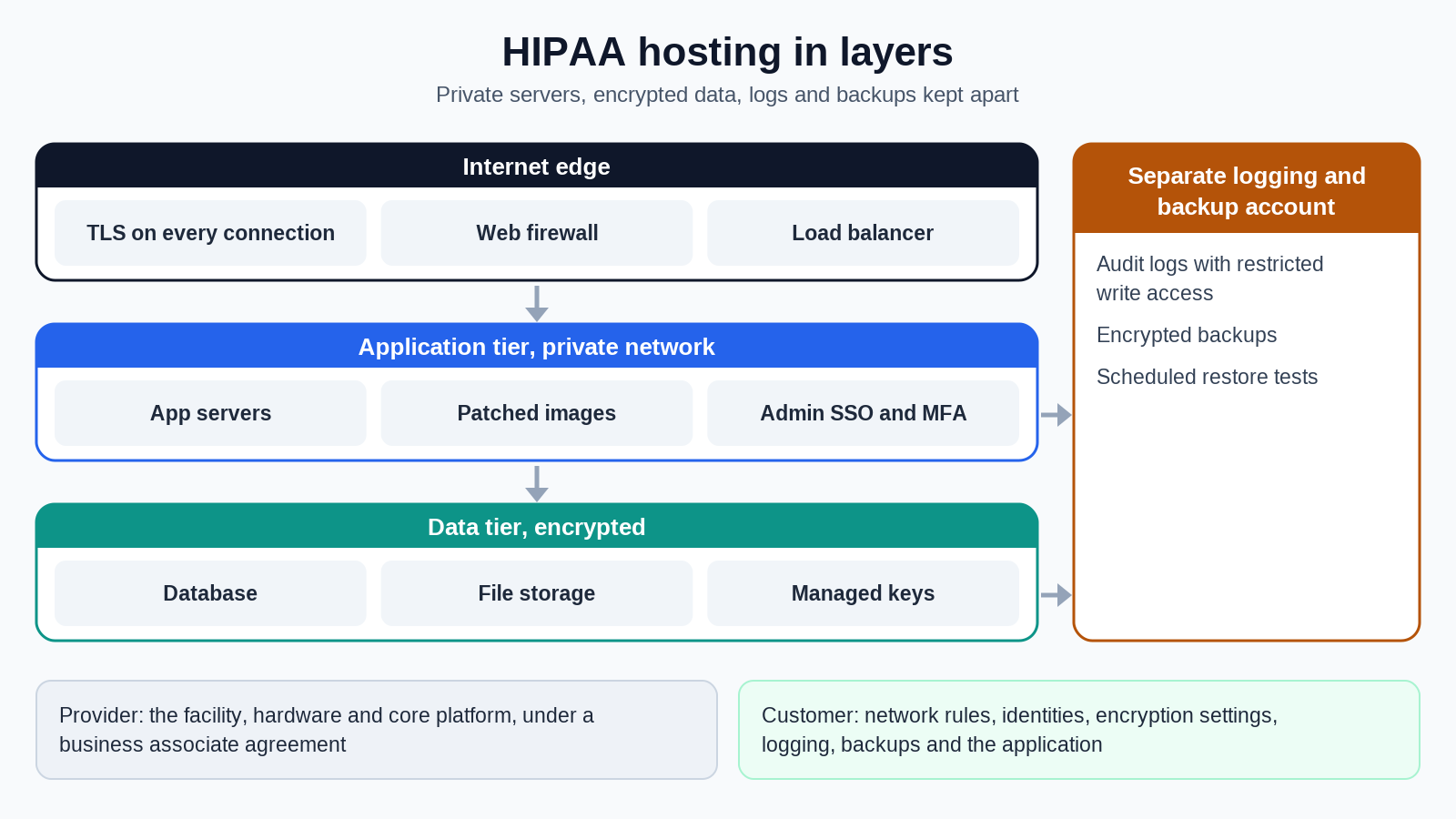
The provider runs the physical data center, hardware and core platform. You run the operating systems you manage, the network rules you write, the identities you create and the application itself.
Write that split down for your own setup. Most hosting gaps sit on the customer side: an open storage bucket, a shared admin login or logs that were never turned on.
Managed services shift the line. With a managed database, the provider patches the engine, but you still choose who can connect, whether encryption is on and how long backups are kept. Record the split per service, not once for the whole account.
If a hosting partner runs the environment for you, add a third column for them, and make sure their access is under an agreement too.
Which technical controls do you build?
These are the controls that turn a provider's infrastructure into a hosting setup you can defend.
Encryption and decryption of ePHI is an addressable implementation specification under 45 CFR 164.312(a)(2)(iv), and 164.312(e)(1) requires technical security measures against unauthorized access to ePHI transmitted over an electronic communications network.
- Network: application and database servers in private networks, with only the load balancer facing the internet.
- Encryption: storage and databases encrypted, with keys in a managed key service and TLS on every connection.
- Identity: single sign-on and multi-factor authentication for every admin, and no shared root logins.
- Patching: a schedule for operating systems and images, with records of what was applied.
Where should logs and backups live?
Away from the systems they protect. If an attacker or a mistake can delete the logs along with the servers, the logs cannot help you.
- Audit logs: platform and application access logs sent to a separate account with restricted write access.
- Retention: kept for the period your policy names.
- Backups: automated, encrypted, copied to a separate account or region.
- Restores: tested on a schedule, with the result recorded.
Do you need dedicated servers?
Usually not. HIPAA does not require dedicated hardware. Shared cloud infrastructure under a business associate agreement, configured correctly, is the common setup.
Dedicated hosting can still make sense for other reasons, such as a customer contract that requires it, but it does not replace any of the controls above.
How should environments be separated?
Keep production apart from everything else, ideally in its own account or subscription. Development and test environments are where most mistakes happen, and they should not be able to reach patient data.
- Separate accounts: production, staging and development each in their own account, with different access lists.
- No real PHI in test: use synthetic or properly de-identified data outside production.
- Same configuration: define environments as code, so staging matches production in everything except data and size.
- Limited bridges: no network path from development into production.
How do you choose a hosting provider?
Start with whether the provider will sign a business associate agreement and which services it covers. Then look at how well its tools support the controls above.
- Agreement: signed before any ePHI, covering the services you plan to use.
- Key management: a managed key service with access logging.
- Logging: platform audit logs you can send to a separate account.
- Identity: single sign-on and enforced multi-factor authentication for administrators.
- Regions: data centers in the locations your contracts require.
- Support: a way to reach the provider during an incident.
What should you monitor?
Monitor for the events that would matter in a breach investigation or an outage, and make sure someone is alerted when they happen.
- Access: administrator sign-ins, new users and changes to permissions.
- Configuration: storage made public, encryption turned off or logging stopped.
- Health: failed backups, full disks and expiring certificates.
- Application: unusual volumes of record access by a single user.
Review the alerts that fire each month and tune them. Alerts nobody reads are as risky as no alerts at all.
Why define hosting as code?
Because a setup written as code can be reviewed, repeated and checked, while one built by clicking in a console drifts as soon as someone makes a quick fix. Code also becomes evidence: every change has an author, a reviewer and a date.
- Reviewed changes: network rules, encryption settings and access policies change only through approved pull requests.
- Policy checks: automated rules in the pipeline that block public storage, unencrypted volumes or open admin ports before they deploy.
- Drift detection: a scheduled comparison between the code and what is actually running, with an alert on any difference.
- Rebuild test: create a full copy of the environment from code on a schedule, which proves recovery does not depend on one person's memory.
What should a hosting incident runbook cover?
It should take the on-call engineer from first alert to a recorded close without guessing. Write it before the first incident, then test it in a planned exercise.
- Detect: which alerts start the runbook and who is paged.
- Contain: how to revoke keys, disable accounts and isolate a server without destroying evidence.
- Preserve: copy the relevant logs and snapshots to a protected location before anything is rebuilt.
- Notify: who inside the organization decides on notifications, and how the provider and customers are told under the agreements in place.
- Recover: restore from backup or rebuild from code, then confirm the data is complete.
- Review: a written account of cause and fixes, with owners and dates.
What documents will security reviews ask for?
Customers and auditors ask for the same core set, so keep it current rather than writing it per request. A current network diagram, the responsibility split, encryption settings, the administrator access list, backup and restore reports, and the latest risk assessment cover most questions.
Mistakes in HIPAA hosting
- Agreement signed, services ignored: ePHI stored in a service the agreement does not cover.
- Public by default: storage or databases reachable from the internet.
- Logs in the same account: deleted with the system they were meant to record.
- Untested backups: discovered to be incomplete during an incident.
- PHI in debug logs: application logs that copy full patient records.
What are best practices for HIPAA compliant hosting?
Sign the business associate agreement first, use only covered services for ePHI, keep servers in private networks, encrypt storage and connections, enforce multi-factor access, send logs and backups to a separate account, and test restores. Document the responsibility split so auditors and customers can see who does what.
How Agnotic can help
Agnotic sets up hosting for health applications under the client's own provider agreement: network design, encryption, identity, logging, backups and restore tests, defined as code so each environment matches. We hand over the documentation your security reviews will ask for.
Run your hosting with Agnotic
Our healthcare cloud managed services keep environments patched, logged and backed up under a BAA.
Related reading on Agnotic
Managed cloud, cloud moves and API safeguards.


