



A hospital rarely runs on one screen. Registration admits the patient, bed management finds a place, the pharmacy needs to know the patient exists, and billing needs a charge that will survive a payer edit. When those modules disagree about who the patient is or whether they are still in a bed, the chart and the claim both go wrong.
Hospital management software is that operational set, and this guide maps the modules and the messages between them. It is for hospital IT leaders and the teams building or replacing a hospital information system. The clinical note still lives in the EHR. The census, the movement, and the charge live here.
What is hospital management software?
Connecting hospital modules to the EHR?
Agnotic builds hospital management software and the ADT, order, and billing interfaces around it.
Hospital management software is the set of operational systems that run beds, registration, scheduling, pharmacy supply, and billing around the clinical record. The EHR holds the chart. Hospital management software holds the census, the orders that move people and supplies, and the charges that become a claim.
Vendors bundle these modules under names that do not match. Ask what each module is allowed to change. If two modules can both edit the attending physician, you do not have a system. You have a race.
Which modules belong in hospital management software?
The core modules are registration, bed and census, scheduling, supply and pharmacy operations, and patient billing. Clinical documentation can sit in the EHR beside them. Ancillary systems such as laboratory and imaging join by interface, not by sharing a patient table.
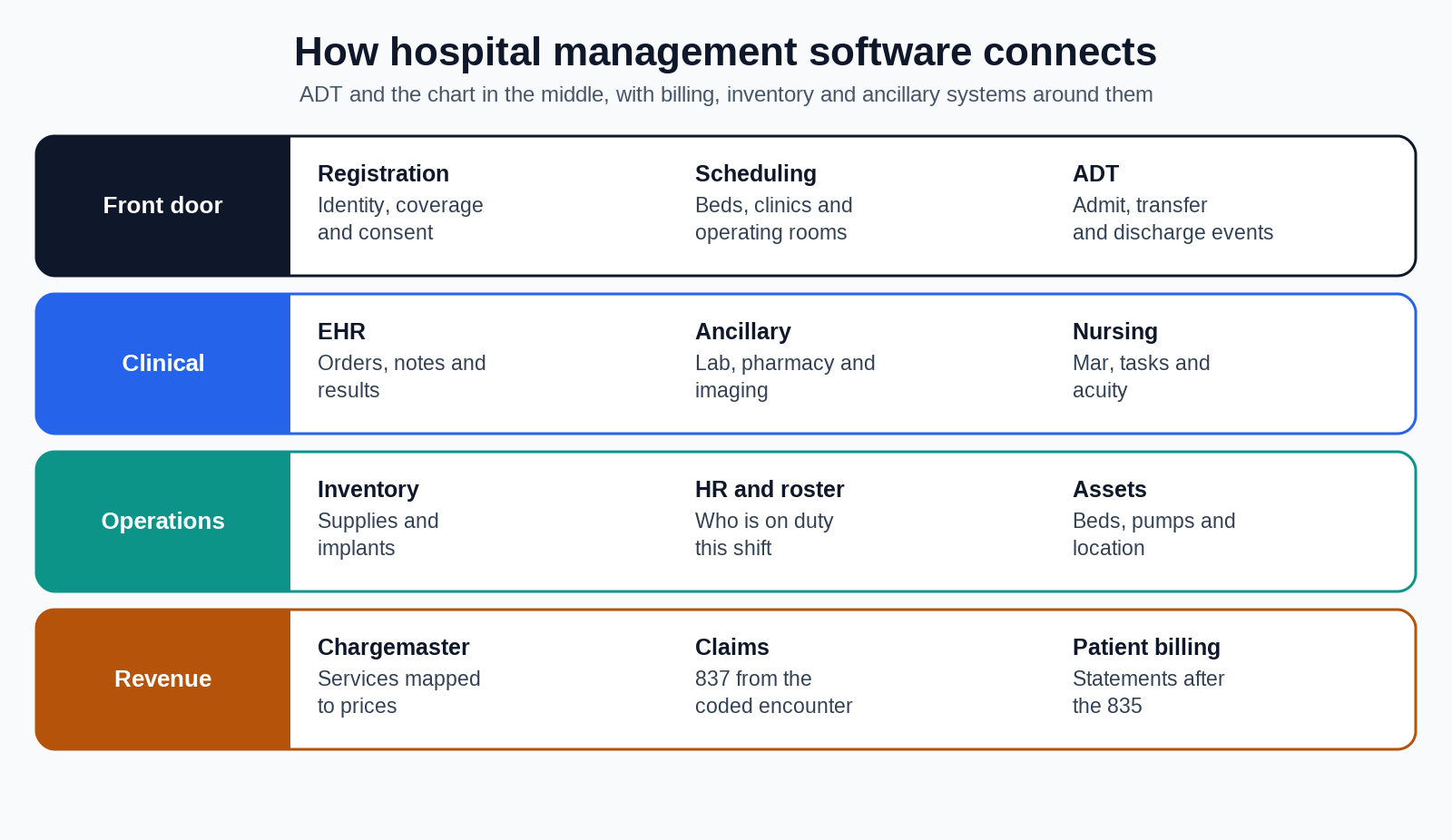
- Registration: identity, encounter, guarantor, and the moment the stay starts.
- Beds and census: assigned location, transfer, and leave, which is the source for who is in the house.
- Scheduling: clinics, procedures, and the link from a request to a slot.
- Pharmacy and supply operations: formulary location, cabinet, and the chargeable issue. The clinical order can still start in the EHR.
- Charging and billing: the charge master hit, the claim, and the remittance posted back.
- Staff and credential context: who may admit or transfer, without becoming a full HR system.
How do HL7 v2 ADT messages tie the modules together?
HL7 v2 ADT messages tell every other system that the stay started, the patient moved, or the stay ended. They are the census broadcast. They are not the claim, and they are not the clinical note.
HL7 Version 2.9 describes an A01 admit/visit notification as the event sent when a patient is admitted and assigned to a bed. It signals the start of the stay and is normally entered in the patient administration system and broadcast to nursing and ancillary systems. The same chapter says an A01 can notify pharmacy that the patient may receive medications, dietary that a new patient needs service, and the finance system of the start of the billing period. An A02 is a transfer when the assigned location changes. An A03 signals discharge and the end of the stay, with the patient's status changed to discharged.
- A01: create the encounter downstream, including the billing account start. Do not wait for a clerk to retype it.
- A02: move the location. Results and medications should follow the new bed, not the old one.
- A03: stop in-house services and start the coding and claim clock.
- A08: demographics or visit updates that are not a transfer. Do not hide a transfer inside an update.
- ACK: every receiver owes an acknowledgement. A missing ACK is a down interface, not a quiet success.
Pick one system as the ADT source, almost always registration. The EHR may be that source in some hospitals. It cannot be one of three sources. Downstream systems update from the message. They do not invent a second admission.
How do hospital charges become an X12 claim?
Charges become a claim when coded services, the encounter, and the payer rules are assembled into the HIPAA claim transaction. An ADT message can open the billing period. It does not replace the claim.
45 CFR 162.1102 adopts standards for the health care claims or equivalent encounter information transaction. HHS lists ASC X12N 837 Version 5010 as the adopted standard for institutional, professional, and dental health claims. Hospital management software has to produce an institutional 837 from the stay, or hand a clean charge set to a billing system that will. The handoff fails when the attending, the discharge disposition, or the revenue code was never captured at A03 time and a biller types it from memory.
- Charge capture: a coded event from pharmacy, supply, or a procedure, tied to the encounter id from ADT.
- Coding: diagnoses and procedures in the set the institutional claim expects, owned by health information management, not by the bed board.
- Edits: payer and clearinghouse edits run before the 837 leaves, with a queue a person owns.
- Remittance: the 835 comes back to the same encounter. Posting it in a spreadsheet splits the stay from the cash.
Where is the boundary between the EHR and the hospital system?
The EHR owns the clinical chart: notes, orders, results, and the medication record clinicians read. Hospital management software owns the stay: identity events, location, scheduling slots, and charges. Orders can start on either side if you name one writer per order type.
A practical split that holds up: registration sends ADT, the EHR consumes it and files orders and results, and billing consumes both the ADT account and the charge events. If the EHR is also the registration system, hospital management software may be the bed board, the supply chain, and the billing workflow around that EHR. Do not build a second full registration stack because a module screen looks empty.
- Identity: one medical record number, issued once, present on every ADT and every claim.
- Encounter: one visit number for the stay, shared by the EHR and billing.
- Orders: CPOE in the EHR if clinicians already work there. Department systems receive ORM or a FHIR service request, they do not re-key.
- Results: ORU or FHIR observations back to the EHR. The department system is not a second chart.
What fails when each module keeps its own patient?
Each module's private patient record fails the first transfer and the first claim. The lab has the old room. Billing has no discharge. The EHR has two encounters for one stay.
- Duplicate MRNs: the same person admitted twice because the search did not check date of birth and sex.
- Stale location: A02 never reached pharmacy, so a medication goes to a discharged bed.
- Account with no clinical stay: a charge on an encounter the EHR does not know.
- Stay with no account: care documented, no 837, found at month-end.
- Timezone and discharge hour wrong on A03, so the length of stay and the room charge disagree.
Run a daily reconciliation: admissions in registration versus encounters in the EHR versus accounts in billing. The differences are a work queue, not a report nobody opens.
Watch the interfaces the same way you watch the census. Count A01, A02, and A03 sent, and count acknowledgements received, by downstream system. A pharmacy interface that accepts every message and then drops the location update will look healthy in a simple up-or-down check. Pair the message id with the bed you expect to see an hour later. When registration is down, capture admissions in a numbered downtime log and replay them in order. Replaying out of order turns a transfer into an admission and opens a second account. That replay job is part of the software, not a favor the interface analyst does from memory.
Should you buy one suite or connect separate modules?
Buy a suite when one vendor already covers registration, census, and billing the way this hospital works, and the EHR strategy is settled. Connect separate modules when the clinical EHR is chosen and the gaps are beds, supply, or a billing workflow the suite will not change.
- Suite: fewer interfaces, slower change when a department is special, and a harder exit if the data model is closed.
- Best of breed: a better departmental tool, and an ADT contract you must actually monitor.
- Either way: you own the identifier map and the reconciliation. The vendor does not feel the duplicate MRN at 2 a.m.
- Do not mix the decision by department politics alone. The census has to have one source or the A02 has no meaning.
What should be decided before a hospital system build?
Decide the ADT source, the encounter id, the charge owner, and the EHR boundary before you configure screens. Those four choices determine every interface you will regret.
- ADT source: one system sends A01, A02, A03, and A08. Name the backup if that system is down.
- Identifier policy: how an MRN is issued, merged, and never reused.
- Charge master owner: who adds a code, and which event is allowed to post it.
- Downtime: how registration and location are captured on paper and replayed, in order, when the interface returns.
- Acknowledgement rules: what happens to a message that no one accepts. Queue it. Do not drop it.
How Agnotic can help
Agnotic Technologies builds hospital management modules and the interfaces between them: registration and ADT, bed and census updates, scheduling links, charge capture, and the path from a stay to an X12 837. We connect the operational system to the EHR instead of cloning the chart into every department.
For a replacement, we start with the source-of-truth decisions and the reconciliation queue, then build the modules you cannot get from the suite you already run.
Map the hospital modules before you wire them
Plan hospital management software with our engineers, or read more in the guides hub.
Related reading on Agnotic
How the EHR database is shaped, how a claim moves, and how healthcare software is put together.


