


Maternal RPM for preeclampsia and gestational diabetes is a remote monitoring program in which pregnant and postpartum patients take blood pressure and glucose readings at home and send them to the obstetric team between visits. The software's job is narrow but hard: get each reading to the right person at the right speed.
This guide covers device choice, threshold and triage design, after-hours escalation, billing codes, the EHR connection and the points where these programs break down, for obstetric practices, health systems and maternal health startups.
What is maternal RPM for preeclampsia and gestational diabetes?
Building a maternal remote monitoring program?
Agnotic builds maternal health platforms with connected blood pressure cuffs and glucose meters, clinician-set thresholds and escalation to the obstetric team.
Maternal RPM for preeclampsia and gestational diabetes is a program in which pregnant or postpartum patients measure blood pressure or blood glucose at home with connected devices, and the readings reach an obstetric team that reviews them against thresholds each patient's clinician has set, with urgent readings escalated to a named person.
The two conditions need different software behavior. Hypertensive disorders call for fast escalation of single readings, often continuing for weeks after delivery. Gestational diabetes calls for pattern review across days of fasting and after-meal values, usually by a diabetes educator or dietitian rather than an on-call nurse.
How does a maternal RPM program work step by step?
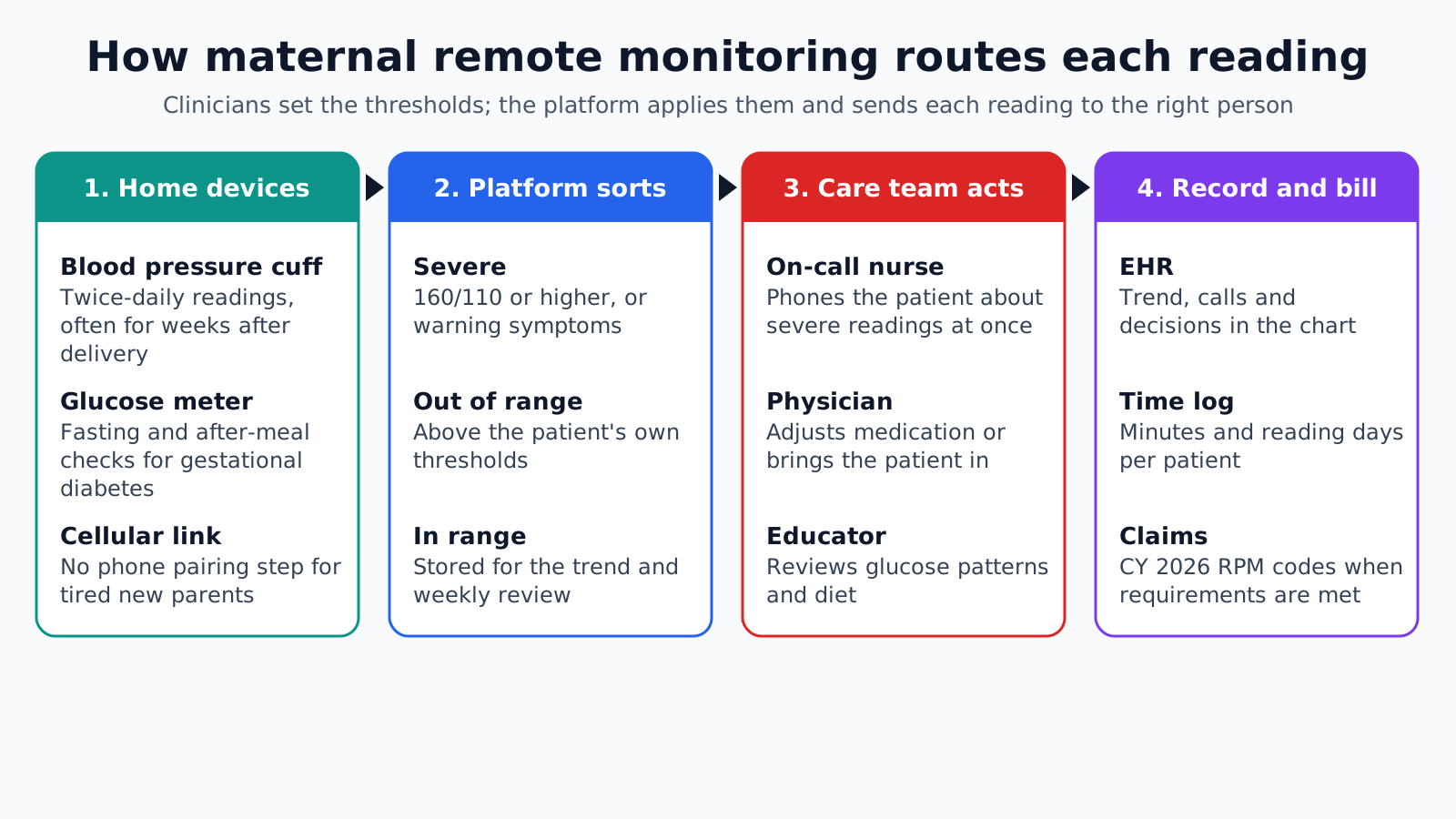
A maternal RPM program moves each reading from a home device through a sorting step to a person. Readings from a home blood pressure cuff and glucose meter reach the platform, which sorts each one as severe, out of range or in range and routes it to the obstetric nurse, the physician or the weekly review.
- 1. Order and enroll: A clinician orders monitoring, the patient gives consent, and the team records each patient's thresholds, reading schedule and monitoring end date.
- 2. Ship and set up devices: The patient receives a cuff, a meter or both, with setup done before she leaves the clinic or the hospital where possible.
- 3. Receive and sort: The platform stores every reading with its device, measured time and received time, then compares it with that patient's thresholds.
- 4. Escalate: A severe-range reading becomes an urgent task for a named on-call person, and the patient sees the instructions her clinicians wrote for that case.
- 5. Review patterns: Out-of-range glucose patterns and borderline blood pressure trends go to a scheduled review queue rather than paging anyone.
- 6. Document: Every review, call and medication change is logged with the time spent, so the chart shows the trend and the practice can support what it bills.
- 7. End on purpose: Monitoring stops on the date the clinicians set, with a closing note, rather than fading out when the patient stops sending readings.
Which devices suit pregnant and postpartum patients?
Devices that work without a pairing step suit this population best, because a patient who has just delivered has little time or sleep to troubleshoot Bluetooth. Cellular cuffs and meters send readings straight to the vendor's cloud, and the platform pulls them from there.
- Cellular devices: No phone needed and no pairing, but a higher device cost and a dependence on mobile coverage at the patient's home.
- Bluetooth devices: Lower device cost and data through the patient's phone app, but readings stop if the phone is lost, the app is closed or permissions change.
- Cuff size and validation: Arm circumference changes in pregnancy, so ship the right cuff size and choose models validated for use in pregnancy where a validation listing exists.
- Glucose meters and CGMs: A meter produces a few values a day; a continuous glucose monitor produces readings every few minutes and needs summary views instead of single-value alerts.
Whichever device is chosen, record the device serial number against the patient. When a reading looks wrong, the team needs to know whether the cuff, the meter or the patient's technique is the cause, and the device record makes swapping a faulty unit quick.
How should thresholds and triage rules be set?
Thresholds should be set and signed by the obstetric team for each patient, and the software should only apply them. The platform's job is to sort readings consistently, not to decide what is clinically safe.
ACOG Practice Bulletin 222 defines severe-range blood pressure in pregnancy as a systolic of 160 mm Hg or more, or a diastolic of 110 mm Hg or more. A platform can build its urgent tier around that definition, then add lower, patient-specific tiers for review.
- Repeat rule: A single high reading prompts the patient to rest and repeat, and the rule for what happens after the repeat is written by the clinicians.
- Symptom questions: Each high blood pressure reading asks about the symptoms the team lists, such as headache or vision changes, and a positive answer raises the tier.
- Glucose patterns: Rules look at fasting and after-meal values across several days against the targets the clinician set, and create one review task rather than one alert per value.
- Versioned rules: Every threshold change is stored with who made it and when, so a later review can show which rule applied to a given reading.
Thresholds also change during monitoring. A patient started on blood pressure medication may need new targets, and postpartum targets can differ from antenatal ones, so the rule editor should let a clinician change one patient's thresholds with an effective date rather than editing a global default.
Who answers a severe reading at 2 a.m.?
A named on-call person answers it, reached by phone or page, with a backup if that person does not acknowledge in the time the clinical team set. A portal inbox or a chart message is never the primary route for a severe reading.
The escalation chain needs three parts. First, an on-call roster the platform reads, so alerts follow the schedule rather than a fixed list. Second, an acknowledgment step that restarts escalation if nobody responds. Third, a record of every attempt, so the team can review the response afterwards.
The patient side matters as much. When a reading crosses the urgent tier, the app should show the instructions the clinicians wrote, such as repeating the reading, calling the labor and delivery unit or calling emergency services, without waiting for a nurse to call back.
Write those instructions at a plain reading level and in the languages your patients use. Test the urgent flow with patients on limited data plans, and send the same instructions by text message when the app cannot reach the server.
Billing maternal RPM under the CY 2026 codes
In the CY 2026 Medicare Physician Fee Schedule final rule (CMS-1832-F), CMS added 99445 for device supply with 2 to 15 days of readings in a 30-day period and 99470 for the first 10 minutes of treatment management. These sit beside 99453 for setup, 99454 for 16 to 30 days of readings, and 99457 and 99458 for 20-minute management blocks.
Medicare covers few pregnant patients, because it serves mainly people aged 65 and older and people with disabilities. Medicaid and commercial payer policies therefore decide what a maternal program can bill, and the software should track each payer's rules separately.
For billing support the platform needs three counts per patient: reading days in each 30-day period, clinician and staff minutes with the type of activity, and the dates of interactive communication. Postpartum programs that run only a few weeks may land in the shorter-period tier, which is where the 2026 codes matter.
How does the platform connect to the EHR?
The platform connects to the EHR at three points: enrollment, results and documentation. Each one can start simple and become an interface later.
- Enrollment: An HL7 v2 ADT discharge message, or an order placed in the EHR, can create the enrollment so postpartum monitoring starts the day the patient goes home.
- Results: Readings can be filed as flowsheet values, a periodic summary note or a link, depending on what the health system supports.
- Documentation: Review notes and time logs flow back so the chart carries the record of care, not only the platform.
Patient identity needs care after delivery. The newborn receives a record of their own, and the mother's readings must stay on her record. Match patients on the health system's identifier from the enrollment message, not on a name and date of birth typed into the app.
Start with the lightest connection the health system will accept. A program can launch with manual enrollment and a weekly summary note, then move to ADT-driven enrollment and flowsheet filing once the clinical workflow has settled.
Where maternal RPM programs break down
Maternal RPM programs usually break at the handoffs between device, software and people. This failure-point list is a useful review before launch.
- Unwatched queue: Urgent readings go to an inbox that nobody watches at night or at weekends.
- One threshold for all: The platform applies a single default instead of the values each patient's clinician set.
- Glucose as alarms: Every out-of-range glucose value pages someone, which floods the team with low-value tasks.
- Silent devices: A patient stops sending readings and nobody notices, because there is no missing-data rule.
- Late enrollment: Postpartum monitoring starts days after discharge because enrollment depends on a manual step.
- Language and connectivity: The app and messages exist in one language and assume strong home coverage.
- Billing without records: Codes are billed without the reading days, time logs and consent behind them.
How Agnotic can help
A maternal monitoring program is only as safe as its escalation path, so Agnotic Technologies designs that path with your obstetric leads before building the screens. Agnotic then builds the device feeds, threshold engine, nurse and educator queues, patient app and EHR connection for the program.
Your clinicians own every threshold, symptom question and patient instruction. The platform applies them consistently, records each step, and makes sure every severe reading reaches a person.
Plan maternal RPM with Agnotic
Explore maternal health app development, or browse more articles in our Women's Health hub.
Related reading on Agnotic
Continue with maternal health Epic integration, fertility clinic records, women's health tracking apps and RPM alert fatigue.


