



A hospital that still retypes a cashless case into each insurer portal will meet NHCX as a gateway, not as another login. The National Health Authority built the National Health Claims Exchange under the Ayushman Bharat Digital Mission so a provider system and a payer system can exchange the same case in a form both can read.
This guide is for hospital leaders deciding what to connect: eligibility, pre-authorization, the claim, and payment. It stays with the flows and FHIR profiles the NHA and NRCeS publish. It does not guess how many hospitals are live or how fast a payer will answer.
What is NHCX, and why should a hospital leader care?
Connecting a hospital to NHCX?
Agnotic Technologies builds the hospital-side NHCX connection: eligibility, pre-authorization, claims, and payment bundles.
NHCX is the National Health Authority's claims exchange under the Ayushman Bharat Digital Mission. A hospital uses it to send eligibility checks, pre-authorizations, claims, and payment notices to payers and TPAs as FHIR messages, instead of retyping the same case into each insurer portal.
The ABDM developer portal describes NHCX as three rulebooks and a referee. The protocol says how a message is addressed, protected, acknowledged, and answered. The data specifications say what is inside, as FHIR records using profiles NRCeS publishes. The operational guidelines say who may join and how they are checked. NHA publishes the rules and runs the exchange, with NRCeS and IRDAI involved when the rules change. A hospital leader does not need to implement the gateway. The hospital needs a system that can build the bundles and a participant identity on the exchange.
Who sits on the exchange, and what moves between them?
The hospital system and the payer or TPA system exchange bundles through NHCX. NHCX routes and validates. It is not the hospital's billing module and it is not the payer's adjudication engine.
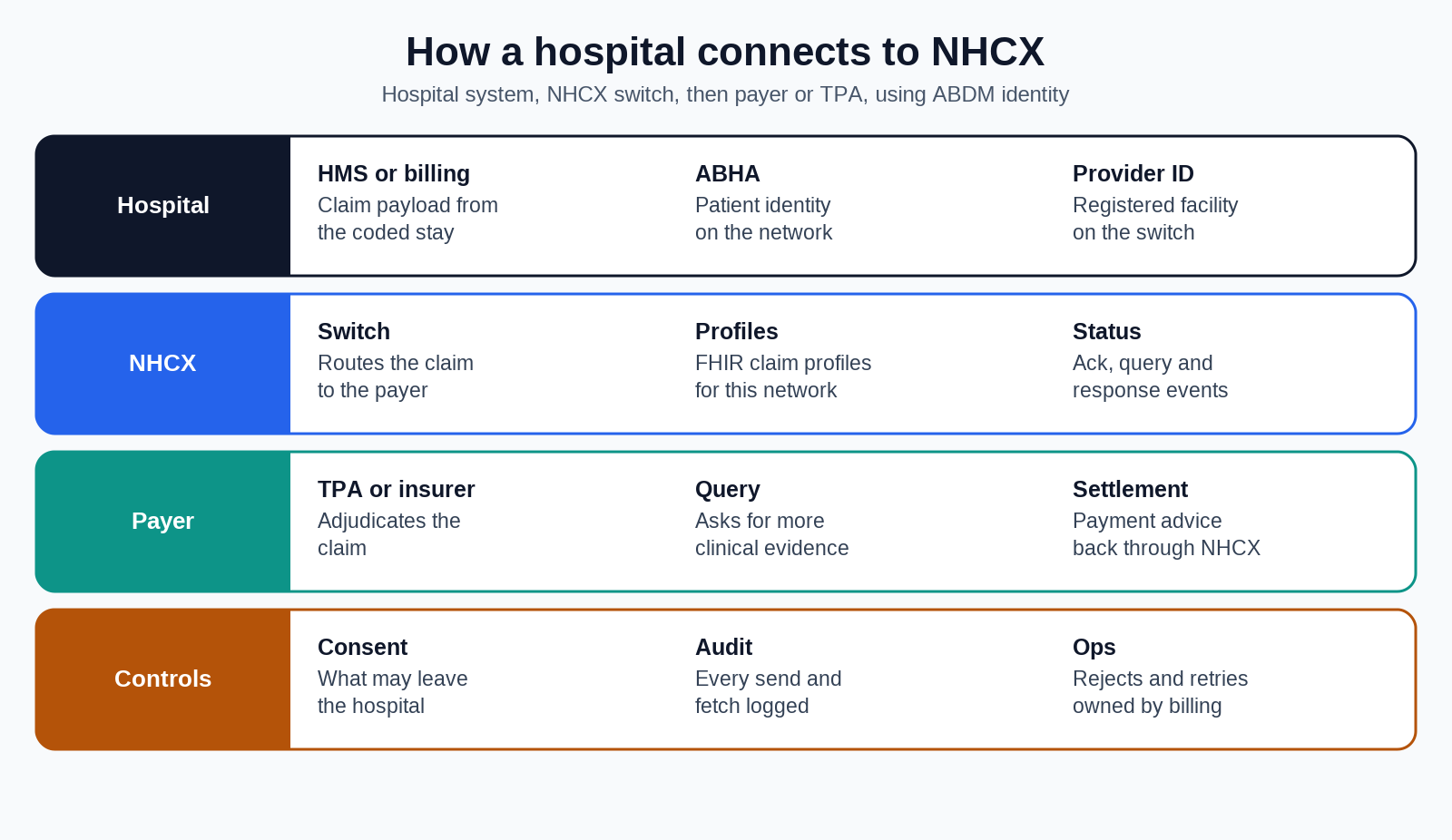
- Hospital HIS or billing: Builds the request from the admission, the package, and the clinical documents it already holds.
- NHCX: Checks the message against the protocol and routes it to the participant it is addressed to.
- Payer or TPA: Adjudicates eligibility, pre-authorization, and the claim, then returns a response bundle.
- Beneficiary context: The patient and coverage details travel inside the bundle. The hospital still owns registration.
The portal compares the protocol to email: the message goes to the exchange, the exchange passes it on, and the reply comes back the same way. That shape matters for operations. A timeout is not the same as a denial. Store the request id, the send time, and whether an acknowledgement returned, before you show a clinician a yes or a no.
Which flows does the published NHCX specification cover?
NRCeS describes the first NHCX focus as the cashless claims process, with a fixed list of information flows. Start there. Do not design a second workflow the specification does not name.
The NHCX profiles page lists: get provider or payor details, eligibility check, pre-authorization request, claims request, payment notification, payment acknowledgement, and search or fetch of claims for status and regulatory use. A hospital program can sequence them. Eligibility before pre-authorization. Pre-authorization before the expensive service when the payer requires it. The claim after discharge or after the package is complete. Payment notification and acknowledgement after the payer pays. Search when someone asks where a case stands.
- Details: Confirm you are addressing a participant the exchange knows before you send a clinical bundle.
- Eligibility: Coverage and whether this payer will consider the case.
- Pre-authorization: Approval to proceed, which is not the same document as the final claim.
- Claim: The request for payment, with the clinical and package detail the profile requires.
- Payment: Notification and acknowledgement so the hospital ledger and the payer ledger can be matched.
What FHIR profiles does the hospital system have to produce?
The hospital produces a FHIR R4 Bundle of type collection that conforms to the NRCeS profiles for NHCX. A Claim sitting alone, without the patient, coverage, and organization the profile expects, is not a message the other side can adjudicate.
The ABDM NHCX FHIR reference says everything that crosses the exchange is one FHIR R4 Bundle of type collection, built to the NRCeS profiles. The profiles named there include Claim, ClaimResponse, Communication, Coverage, CoverageEligibilityRequest, CoverageEligibilityResponse, InsurancePlan, Patient, Organization, Practitioner, and related resources. The same reference says the bundles are generic so a payer on the exchange can take them, including private insurers and TPAs, and that PMJAY adds its own constraints on top. Validate against the NRCeS package version your participant agreement names. A bundle that passed last year's examples can fail the current guide.
- Patient and coverage: Identifiers the payer can match. A local MRN with no system URI will not survive the trip.
- Claim: Use the NRCeS Claim profile, and keep pre-authorization and final claim as different exchanges.
- Clinical attachments: Send them as the profile allows, often Communication or the documents the bundle references, not as a free-text note in the wrong field.
- Codes: Use the code systems the guide binds. A hospital-only procedure name will not match a package on the payer side.
How is NHCX different from a direct TPA portal?
A TPA portal is one payer's website. NHCX is the shared exchange: one hospital integration can address many participants, and each message is a FHIR bundle instead of a form a clerk retypes.
The portal does not disappear on day one. Some payers will answer on NHCX and some will still ask for the old upload. Leadership should ask, for each high-volume payer, whether that payer is a participant and which of the published flows it answers. Building every screen of every old portal into the HIS is the wrong project. Building the bundle once, and keeping a clear exception path for payers not on the exchange, is the right one.
What should a hospital connect first?
Connect the system that already owns admission, package, and discharge, and start with eligibility plus one cashless flow you can finish end to end. A pilot that sends a claim the billing system cannot later reconcile will be abandoned.
- Source of truth: HIS or billing for the patient, the encounter, and the package. Do not type a second case into a side spreadsheet.
- First flow: Eligibility, then pre-authorization for one department that already does cashless work.
- Identity: Hospital participant id, payer participant id, and the correlation id you will store on the bill.
- Reconciliation: The payment acknowledgement has to hit the same ledger the finance team closes.
- Exception queue: A named person for acknowledgements that never return and for bundles the validator rejects.
Assign a clinical owner and a finance owner. Pre-authorization is a care decision and a payment decision. If only IT attends the pilot, the bundle will be technically valid and operationally unused.
Store four fields on the hospital bill for every exchange: the NHCX correlation id, the participant you addressed, the time you sent the bundle, and the latest response type. A protocol acknowledgement means the exchange accepted the message for routing. It does not mean the payer approved the case. Show those as different statuses to the cashless desk. When finance closes the day, the payment acknowledgement amount has to match a receipt on that same bill. If the amount lives only in a vendor console, the HIS ledger and the exchange have already drifted. Pick one department for the pilot, such as planned surgery or daycare procedures, where cashless volume is high enough to matter and the package codes are already stable. Run eligibility and pre-authorization there until the cashless desk trusts the status on the bill. Only then add the claim and the payment acknowledgement. A hospital-wide switch on day one forces every coordinator onto a path that has not been reconciled.
Where do NHCX projects stall?
They stall on identifiers, on treating pre-authorization as the claim, and on vendors who demo a screen that never calls the exchange. The specification is not the stall. The hospital workflow around it is.
- Unstable patient id: The MRN in the HIS and the identifier in the bundle differ by a prefix nobody documented.
- Package mismatch: The clinical order and the claim line use different procedure names, so the payer returns a query.
- Missing acknowledgement: Staff assume silence is approval and start the procedure.
- Validator skipped: The team tests against a sample JSON and never runs the NRCeS validator on a real discharge.
- Two queues: Cashless coordinators keep the old portal because the HIS status is a day behind.
What should leadership ask a vendor before signing?
Ask which published flows the product sends, which NRCeS profiles it validates against, and where the correlation id is stored on the hospital bill. A demo of a claim form is not a connection to NHCX. Ask for a sandbox run that uses your discharge, not a canned sample, and for the validator output on that bundle.
- Flows: Eligibility, pre-authorization, claim, payment notification, payment acknowledgement, and status search. Which of these are in the contract?
- Validation: The product rejects a bundle that fails the NRCeS guide before it leaves the hospital.
- Sandbox: You can run the ABDM sandbox with your own sample patient, not only the vendor's recording.
- Payer list: How the product chooses a participant, and what staff do when that payer is not on the exchange.
- Audit: Who sent the bundle, when, and the response body, kept with the bill.
How Agnotic can help
Agnotic Technologies builds the hospital side of NHCX for the HIS or billing product you already run. Agnotic maps eligibility, pre-authorization, claim, and payment onto the NRCeS profiles, stores the correlation id on the bill, and validates bundles before they are sent. We sit with finance and the cashless desk so the status staff see is the status the exchange returned.
We work from the NHA and NRCeS documents for the version in your participant agreement. We do not fill gaps with unpublished message names.
Scope the hospital NHCX connection
Review flows and FHIR bundles with an engineer, or read more interoperability guides.
Related reading on Agnotic
Claims software, FHIR integration, and how health data standards fit together.


