



Many healthtech companies start with one product and add a second a year later. By the third product, each one has its own login, its own copy of the patient, its own connection to the same EHR and its own audit log, and every customer asks why.
This post is a step-by-step guide to building the shared platform underneath several health products. It covers what to share and what to leave inside each product: identity, the shared data layer, the integration layer, tenancy and audit, plus the mistakes that turn a platform project into a bottleneck.
What is a healthcare technology platform?
Planning a platform under several health products?
Our custom healthcare software page explains how we design shared services, data and integrations for product companies.
A healthcare technology platform is the shared layer beneath several health products that gives them one identity system, one patient record, one integration layer, one tenancy model and one audit trail. Agnotic Technologies builds platforms like this so each product team can ship features without rebuilding the same plumbing.
A platform is not a bigger product. It is the set of services that products agree to depend on.
When does a healthtech company need a platform?
A company needs a platform when a second or third product starts repeating work the first already did, and customers notice the joins. Common signs are separate logins, duplicate patients across products and two teams connecting to the same EHR.
Building a platform too early is also a mistake. With one product, the shared layer is just that product's code; extract it when a second product actually needs it, not when a slide says it might.
Which layers make up the platform?
Most healthcare platforms have four shared layers under the products: platform services, a shared data layer, an integration layer, and tenancy and operations. Each product keeps its own screens, rules and release schedule on top.
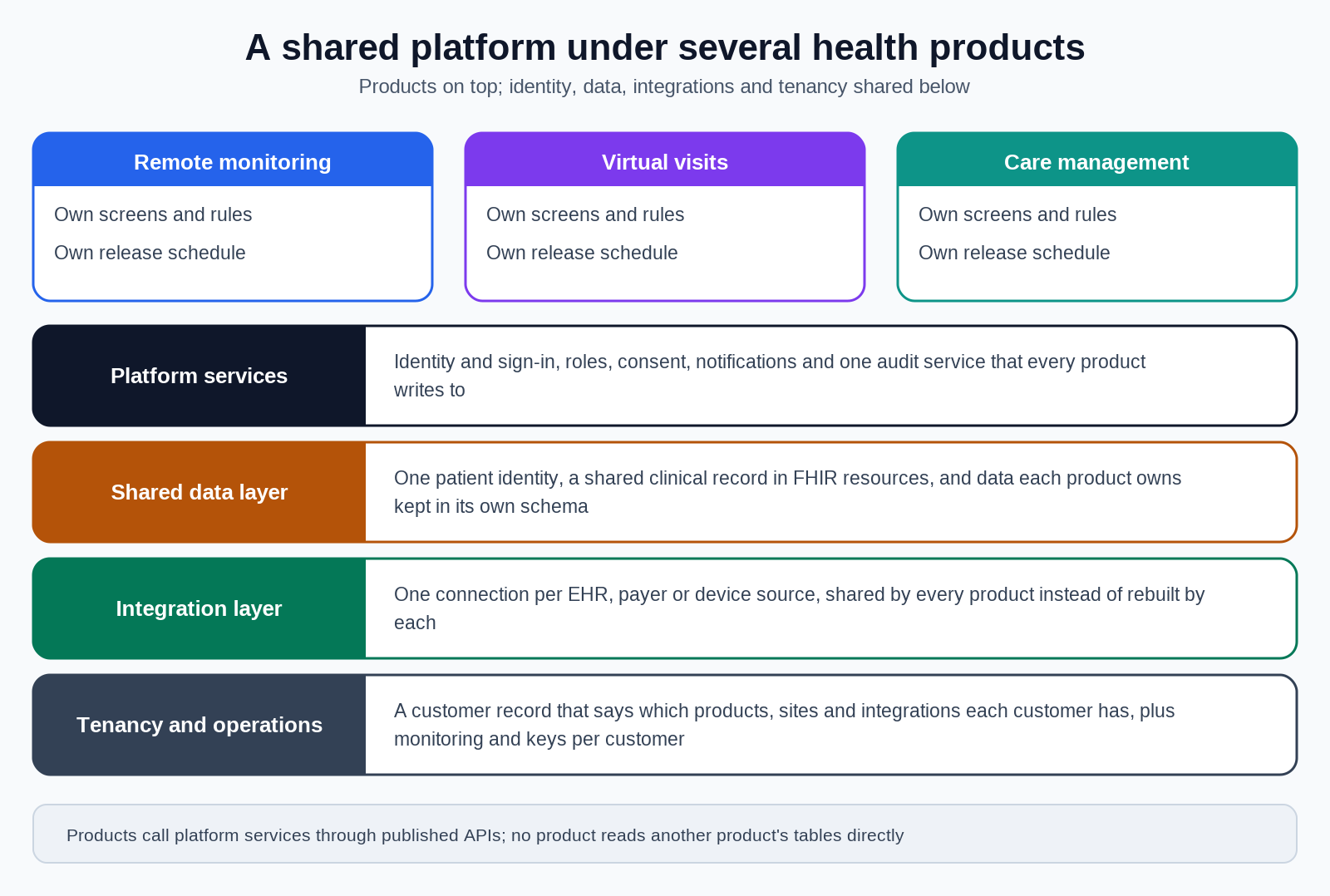
The rule that holds it together is simple: products call the platform through published APIs, and no product reads another product's tables directly.
Step 1: how should identity work across products?
Identity should be one service for every product: one account per person, one sign-in, and roles that say what the person may do in each product. A clinician who uses two of your products should not have two passwords.
- Staff identity: sign-in through the customer's identity provider where they have one, with your own as a fallback.
- Patient identity: one account across products, linked to the patient record rather than to a product.
- Roles per product: a nurse may be an admin in one product and a viewer in another.
- EHR launch: products launched from an EHR exchange the EHR's context for a platform session.
Step 2: what belongs in the shared data layer?
The shared data layer should hold the data more than one product needs: the patient, their identifiers, consents, care team and core clinical facts. Data only one product uses stays in that product's own schema.
HL7 FHIR is a standard published by HL7 International for exchanging health data through RESTful APIs built on defined resources such as Patient, Observation and MedicationRequest.
Using FHIR resources for the shared record gives every product the same shape for a patient or an observation, and makes integrations simpler. Product-specific data does not need to be FHIR.
The HIPAA Privacy Rule's minimum necessary standard requires covered entities to limit uses and disclosures of protected health information to the minimum needed for the purpose.
In platform terms, each product gets access only to the shared data its function needs, enforced by the data service, not by each product's good behavior.
Step 3: how do you build one integration layer?
Build one connection per external system and let products subscribe to it. A health system that connects its EHR once and finds every product working is the clearest benefit a platform can show.
- Inbound: EHR events, device data and payer responses land once, are matched to the shared patient and published to subscribed products.
- Outbound: products ask the integration layer to write back, which handles each EHR's format and credentials.
- Per-customer settings: which feeds are on, which endpoints and which products may use them.
- Monitoring: one view of every feed per customer, so support sees a silent interface before a clinician does.
Step 4: how should tenancy be modeled across products?
Model tenancy as one customer record that lists the products, sites, integrations and agreements each customer has. Every service reads that record instead of keeping its own idea of who the customer is.
Decide early how isolation works for data, keys and logs, and apply the same rule in every product. A customer that buys two of your products should get one security review, not two different answers.
Step 5: why should audit be a shared service?
Audit should be shared because customers and regulators ask questions that cross products: who saw this patient's record, in any of your products, last month. Separate logs per product make that question slow and unreliable.
The HIPAA Security Rule's audit controls standard requires mechanisms that record and examine activity in information systems that contain or use electronic protected health information.
A shared audit service takes a standard event from every product, with user, patient, action, product and time, stores it in a tamper-evident way and answers queries across products.
Step 6: what stays inside each product?
Screens, workflows, product rules and product-specific data stay inside each product. The platform should make products faster to build, not decide how they behave.
If a platform change is needed for every new feature, the line is in the wrong place. Product teams should be able to ship most work without waiting for the platform team.
What goes wrong when healthtech platforms are built?
Platform projects fail in two directions: too little shared, so nothing improves, or too much shared, so every change waits in one queue.
- Big rewrite first: pausing product work for a year to build a platform nobody uses yet.
- Shared database: products reading each other's tables, so no schema can change safely.
- Platform as gatekeeper: every product change needs a platform ticket.
- Two patient records: the shared patient exists, but products keep their own and drift.
- No customer record: each service keeps its own list of customers and settings.
A worked example: from two products to a platform
A company runs a remote monitoring product and adds virtual visits. Both connect to the same health systems, both keep their own patient tables and clinicians have two logins.
The team extracts identity first, so one sign-in covers both products. Next, they move the patient and consent records into a shared service and point both products at it, then merge the two EHR connections into one integration layer.
Audit comes last, as a shared service both products write to. When a third product starts, it begins on the platform from day one.
Who owns the platform?
A small platform team should own the shared services, and product teams should be its customers. The platform team publishes APIs, keeps them stable and measures how easy they are to use.
- Platform team: identity, shared data, integrations, tenancy, audit and their APIs.
- Product teams: screens, workflows and product data, built on the platform.
- Architecture lead: the line between platform and product, and decisions that move it.
- Security lead: isolation rules, access reviews and the shared audit.
How do you know the platform is working?
The platform is working when products ship faster, customers connect once and cross-product questions are easy to answer. Measure those directly.
- Time to start a new product on the platform compared with the first product's start.
- Integrations reused when an existing customer buys a second product.
- Duplicate patient records across products, which should trend to none.
- Product changes that needed a platform change, which should stay a small share.
What are healthcare technology platform best practices?
Extract shared services when a second product needs them, start with identity, keep one patient record and one connection per external system, model customers once and make audit a shared service. Keep product logic in products.
Publish platform APIs with versions and treat product teams as customers whose feedback sets the platform roadmap.
How Agnotic can help
Agnotic helps healthtech companies move from separate products to a shared platform: deciding what to share, extracting identity and patient services, building one integration layer and a shared audit, without stopping product delivery.
Plan your platform with Agnotic
Our fractional CTO service helps you draw the line between platform and products before you build.
Related reading on Agnotic
Architecture, tenancy and FHIR design.


