

Command center
Nurses and physicians watch every home bed on one board and act on alerts.
- Census of home patients by acuity
- Alert queue tied to each patient's parameters
- Video and voice to the home in one click


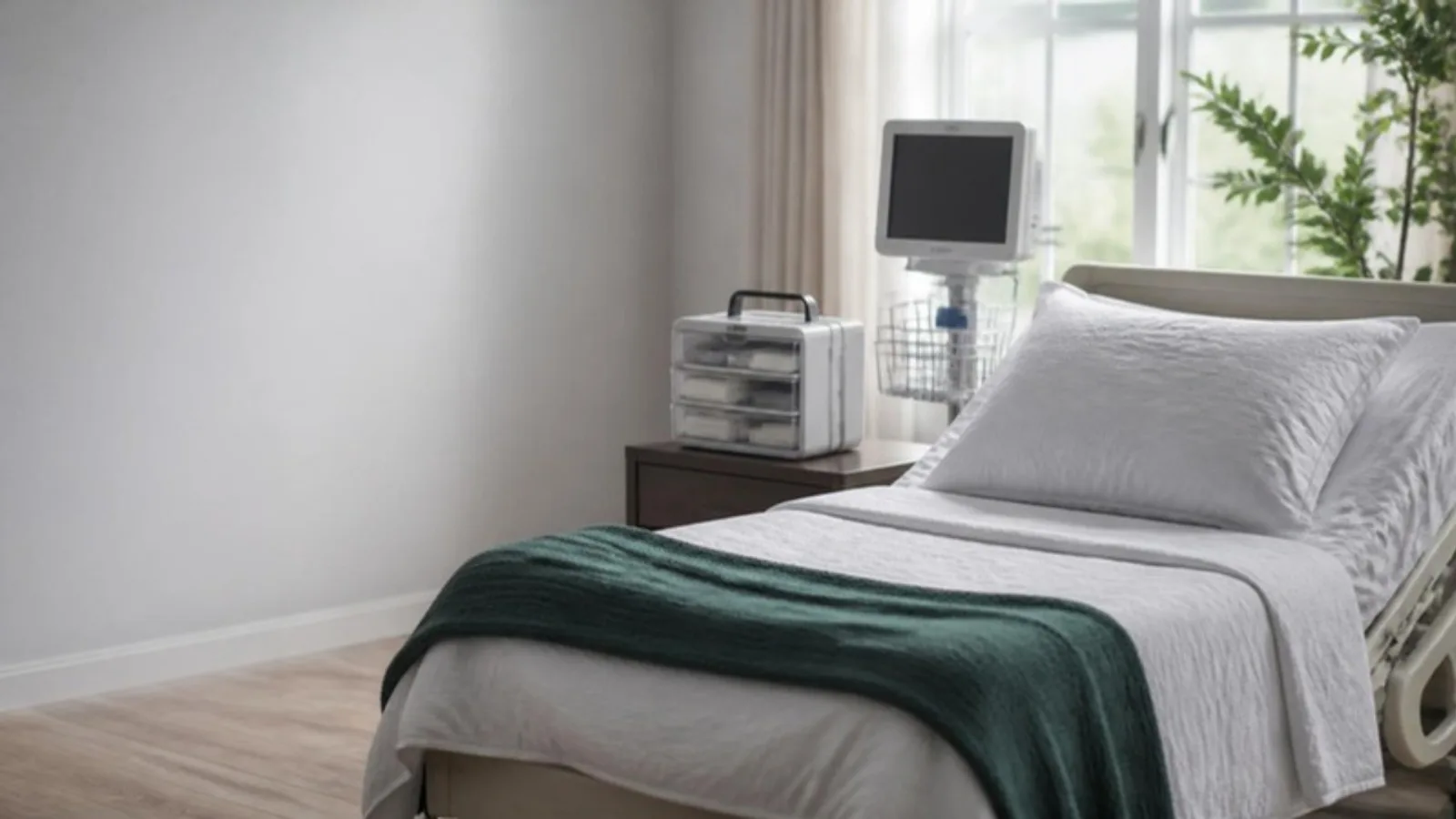
A hospital at home program puts an inpatient in their own bedroom, so the hospital has to see, reach and treat them there. Agnotic Technologies builds the platform behind it: the command center, the home kit, visit and courier dispatch, and an inpatient record that stays in your EHR.
Trusted by global innovators











A hospital at home technology platform is the software that lets a hospital treat acute inpatients in their homes: a command center watching continuous vitals, a home device kit, dispatch of nurses, paramedics and couriers, escalation back to the hospital, and an inpatient encounter in the EHR. Agnotic Technologies builds and connects this platform for hospitals and care providers.
Five parts, each with one owner. The command center is the hub; everything else reports to it or takes orders from it.
Nurses and physicians watch every home bed on one board and act on alerts.
The vitals devices, tablet and connectivity hub delivered to the patient.
In-person nurse or paramedic visits, plus medications, lab draws and supplies.
The admission lives in the hospital record, with the home as the location.
What the household sees: the day's visits, a help button and simple device prompts.
These are the failure points we design against first, because each one sends a patient back to a ward or leaves a gap in the record.
Device drop-off: a sensor loses contact or a hub loses signal overnight, and nobody notices the stream has gone quiet until the morning round.
Slow escalation back to the hospital: the decision is made at home, but transport, a bed and the handoff are arranged by phone while the patient waits.
Missed in-person visits: a nurse visit slips after a traffic delay and the care plan's visit count for the day is not met.
Late medications: an IV antibiotic arrives after its due time because the courier job was not linked to the order schedule.
Split records: readings sit in a vendor portal while orders and notes are in the EHR, so the chart does not show the full stay.
Kit losses: devices are not collected after discharge, or reach the next patient without cleaning and reset.
Three decisions on the scoping call shape the rest of the platform.
The home stay is an inpatient encounter with the home as its location. Orders, notes and medication administration go where the rest of the hospital stay lives, not into a side system.
A missing reading is as important as an abnormal one. The command center alerts on gaps in the data, not only on values outside range.
Escalation to the hospital is designed before the first patient goes home: who decides, how transport and a bed are requested, and what the receiving unit sees.
Modules we build or integrate, alone or as one platform around your program.
A live board of home patients with vitals trends, alerts, visit status and open tasks for each bed.
Eligibility screening and consent at the ward or emergency department, plus a home check for power, signal and access.
Kit assignment, delivery, pairing, swap and return, with cleaning and reset tracked before reuse.
Nurse and paramedic visits scheduled from the care plan, and courier jobs for medications, specimens and supplies.
One action starts the return to hospital: transport request, bed request and a handoff packet for the receiving unit.
Visit times, a help request and device prompts in plain language, on the supplied tablet.
Observations, visit notes and administration records filed to the inpatient encounter.
Census, escalations, visit completion and kit status, reviewed with the program's clinical leads.
The path we build for a single patient, from the decision to admit at home to the kit coming back. Every step is logged against the encounter.
The admitting team confirms the patient meets the program's criteria and records consent to be treated at home.
Address, access, power and mobile signal are checked, and the caregiver contact is confirmed.
The kit is assigned to this admission, delivered and paired, and the first readings appear on the command center board.
The inpatient encounter takes the patient's home as its location, so orders and notes file to the same stay.
Readings stream in, visits run from the care plan and courier jobs follow the medication and lab schedule.
The care team either returns the patient to the hospital with a handoff or moves them toward discharge.
The discharge summary goes to the next provider, the kit is collected, and its cleaning and reset are recorded.
Chosen to fit your EHR, your device partner and your dispatch model.
Each signal has an owner, an action and a record. We agree the thresholds and time windows with your clinical leads; the platform enforces them.
| Signal | What the platform does | Who acts | What is recorded |
|---|---|---|---|
| Readings stop arriving | Alerts the command center once the agreed silence window passes and opens a device check | Command center nurse | Gap period and device status on the encounter |
| A reading crosses the patient's escalation parameters | Pages the responsible clinician with the recent trend | Physician or advanced practice clinician | Alert time, review time and any new order |
| The team decides the patient needs the hospital | Starts the return: transport request, bed request and handoff packet | Command center with bed management | Location change on the encounter and the handoff note |
| A visit is late or missed | Re-dispatches the visit and escalates after the agreed window | Dispatch lead | Visit status and the reason for delay |
| A medication delivery is delayed | Tells the pharmacy and the nurse and flags the dose due time | Pharmacy and visiting nurse | Administration time against the order |
| The patient or caregiver asks for help | Connects a video or voice call to the command center | Command center nurse | Call record and any action taken |
Measures we build reporting around, agreed with your program leads before the first admission.
Hours each patient's devices were reporting, and every gap with its cause.
Time from alert to clinician review, by alert type.
Planned visits against completed visits, by day and by patient.
Patients returned to the hospital, with the trigger and time to bed.
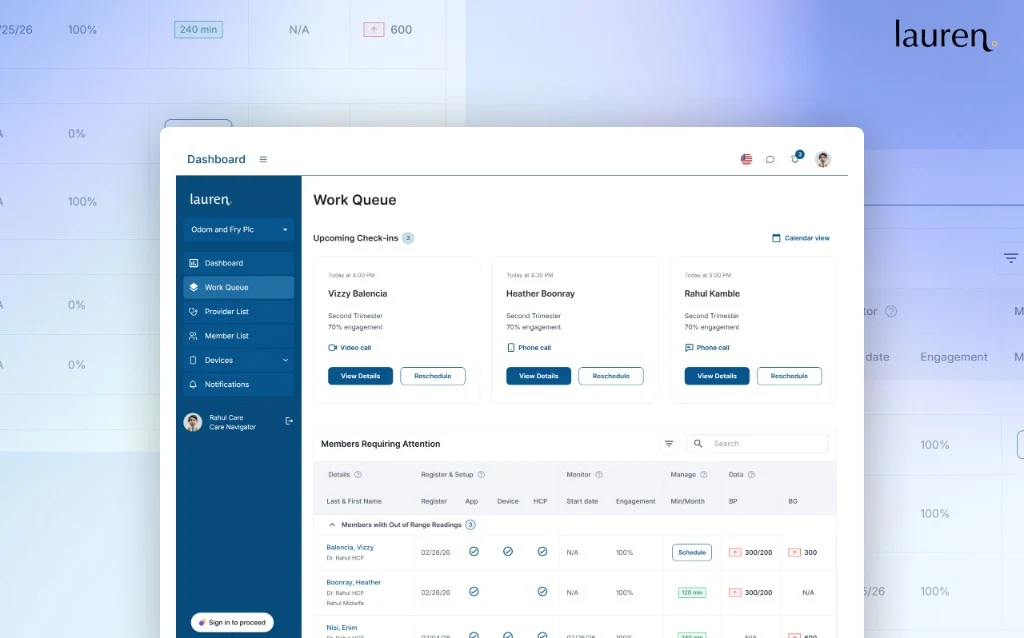
A HIPAA-ready maternal health platform enabling remote patient monitoring, care coordination, and personalized engagement from pre-pregnancy through postpartum.
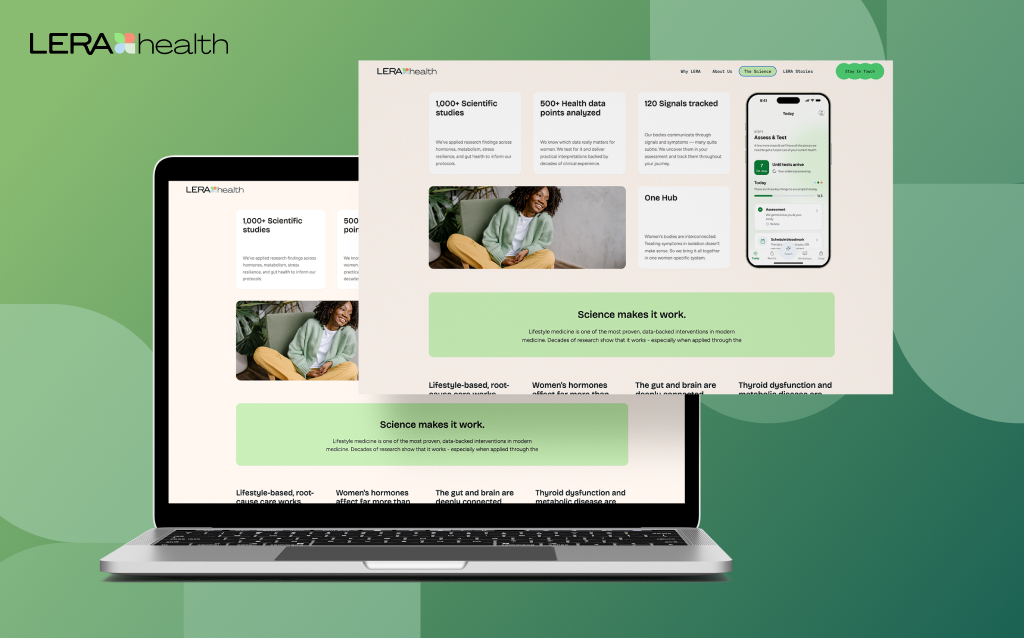
A women’s health product experience focused on guided care journeys, education, and compliance-aware workflows to support long-term engagement.
Teams that need more than a monitoring dashboard bolted onto a ward.
A first service line, such as heart failure or respiratory infection, on one platform.
Replacing spreadsheets and vendor portals with one board and one record.
Dispatch and visit documentation that feed the hospital's encounter.
Kit tracking and data feeds that plug into a hospital's command center.
A hospital at home technology platform for startups selling to health systems.
Programs that also need research data exports from the home stay.
The systems a hospital at home platform reads from and writes to.
We build secure, scalable products designed for privacy, interoperability, and regulatory readiness from day one across every sector we serve.

Protect PHI with privacy-first architecture, encrypted storage and transmission, and strict access controls.

Enabling standardized health data exchange through standards-based API mappings.

Supporting enterprise-grade interoperability for clinical messaging and record workflows.
We combine deep technical expertise with industry-specific knowledge to deliver solutions that aren't just functional, but transformational.
We implement rigorous security protocols and compliance standards (HIPAA, GDPR, SOC2) across all industrial solutions to protect sensitive data.
Our architectures are built to handle massive data loads and user bases, keeping performance steady whether you're serving ten or ten million.
Using our suite of internal tools and proven frameworks, we cut setup work so your first release reaches users sooner.
Beyond simple wrappers, we build deep-learning integrations and predictive analytics directly into the core of your industry-specific workflows.
How to build a hospital at home technology platform one service line at a time. Timing depends on scope; we agree a fixed first release on the scoping call.
We review your EHR, device partner, dispatch model and the service line you plan to start with.
Your clinical leads set the parameters, silence windows and the return path to the hospital before screens are drawn.
One service line with the command center board, kit tracking, dispatch and EHR write-back working end to end.
Alert thresholds and visit rules are tuned with the care team on the first patients.
More service lines, more device types and monitoring of the platform under agreed change control.
Short facts we design the record and the data around, each linked to its primary source.
In HL7 FHIR R4, Encounter.class uses the HL7 v3 ActEncounterCode value set, which defines an inpatient encounter (IMP) as one where the patient is admitted by a hospital or equivalent facility, and a home health encounter (HH) as one that takes place in the patient's residence.
Source: HL7 FHIR R4, ActEncounterCode value setThe HL7 FHIR R4 Vital Signs profile requires each vital signs Observation to carry a status, the vital-signs category, a LOINC code for what was measured, the time of measurement and, for a numeric result, a standard UCUM unit.
Source: HL7 FHIR R4, Vital Signs profileHospital Conditions of Participation require every medical record entry to be legible, complete, dated, timed and authenticated by the person responsible for the service, and every order, including a verbal order, to be dated, timed and authenticated promptly.
Source: 42 CFR 482.24(c) (eCFR)Under the hospital nursing Condition of Participation, drugs and biologicals must be prepared and administered in accordance with Federal and State laws, the orders of the practitioner responsible for the patient's care, and accepted standards of practice.
Source: 42 CFR 482.23(c)(1) (eCFR)A hospital must discharge the patient, and transfer or refer the patient where applicable, with all necessary medical information about the current course of illness and treatment, post-discharge goals of care and treatment preferences, to the appropriate post-acute providers.
Source: 42 CFR 482.43(b) (eCFR)We don't just build products; we forge lasting partnerships. See how we've helped industry leaders transform their vision into technical reality.
“I can clearly see how Agnotic has a unique way of handling end-to-end development. They are always active on quick chat and provide support quickly.”

Aaron Phelan
Founder, Benchmark
“Agnotic combines deep technical expertise with strong domain knowledge. They understand the business context, anticipate challenges, and make collaboration smooth and effective.”

John Pasmore
Founder, Latimer
“Agnotic is the best technical team we evaluated. Their engineering excellence made our work dramatically easier and allowed us to stay focused on what matters most for maternal care outcomes. They took full ownership of the technical execution, and we are always happy to continue working together.”

Kim Smith
Founder, My Lauren
This page covers acute care delivered at home. These pages cover the device, monitoring and home care work around it.
Device data ingestion and monitoring for chronic outpatient programs.
Connecting home vitals devices and their clouds to clinical systems.
OASIS, visit scheduling and EVV for skilled home health agencies.
Bedside device data flowing into the hospital record.
The main virtual hospital models and the systems they share.
The safeguards we build into every system that holds patient data.
Explore other production-grade engineering platforms we deliver across healthcare.
The technical patterns behind this platform translate naturally into adjacent verticals.