

Nurses and allied health staff
Short sessions on shared workstations and workstations on wheels between patients.
- Quick sign-in through the hospital's identity provider
- Session ends when they walk away
- Two or three taps to an attestation


A nurse on a night shift has minutes, not a desk, to read the updated sedation policy and confirm a licence renewal. Agnotic Technologies builds the staff portal that works on the shared workstations and phones hospital teams actually use, and keeps the attestation, licence and competency records surveyors ask for.
Trusted by global innovators











A hospital staff portal is the employee portal frontline teams open on shared workstations and phones to read policies and attest to new versions, see licence and certification expiry dates, keep competency and annual education records, and check their shifts. Agnotic Technologies builds these portals for hospitals, connected to the HR, learning and scheduling systems already in place.
The same portal, used in very different ways. We design for the hardest case first: a shared workstation on a busy unit.
Short sessions on shared workstations and workstations on wheels between patients.
Mostly on their own phones, often outside the building.
No fixed desk and little overlap with educators or managers.
Need to know who is overdue, by unit, today.
Most hospital intranets were built for office staff with their own laptops. The floor is different.
Sign-in takes longer than the task, so staff ask a colleague to read the policy to them instead.
Sessions stay open on a shared workstation, and the next person sees someone else's records.
The policy library is a folder of PDFs with no versions, so nobody can prove who read which revision.
Licence and certification expiry dates live in a spreadsheet that one coordinator updates by hand.
Competency sign-offs sit on paper in unit binders, and float staff have no record on their new unit.
Small buttons, short timeouts and password-only sign-in shut out staff with accessibility needs.
Three principles we agree on before any screen is designed.
Sign-in, session timeout and sign-out are designed for a workstation used by many people in one shift. The phone experience follows from that, not the other way round.
Each attestation stores the person, the policy version and the time. Reports are built from those records, so there is nothing to reconcile before a survey.
HR, learning and scheduling data stay where they are. The portal reads them, shows them and links to them, and only writes the records it owns.
Modules we build or connect, in the order most hospitals need them.
Single sign-on through your identity provider, with timeouts and sign-out tuned for shared devices.
Every policy with its version, owner, effective date and review date, searchable by unit and role.
Campaigns for new or changed policies, with reminders and a record of who attested to which version.
Expiry dates by person and role, with alerts to staff and managers ahead of the window you set.
Required competencies by unit and role, with the validator, method and date of each sign-off.
Required courses and completion dates read from your learning management system.
Upcoming shifts from the scheduling system, so staff do not need another login.
Overdue items by unit, float staff gaps and an export for each survey report.
The portal sits on top of the systems hospitals already run.
Measures we build into the manager dashboards, agreed with nursing education and HR.
How long staff wait on a shared workstation before the portal opens.
Share of staff who attested to each policy version, and how fast.
Licences and certifications flagged before they lapse, not after.
Staff working on units where a required competency is missing.
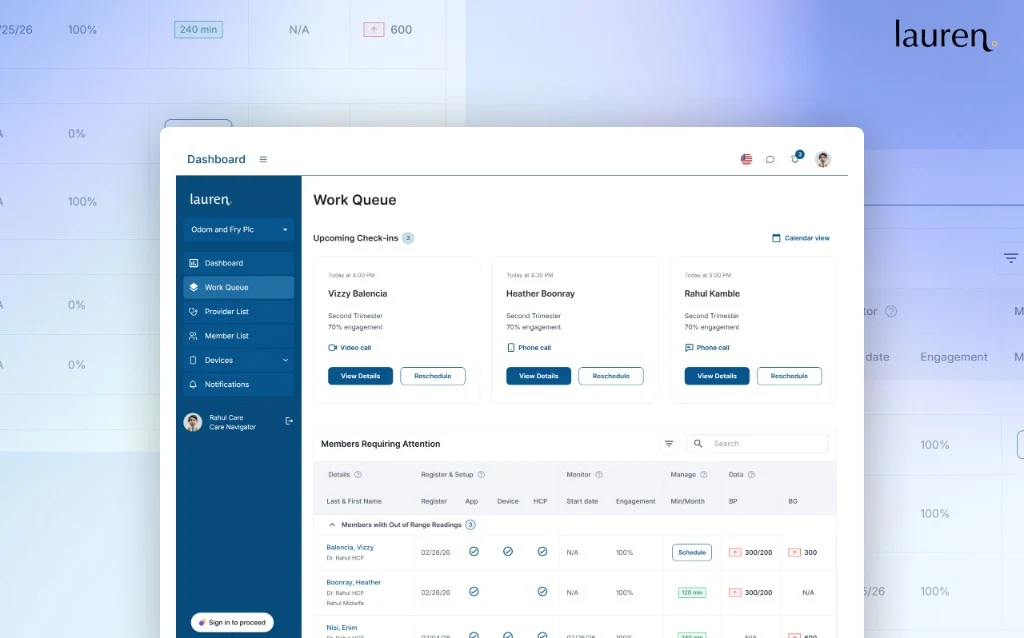
A HIPAA-ready maternal health platform enabling remote patient monitoring, care coordination, and personalized engagement from pre-pregnancy through postpartum.
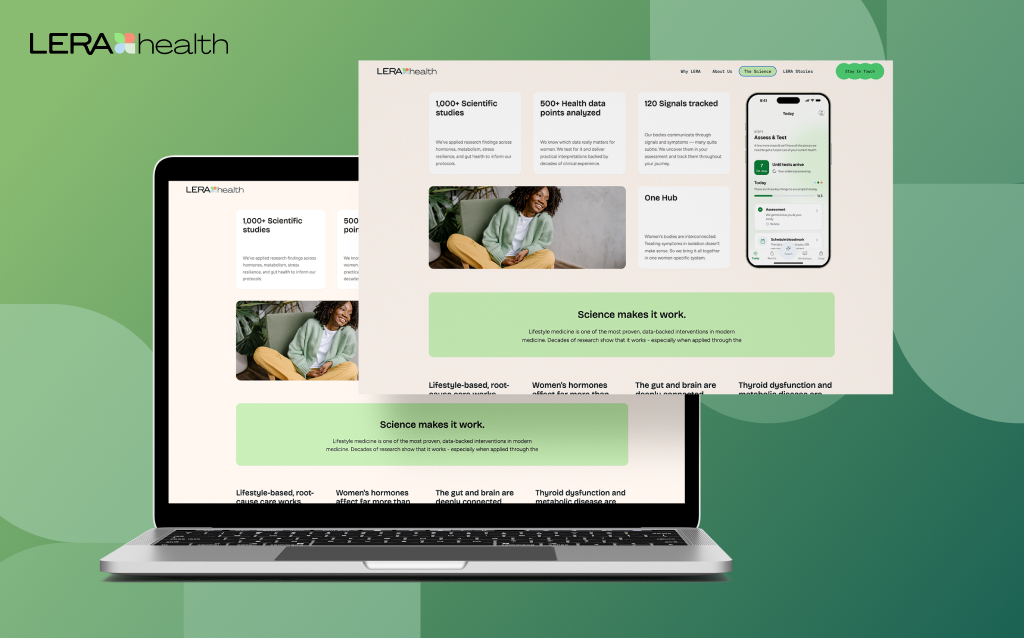
A women’s health product experience focused on guided care journeys, education, and compliance-aware workflows to support long-term engagement.
The groups that own the records and chase the follow-ups.
Competency validation and annual education without paper binders.
Licence and certification expiry tracked in one place.
Survey-ready reports on attestations and staff records.
A read view of appointment and reappointment dates from the credentialing system.
One portal with policies and competencies that differ by site.
A lighter portal for small teams with the same record keeping.
The systems we integrate so staff do not sign in five times.
The checklist we build the portal's reports against: each record, where it comes from and the report that proves it. Your accreditation body decides what it asks for; the portal makes the answer quick.
We build secure, scalable products designed for privacy, interoperability, and regulatory readiness from day one across every sector we serve.

Protect PHI with privacy-first architecture, encrypted storage and transmission, and strict access controls.
We combine deep technical expertise with industry-specific knowledge to deliver solutions that aren't just functional, but transformational.
We implement rigorous security protocols and compliance standards (HIPAA, GDPR, SOC2) across all industrial solutions to protect sensitive data.
Our architectures are built to handle massive data loads and user bases, keeping performance steady whether you're serving ten or ten million.
Using our suite of internal tools and proven frameworks, we cut setup work so your first release reaches users sooner.
Beyond simple wrappers, we build deep-learning integrations and predictive analytics directly into the core of your industry-specific workflows.
We release in the order your surveys need. Timing depends on scope; we agree a fixed first release on the scoping call.
We review your identity provider, HR, learning and scheduling systems and the records you are asked for most.
We watch sign-in and policy lookup on real shared workstations on two or three units.
Sign-in, the policy library and read attestations working for a pilot group of units.
Expiry tracking and competency records added, with manager dashboards.
More units, sites and reports, with accessibility checks on every release.
Short facts we design the records, sign-in and screens around, each linked to its primary source.
The hospital Conditions of Participation require a hospital to assure that its personnel are licensed or meet other applicable standards required by State or local laws.
Source: 42 CFR 482.11(c) (eCFR)The medical staff must periodically conduct appraisals of its members and examine the credentials of every eligible candidate before recommending appointment to the governing body.
Source: 42 CFR 482.22(a)(1) and (2) (eCFR)NIST SP 800-63B-4 (July 2025) says that at authentication assurance level 2 the overall reauthentication timeout should be no more than 24 hours and the inactivity timeout should be no more than 1 hour.
Source: NIST SP 800-63B-4, Authentication and Authenticator ManagementWCAG 2.2 success criterion 3.3.8 (Level AA) says no step in an authentication process may require a cognitive function test, such as remembering a password, unless an alternative method or an assisting mechanism is offered.
Source: W3C, WCAG 2.2, success criterion 3.3.8WCAG 2.2 success criterion 2.5.8 (Level AA) sets a minimum pointer target size of 24 by 24 CSS pixels, with exceptions for spacing, equivalent controls and inline targets.
Source: W3C, WCAG 2.2, success criterion 2.5.8We don't just build products; we forge lasting partnerships. See how we've helped industry leaders transform their vision into technical reality.
“I can clearly see how Agnotic has a unique way of handling end-to-end development. They are always active on quick chat and provide support quickly.”

Aaron Phelan
Founder, Benchmark
“Agnotic combines deep technical expertise with strong domain knowledge. They understand the business context, anticipate challenges, and make collaboration smooth and effective.”

John Pasmore
Founder, Latimer
“Agnotic is the best technical team we evaluated. Their engineering excellence made our work dramatically easier and allowed us to stay focused on what matters most for maternal care outcomes. They took full ownership of the technical execution, and we are always happy to continue working together.”

Kim Smith
Founder, My Lauren
This page covers the frontline staff portal. These pages cover the HR records, scheduling and survey work around it.
Payroll, leave and the core employee record.
HR systems built around your own processes.
Staff scheduling rules and capacity planning.
Facility-wide survey preparation and tracer tracking.
The operational systems a hospital runs on.
How an employee portal differs from a partner or client portal in sign-in, data and access reviews.
Explore other production-grade engineering platforms we deliver across healthcare.
The technical patterns behind this platform translate naturally into adjacent verticals.