Radiology PACS
Full acquisition-to-reading workflow for hospital and imaging-center radiology.


We build picture archiving and communication systems, zero-footprint viewers, and imaging pipelines on DICOM, DICOMweb, and FHIR ImagingStudy: built for the speed radiologists expect, not a repackaged open-source viewer.
Trusted by global innovators









Medical imaging PACS software stores, moves and displays medical images such as CT, MRI and X-ray studies, using the DICOM standard. Agnotic Technologies builds PACS components, vendor-neutral archives and zero-footprint viewers for you, served over DICOMweb and linked to the EHR through FHIR ImagingStudy.
Performance decides whether radiologists trust it. DICOMweb (WADO-RS, QIDO-RS, STOW-RS) lets a viewer open a large CT without waiting for a full download.
Context matters as much as pixels. FHIR ImagingStudy, DiagnosticReport and ServiceRequest tie each study to the right order, patient and report.
What it is
A PACS acquires, stores, distributes, and displays medical images. A vendor-neutral archive decouples that storage from any single vendor so your data stays portable, and a zero-footprint viewer puts studies in any browser without a client install.
We build these medical imaging solutions as one coherent surface on DICOM and DICOMweb, then link it to the EHR through FHIR ImagingStudy so imaging is part of the record, not a disconnected island.
See how we design DICOM ingestion, vendor-neutral archives, DICOMweb serving, and FHIR ImagingStudy links across imaging platforms we build.
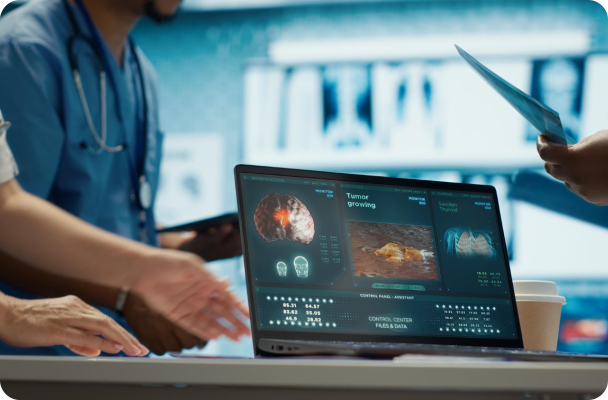
Each capability pairs an imaging workflow with the standard that makes it interoperable.
C-STORE, C-FIND, and MWL for modality connectivity, plus DICOMweb WADO-RS, QIDO-RS, and STOW-RS for browser-native retrieval: the transport layer every downstream viewer depends on.
A single archive that stores studies independent of any one PACS vendor, with tiered object storage, DICOM tag morphing, and lifecycle rules so imaging data outlives the system that created it.
We expose FHIR ImagingStudy, DiagnosticReport, and ServiceRequest so studies map cleanly to EHR orders and reports, closing the loop between the imaging silo and the clinical chart.
Browser-based viewing with progressive loading, MPR, window/level, and measurement tools built on OHIF/Cornerstone patterns, no client install, no per-workstation plugin sprawl.
Integration points for FDA-cleared and research imaging models, with results written back as DICOM SR or FHIR observations and surfaced in the reading workflow rather than a separate tool.
Role-based study access, break-glass logging, and immutable audit trails aligned to HIPAA: every image view, export, and share is recorded and reviewable.
Where it runs
Full acquisition-to-reading workflow for hospital and imaging-center radiology.
Remote reading platforms with secure study distribution and worklist routing.
Multi-department image consolidation across radiology, cardiology, and pathology.
MedTech platforms that ingest DICOM, run inference, and return findings to the reader.
Portal-based study sharing so patients and referring physicians can view images.
De-identified image repositories for trials, model training, and teaching files.
Imaging is where generic viewers and document stores fall over. We treat DICOMweb performance and archive design as first-class engineering from week one.

Health Insurance Portability and Accountability Act
Protect PHI with privacy-first architecture, encrypted storage and transmission, strict access controls, and traceable audit logs.

General Data Protection Regulation
Implement lawful consent flows, data minimization, retention controls, and secure processing for sensitive health data.

Fast Healthcare Interoperability Resources
Enable standardized health data exchange across apps, care teams, and systems through standards-based FHIR APIs.

Health Level Seven International
Support enterprise-grade interoperability with HL7-based integrations for records, events, and clinical messaging workflows.

Health Information Trust Alliance
Align security programs to healthcare-specific control and risk management practices trusted by providers and ecosystem partners.

Health Information Technology for Economic and Clinical Health Act
Design with breach notification readiness, digital record safeguards, and operational controls that support regulated care programs.

FDA Software as a Medical Device
Plan software quality, traceability, and documentation pathways for products that may require SaMD review and submission.

Medical Device Regulation (European Union)
Prepare EU market-ready processes for risk classification, evidence tracking, and lifecycle governance under MDR expectations.

Substance Abuse and Mental Health Services Administration
Apply confidentiality controls and consent-aware sharing models for behavioral and mental health data experiences.
Standards we build against
Modality connectivity, archive design, and viewer performance run as parallel tracks so the platform reaches production reading, not just a demo.
We inventory modalities, worklists, and target EHRs, then map the DICOM tags, transfer syntaxes, and FHIR resources the platform must speak before any code is written.
We stand up the vendor-neutral archive, object storage tiers, and DICOMweb services, validating C-STORE ingestion and WADO-RS retrieval against real study volumes.
We build the zero-footprint viewer and wire FHIR ImagingStudy and DiagnosticReport into the EHR so studies, orders, and reports stay in sync.
Phased go-live with retrieval-latency dashboards, storage lifecycle automation, and alerting on failed modality transfers as study volume grows.
Short facts we design around, each linked to its primary source.
DICOM is the international standard for medical images and related information, maintained by NEMA and also published as ISO 12052.
Source: DICOM Standard (NEMA)In HL7 FHIR R4, the ImagingStudy resource represents the content of a DICOM imaging study and points to the endpoints where its images can be retrieved.
Source: HL7 FHIR R4, ImagingStudyFDA's guidance on device software functions focuses oversight on software that meets the definition of a medical device and could put patient safety at risk if it does not work as intended.
Source: FDA, Policy for Device Software Functions and Mobile Medical Applications (2022)The HIPAA Security Rule requires administrative, physical and technical safeguards for electronic protected health information.
Source: 45 CFR Part 164 Subpart C (eCFR)Related proof of compliant delivery: for Lera Health we built the privacy-first data layer, secure clinical workflows, and patient experience end to end: the same rigor around PHI handling, access control, and audit that an imaging platform demands.

Imaging is unforgiving about performance and standards. We bring both, plus the compliance discipline PHI-heavy pixel data requires.
HIPAA-aligned access control, encryption, and audit logging designed into the archive and viewer from sprint one, not bolted on before launch.
We speak DICOMweb, transfer syntaxes, and FHIR ImagingStudy natively, so your team isn't teaching us the standards mid-project.
Progressive loading, tiled retrieval, and storage tiering tuned so radiologists open large studies fast, not after a spinner.
Vendor-neutral architecture keeps your imaging data portable across PACS vendors and connected to the EHR record.

Share your modalities, study volume, and EHR landscape. We'll return a phased plan covering DICOMweb architecture, archive design, and FHIR ImagingStudy integration.
contact@agnotic.com
Partnerships
contact@agnotic.com