



The frontend is the visit. The backend is the record, the audit and the permission check. Teams get stuck when they pick a UI kit before they know which actions must be audited and which user may see which chart.
Agnotic Technologies separates those decisions so a screen change does not rewrite the clinical store.
How should you choose an EHR frontend and backend?
Choose the EHR backend for the record, the audit and the permissions, and the frontend for the visit clinicians actually finish. Agnotic Technologies keeps those apart so a new screen does not become a new database, and the signed note stays on the server.
The HIPAA Security Rule requires hardware, software and procedural mechanisms that record and examine activity in information systems that contain or use electronic protected health information.
Planning the record and the screens?
EHR integration services cover how a custom record sits next to the systems you already run.
What belongs on each side?
Put anything a clinician judges by eye on the frontend. Put anything you must prove later on the backend.
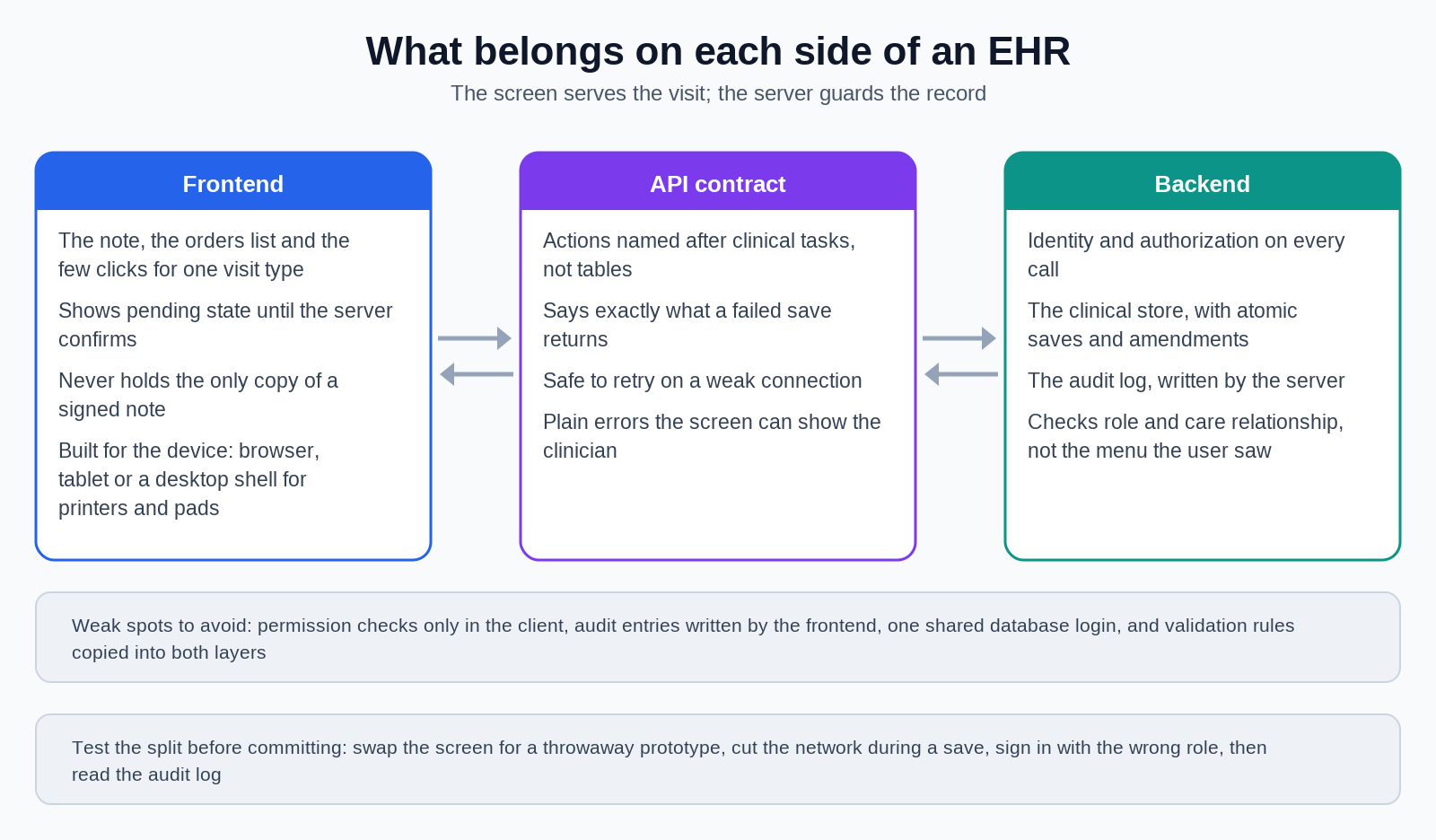
- Frontend: the note, the orders list, and the few clicks for one visit type.
- Backend: identity, authorization, the clinical store and the audit log.
- API: the contract between them, including what a failed save returns.
- Not on the client: the only copy of a signed note.
Drafts are the grey area. A draft kept on the device protects the clinician from a dropped connection, but the server copy is the one that counts, and the screen should say plainly when the two differ.
Search and lists sit in the middle too. The frontend decides how results look, while the backend decides which patients the user is allowed to see in them.
How do teams approach the choice?
Write the three actions the first visit must support: open the chart, write a note, sign it. Design the API for those actions, including who may call them. Then pick UI tools that can call that API. Our EHR database architecture post is the storage view. This post is the split between screen and service.
What is a weak reason to pick a stack?
A framework a developer used last year, or a component library demo that has no audit log. The stack is fine if the signed note, the permission check and the log survive a UI rewrite.
Which decisions can wait?
Styling, the component library and the charting package can wait until a clinician has clicked through a draft. Those choices are cheap to change. The data contract, the permission model and the audit format are not, so settle them first.
A simple rule helps. If changing the choice later means migrating stored records, make it now. If it only means rebuilding screens, make it after the first visit type has been tried by the people who will use it.
Should the frontend be a web app, a desktop app or both?
Most EHR builds start as a browser app, because clinics already run browsers and IT can update one deployment centrally. A desktop shell or a native tablet app earns its place only when hardware or offline work demands it.
- Browser app: one release for every user, and the simplest route to a SMART on FHIR launch inside another record.
- Tablet or phone: bedside rounds or home visits where a keyboard gets in the way.
- Desktop shell: a label printer, signature pad or scanner the browser cannot reach.
- Offline mode: only where the visit happens on a link that drops, and only with a written rule for conflicting edits.
Every extra client is one more place where a permission rule can drift. Keep the rules on the server so each client gets the same answer for the same user.
What does the backend have to guarantee?
The backend guarantees that a saved note is complete, attributed and retrievable, whichever screen sent it. It also decides who may read each chart and writes down every one of those decisions.
- Atomic saves: the note and its signature are stored together or not at all.
- Amendments: a corrected note keeps the original, with the author and time of each version.
- Authorization per call: the server checks role and care relationship, not the menu the user happened to click.
- Safe retries: a request resent from a weak connection does not create a second order.
- Plain errors: the screen can tell the clinician exactly which part did not save.
How should the API between them be designed?
Design the API around clinical actions rather than database tables. An endpoint named for signing a note is easier to secure, test and audit than a generic update on a notes table.
Where the record exchanges data with other systems, expose HL7 FHIR resources at the boundary and keep the internal model free to change. A FHIR R4 facade lets partners read data without dictating how your screens are built.
Version the API from the first release. A clinic laptop may run an older screen build after the server has moved on, and both have to keep working until the update lands.
Which frontend choices affect clinicians most?
Clinicians notice how fast the first useful screen appears, whether repeated orders have keyboard shortcuts, and whether the layout jumps while data loads. They rarely notice the framework behind any of it.
Accessibility belongs in the same list. Contrast, focus order and readable type help a tired user late in a shift, and they cost far less to build in than to retrofit.
Common backend mistakes
Most backend failures in EHR builds come from rules living in the wrong place. Watch for these during code review, not after go-live.
- Permission checks only in the client, so a direct API call skips them.
- Audit entries written by the frontend, so a script can avoid creating one.
- One shared database login for every service, so the log cannot say which part acted.
- Validation rules copied into both layers, so the two copies slowly disagree.
How should orders and results cross the split?
Orders and results should cross the split as server events, not as screen state. The frontend submits an order and shows its status, while the backend owns routing to the lab or pharmacy and the record of what came back.
This keeps a result visible even when nobody has the chart open. When a result lands, the server stores it, attaches it to the right order and raises the task, and any screen that opens the chart later shows the same thing.
- Order placed: saved on the server first, then shown as pending on the screen.
- Result received: matched to the order by identifier, not by patient name.
- Abnormal value: a task created by the server, so it does not depend on a browser tab.
- Acknowledged: the user and time stored beside the result.
What should you measure after go-live?
Measure whether clinicians finish the visit inside the product and whether the server keeps what they did. Framework benchmarks say little about either.
- Notes started but not signed by the end of the day.
- Saves that failed and were retried, grouped by screen.
- Permission refusals, to catch roles that were set up wrong.
- Pages clinicians leave to finish the work somewhere else.
Ownership of each layer
Give each layer one owner. A frontend lead owns the visit flow and accessibility, and a backend lead owns the data model, permission rules and audit log. The API contract is shared and changes only through review.
Clinical sign-off belongs to a named clinician champion who approves the screens. That person should not approve schema changes, and the backend lead should not redesign the note template.
How do you test the split before committing?
Build one thin slice end to end: open a chart, write a note, sign it, then read it back as a second user with a different role. If that slice holds, the stack choice is sound.
- Step 1, swap the screen: rebuild the note form in a throwaway prototype and confirm the server needs no change.
- Step 2, cut the link: drop the network during a save and check that no half-saved note appears.
- Step 3, change the role: sign in as a user with no access to that chart and confirm the server refuses.
- Step 4, read the log: confirm each action above appears with user, patient and time.
What are EHR frontend and backend selection best practices?
- Settle the record, permissions and audit before choosing a UI kit.
- Keep the only copy of a signed note on the server.
- Name API actions after clinical tasks, not tables.
- Put FHIR at the boundary instead of through the whole codebase.
- Choose tools your team can hire for and maintain, not the newest release.
- Test the slice with a real clinician before adding a second visit type.
How Agnotic can help
Agnotic designs and builds EHR software for clinics and product teams, starting with the data contract and permission model. We then build the first visit flow on top, with a clinician testing each screen before the next one is added.
Build your EHR with Agnotic
Custom EHR software development, from the clinical record and audit log to the screens clinicians use every visit.
Related reading on Agnotic
How the record is stored, secured and connected, and how the wider stack fits together.


