



A working integration with Epic is not enough to go live. Before a health system turns on a vendor's app in its Epic environment, its security and privacy teams review the vendor: a long questionnaire, requests for evidence, an architecture review and contract terms. Many promising pilots stall here for months.
This post is for vendors connecting to Epic customers. It covers who runs the review, what the questionnaire probes, which evidence to prepare, what the architecture document must show, the gaps reviewers find most often and how to keep the next review short.
What is an Epic vendor security review?
Connecting your product to Epic customers?
Our Epic integration page covers the SMART on FHIR, API and interface work we build with vendors.
An Epic vendor security review is the assessment a health system runs on a third-party vendor before allowing its app or interface to connect to the system's Epic environment. The health system's teams, not Epic itself, check the vendor's controls, data flows and contracts. Agnotic Technologies helps vendors build products and documents that pass it.
Each health system runs its own review, so a vendor connecting to several Epic customers will face several reviews with overlapping questions.
Who runs the review and what do they decide?
The review is run by the health system's information security team, usually with privacy, legal, procurement and the Epic application team. Together they decide whether the vendor can connect, with what data and under which conditions.
- Information security: questionnaire, evidence and architecture review.
- Privacy: what patient data is used and for what purpose.
- Legal and procurement: business associate agreement and contract terms.
- Epic application team: which app, scopes and interfaces are activated.
When should the review start?
Start the review when the commercial conversation starts, not after the integration is built. Ask the health system for its questionnaire and contract templates early, and run the review alongside technical work.
A review that begins only when the app is ready to activate can hold a finished integration for a long time. Starting early also surfaces requirements, such as a hosting region or a logging rule, while they are still cheap to meet.
What does the security questionnaire ask?
The questionnaire asks how the vendor protects data across its whole operation: governance, access control, encryption, hosting, software development, monitoring, incident response, business continuity and its own vendors. Many health systems use a standard questionnaire, others their own.
Answer every question specifically and point to evidence. Answers such as "industry standard encryption" invite follow-up rounds that add weeks.
Which evidence should you have ready?
Have a security evidence pack ready before the first review, kept current and shared under a nondisclosure agreement. Reviewers trust documents over assurances.
A SOC 2 report is an assurance report, issued by a CPA, on a service organization's controls relevant to security, availability, processing integrity, confidentiality or privacy.
- Assurance: an independent assurance report or penetration test summary, where the vendor has one.
- Policies: information security, access control, incident response and data retention.
- Risk analysis: the most recent risk assessment and the plan that came from it.
- Operations: vulnerability scanning, patching and backup restore test records.
- People: security training records and background check policy.
What should the architecture document show?
The architecture document should show exactly how data moves from Epic to the vendor and onward: the launch and authorization path, the scopes requested, where data is stored and processed, and every third party that touches it.
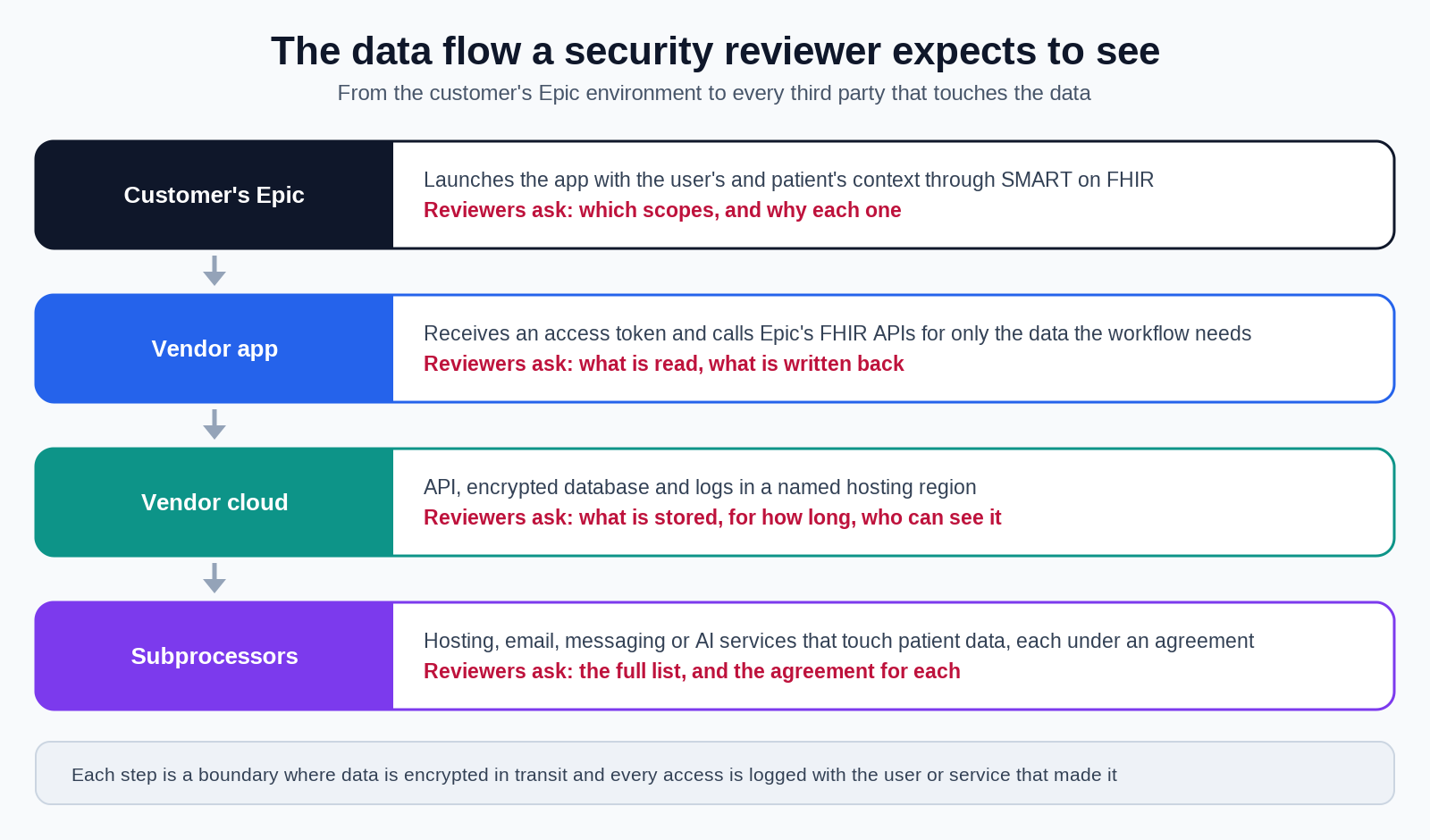
The SMART App Launch implementation guide uses OAuth 2.0 and OpenID Connect so that apps can launch from an EHR with the user's and patient's context and only the access scopes they were granted.
Mark where data is encrypted in transit and at rest, and where each access is logged. List each scope and explain why the app needs it. Reviewers often ask vendors to drop scopes the product does not use, so request only what the workflow needs from the start.
Apps, interfaces and backend connections
The review changes with the type of connection. A SMART on FHIR app launched by users draws questions about scopes, sign-in and session handling, while an HL7 v2 interface through the health system's interface engine draws questions about network connections and message content.
Backend connections that run without a user, such as scheduled data pulls, raise questions about how client credentials and keys are stored, rotated and revoked. Describe each connection type separately in the architecture document.
Which data questions come up most?
The most common data questions are what patient data the vendor stores, for how long, where, and who can see it. Vague answers here stop reviews more often than technical gaps.
- Storage: which data is stored and which is only passed through.
- Location: the hosting region and whether data leaves it.
- Retention: how long data is kept and how it is deleted.
- Access: which vendor staff can see patient data, and how that access is logged.
- Secondary use: whether data is used to train models or for analytics, and under what agreement.
Contracts and the business associate agreement
Most vendors handling patient data for a health system will sign a business associate agreement, and the security review often feeds its terms.
A HIPAA covered entity may share protected health information with a business associate, such as a software vendor, only under a business associate agreement that commits the vendor to safeguard it.
Expect negotiation on breach notification timing, subcontractor terms, insurance, audit rights and data return at the end of the contract. Have your standard positions agreed internally before the first review.
What gaps do reviewers find most often?
Reviewers most often find gaps in basics that small vendors have not yet formalized. These patterns recur.
- No written policies: controls exist in practice but nothing is documented.
- Shared accounts: staff or service accounts used by several people.
- No tested restore: backups taken but never restored to prove they work.
- Broad scopes: the app requests more data than its workflow uses.
- Unknown subprocessors: email, messaging or AI services not listed or covered by agreements.
How should remediation be handled?
Handle findings with a written remediation plan: each gap, the fix, the owner and a target date, agreed with the reviewer. Many health systems will approve a connection with conditions if the plan is credible.
Close the items on time and send evidence when each is done. A vendor that delivers its plan builds trust that shortens the next review.
A worked example: a care coordination startup's first Epic customer
A care coordination startup had a working SMART on FHIR app in a test environment, but its first health system customer's review returned a long list of findings: no incident response plan, shared administrator accounts and an undocumented messaging subprocessor.
The team wrote the missing policies, moved to individual accounts with multi-factor sign-in, added the subprocessor to its agreements and drew a one-page data flow. It also dropped two scopes the app did not use.
The second review went faster, because the evidence pack and architecture document were ready before the questionnaire arrived.
Who owns what on the vendor side?
A vendor needs one person who owns the review end to end, with clear inputs from engineering and leadership.
- Security lead: questionnaire answers, evidence pack and remediation plan.
- Engineering: architecture document, scopes and technical fixes.
- Leadership: contract positions, insurance and risk acceptance.
- Customer success: timelines with the health system's project team.
How do you keep reviews short?
Keep a library of approved answers, update the evidence pack every quarter, and track how long each review takes and which questions cause follow-up rounds.
- Answer library: approved answers reused across questionnaires.
- Evidence freshness: date of each document and when it is next due.
- Review time: from questionnaire received to approval.
- Follow-ups: questions that needed a second round, fixed in the library.
What are Epic vendor security review best practices?
Prepare an evidence pack and architecture document before the first customer asks, answer every question specifically, request only the scopes the workflow uses and list every subprocessor.
Agree contract positions internally, handle findings with a dated remediation plan, and keep an answer library so each review builds on the last.
How Agnotic can help
Agnotic helps vendors prepare for health system security reviews: building Epic integrations with narrow scopes, drawing architecture and data flow documents, closing technical gaps such as logging, access control and restore testing, and supporting answers to technical questions.
Build an Epic-ready product with Agnotic
Our HIPAA-ready development service builds health products with the controls security reviews look for.
Related reading on Agnotic
Epic integration, SMART apps and security.


