



A single study can run on eight or more systems: one to plan and track the study, one to capture data, one to randomize and ship drug, one to file documents, others for patient questionnaires, consent and safety. Each is sold separately, each holds part of the truth, and the people running the study spend a surprising share of their week moving information between them.
This guide maps the software for clinical trials system by system: what each one does, who uses it, how they connect, and where buying makes sense versus building. It is written for sponsors, CROs, research sites and the product teams building tools for them.
What software do clinical trials need?
Building or connecting trial systems?
Agnotic builds clinical trial software and the integrations between CTMS, EDC, eCOA and safety systems.
Clinical trials typically need a CTMS to plan and track the study, an EDC system to capture participant data, an RTSM system for randomization and drug supply, an eTMF for essential documents, eConsent and eCOA tools for participants, and a safety database for adverse events. Larger programs add analytics, payments and site portals on top.
Not every study needs every system. A small investigator-initiated study may run on EDC and a document system alone, while a global phase III program needs all of them, tightly connected. The right stack follows the protocol and the operating model, not a vendor's bundle.
What does each clinical trial system do?
Each system owns one part of the study. Knowing which system is the source of truth for which data is the first step to connecting them cleanly.
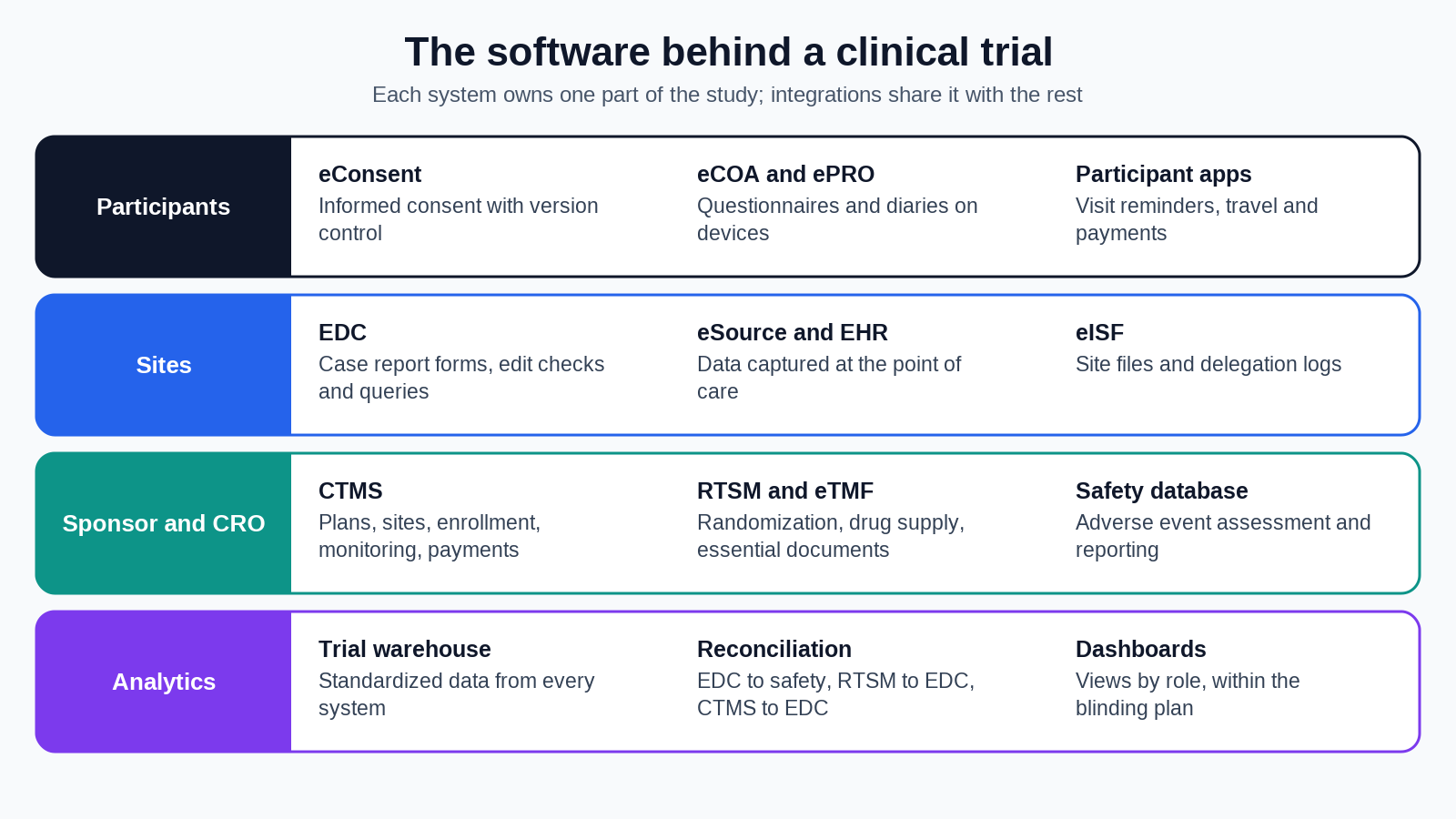
- CTMS: Study plans, site selection and activation, enrollment tracking, monitoring visits and site payments.
- EDC: Electronic case report forms where sites enter participant data, with edit checks and queries.
- RTSM or IRT: Randomization, treatment assignment and drug supply to sites.
- eTMF: The trial master file of essential documents, organized for inspection.
- eConsent: Electronic informed consent, with comprehension checks and version control.
- eCOA or ePRO: Questionnaires and diaries completed by participants or clinicians on devices.
- Safety database: Adverse event collection, assessment and regulatory reporting.
- Site systems: eISF for site files, eSource for capturing data at the point of care, and the site's own EHR.
Which records rules shape trial software?
Trial software has to keep complete records for years and show every change made to them. Those requirements shape the data model and the audit design of every system in the stack.
For studies under an IND, 21 CFR 312.62(b) requires investigators to prepare and maintain adequate and accurate case histories recording all observations and other data pertinent to the investigation on each individual. Under 312.62(c), records are kept for two years after a marketing application is approved for the indication, or for two years after the investigation is discontinued and FDA is notified if no application is filed or approved.
Where those records are electronic, 21 CFR 11.10(e) calls for secure, computer-generated, time-stamped audit trails that independently record the date and time of operator entries and actions that create, modify or delete electronic records, and record changes must not obscure previously recorded information. Every system that holds study records needs this built in, not added later.
How should trial systems connect?
Trial systems should connect around shared identifiers for the study, site, participant and visit, with each piece of data flowing from the system that owns it. Most integration problems come from two systems both thinking they own the same data.
- CTMS to EDC: Site activation and participant enrollment status, so monitors see the same picture as data managers.
- RTSM to EDC: Randomization assignments and dispensing, so the case report form never needs re-keying.
- eCOA to EDC: Questionnaire data and compliance, mapped to the right visit.
- EDC to safety: Serious adverse events sent for assessment, with reconciliation between the two.
- Everything to eTMF: Documents generated by other systems filed automatically in the right place.
- EHR to EDC: Where sites allow it, pulling lab results and vitals from the record instead of transcribing them.
Write down the ownership map before connecting anything: for each data item, the owning system, the systems that receive it and how often. That single page prevents most reconciliation problems later in the study.
Should you buy or build clinical trial software?
Buy the core regulated systems when established products fit your studies, and build where your process, therapy area or participant experience is what sets you apart. Most organizations end up with a bought core and custom integrations and tools around it.
- Usually buy: EDC, eTMF and safety databases, where mature validated products exist and differentiation is low.
- Often build: Integrations between systems, participant-facing apps with a specific experience, site portals and analytics.
- Consider building: CTMS or RTSM for organizations with unusual operating models, such as networks of sites or device studies with special supply needs.
- Always own: Your data exports, mappings and analytics, so you are not tied to one vendor's reports.
If you build any system that holds study records, plan validation from the start. Requirements, risk assessment, test evidence and change control are part of the product, and a regulated sponsor will ask for them during vendor qualification.
How do you choose clinical trial software vendors?
Choose vendors on how well they fit your studies and how openly they share data, not only on features. A system that cannot export your data cleanly will cost more over the life of a program than its license.
- Fit: Does it handle your study designs, therapy areas and countries without workarounds?
- APIs and exports: Can you get all of your data out, on a schedule, in a documented format?
- Validation package: What evidence does the vendor provide, and what must you add?
- Audit trail: Can you see every change with who, when and why, in the system and in exports?
- Study build time: How long does it take to set up a new study, and who does it?
- Support: Who answers sites when the system fails during a visit?
What does a site need from trial software?
Sites need fewer logins and less transcription. A coordinator on a busy study may work in the EHR, several sponsor EDCs, eCOA portals and document systems in one day, entering the same data more than once.
Software that respects site time pays back in data quality. Pre-filled forms, data pulled from the EHR where permitted, clear query messages and a single place to see what each study needs today reduce errors and keep coordinators on the study. Ask a few coordinators to walk through a visit in your planned stack before you sign contracts; the duplicate steps show up within minutes.
What are the common mistakes with clinical trial software?
The common mistakes are about ownership and connections rather than individual products. These are the ones we see most often.
- No ownership map: Two systems holding the same data, with no rule for which one wins.
- Manual transfers: Data moved between systems by export and re-entry, creating errors and delays.
- Late validation: Custom tools built first and validated later, delaying their use in a live study.
- Locked-in data: Vendor contracts with no clear path to export full data and audit trails.
- Ignoring sites: Systems chosen for sponsor convenience that add work at every site visit.
What are best practices for clinical trial software?
The practices that hold up across programs are simple: clear ownership, automated connections and validation treated as part of delivery.
- Map ownership first: One source of truth for each data item, written down before any integration.
- Integrate by API: Prefer documented APIs over file drops, with monitoring and alerts on every feed.
- Reconcile on schedule: Automated checks between EDC and safety, RTSM and EDC, and CTMS and EDC.
- Validate continuously: Keep requirements, tests and change records current with every release.
- Measure site burden: Track how many systems and duplicate entries each study asks of sites.
How Agnotic can help
Agnotic Technologies builds clinical trial software for sponsors, CROs and site networks: integrations between CTMS, EDC, RTSM, eCOA and safety systems, participant apps, site portals and analytics. We design the ownership map first, build with audit trails and validation evidence from the start, and keep your data exportable whatever vendors you use.
For teams choosing a stack, we review your studies and operating model and recommend which systems to buy, which to build and how to connect them.
Connect your trial systems
Plan trial software or integrations with our engineers, or read more guides in the hub.
Related reading on Agnotic
Go deeper on trial data management, hybrid and decentralized studies, trial analytics and speeding up clinical development.


