



Developers who meet healthcare X12 for the first time often find it unfriendly: dense lines of text, separators chosen per file, nested envelopes and loops that are not marked as loops. Yet claims, remittances, eligibility checks and authorizations in the US still run on it, and any billing or payer product has to read and write it correctly.
This guide explains X12 from a developer's point of view: how segments and elements are built, how loops and envelopes nest, what implementation and companion guides add, which acknowledgments come back, and how to parse, generate and test files without losing data.
What do developers need to know about X12 EDI in healthcare?
Building claims, eligibility or remittance exchange into your product?
Our X12 EDI integration page covers the transactions, clearinghouse connections and tooling we build.
Developers working with X12 EDI in healthcare need to understand four layers: segments made of delimited elements, loops that group segments, envelopes that wrap transactions with control numbers, and acknowledgments that report what the receiver accepted. Agnotic Technologies builds X12 parsers, generators and pipelines for billing and payer systems.
HIPAA adopts ASC X12 standards for electronic transactions, including health care claims (837), payment and remittance advice (835), eligibility inquiries (270/271) and prior authorization requests (278).
Which transactions will you meet first?
Most product teams meet a small set first: claims, remittances, eligibility requests and responses, claim acknowledgments and, for some, prior authorization requests. Payer systems add enrollment and premium transactions.
Start with the transactions your workflow needs and the guide versions your partners accept. Each transaction has its own loops and rules, so a parser that handles claims well still needs separate mapping and tests before it can read remittances or eligibility responses.
How is an X12 file structured?
An X12 file is a series of segments, each starting with a short identifier and made of elements separated by a delimiter. The delimiters are declared in the first segment of the file, so a parser must read them there instead of assuming them.
- Segment: one record, such as a name or a service line, ended by a segment terminator.
- Element: one field within a segment, in a fixed position.
- Component: a part of a composite element, split by its own separator.
- Repetition: repeated values within one element, where the version allows it.
Positions matter more than names. An empty element still takes its place, so trailing and empty separators must be handled exactly.
What are envelopes and control numbers for?
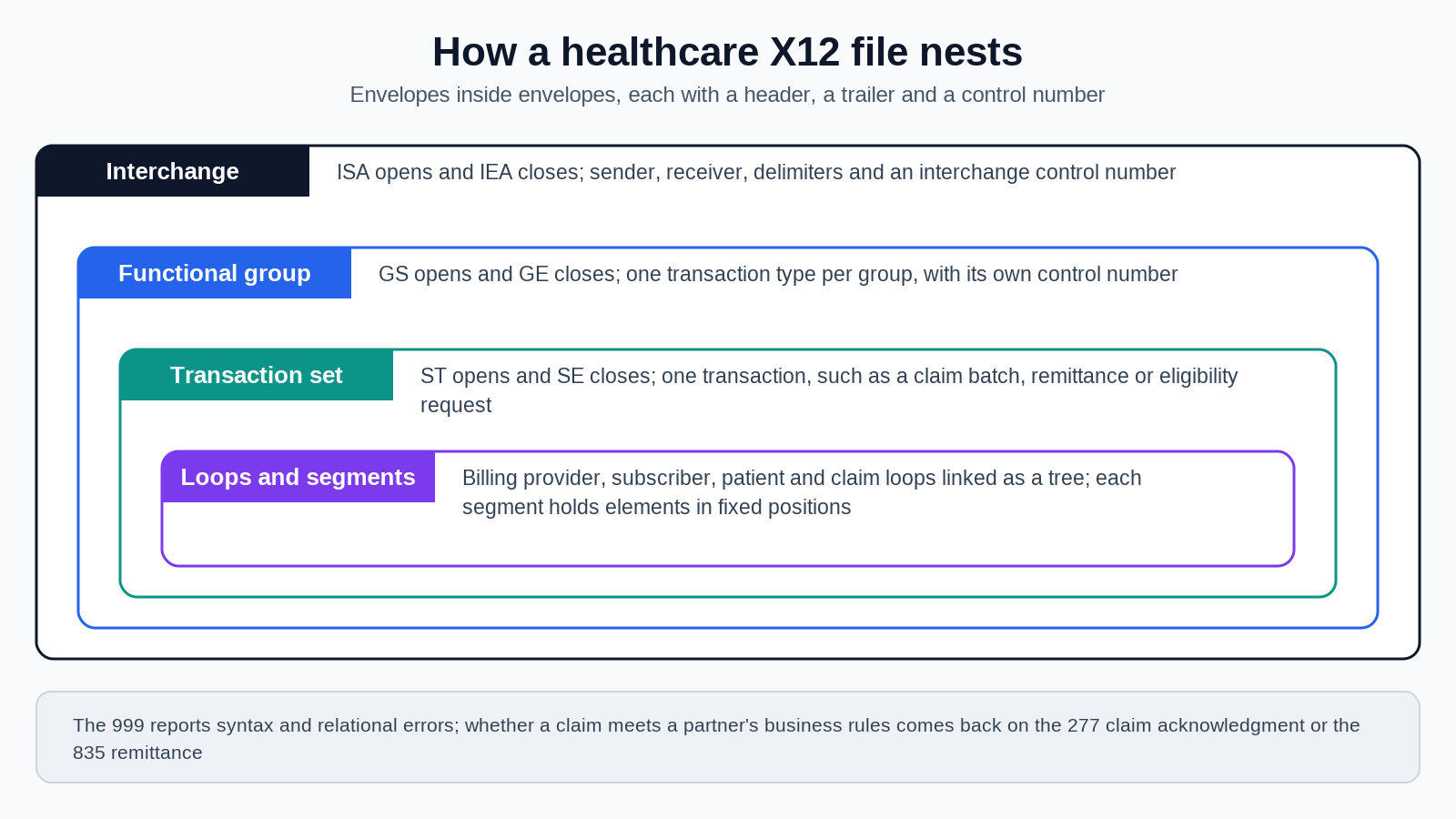
Envelopes wrap transactions in layers so senders and receivers can route, count and acknowledge them. An interchange holds functional groups, and each group holds transaction sets of one type.
X12 states that the basic interchange segments are the ISA, the IEA and the TA1, as set out in its X12.5 Interchange Control Structures standard.
Each layer carries a control number in its header and repeats it in its trailer, with a count of what it contains. Generate unique control numbers per trading partner, store them and use them to match acknowledgments and detect duplicates.
How do loops work?
Loops are repeating groups of segments that belong together, such as a subscriber with their patient and claims, and they are recognized by position and identifiers rather than by explicit start and end markers.
Healthcare claims use hierarchical levels that link billing provider, subscriber and patient, each pointing to its parent. Model these as a tree in code; treating a claim file as a flat list of segments is the root of many parsing bugs. A tree also makes it easy to answer which patient a service line belongs to.
What do implementation and companion guides add?
Implementation guides define how each healthcare transaction uses the base standard: which segments and loops are required, which codes are allowed and what each element means in context. Build to the guide version your partners use, not to the base standard alone.
Payers and clearinghouses add companion guides with their own rules, such as identifiers, size limits or extra required fields. Keep those rules as configuration per partner so one payer's quirk does not leak into every file.
Which acknowledgments come back?
Acknowledgments come back in layers: an interchange acknowledgment about the envelope, a 999 about syntax and structure, and business responses such as the 277 claim acknowledgment and the 835 remittance that say what happened to each claim.
X12 explains that the 999 acknowledgment reports the results of syntactical and relational analysis of the transactions received, while business questions, such as whether a code meets a trading partner's requirements, are reported on the 277 claim acknowledgment or the 835 remittance advice.
Track every file until each layer has answered. A file with no acknowledgment is as much a problem as one that was rejected, and it is easier to miss.
Parsing and generating X12
Use a tested library or engine for the low-level parsing, and spend your own effort on the mapping between X12 loops and your domain objects. Hand-written string splitting breaks on the first file with unusual delimiters.
- Parse to a tree: interchange, group, transaction, loops, then segments.
- Keep the original: store the raw file and link parsed records back to it.
- Validate both ways: check generated files against the guide before sending.
- Version: record the guide version and partner configuration used for each file.
Control numbers, retries and duplicates
Resending a file safely requires knowing whether it was received. Use control numbers and acknowledgments to decide, and never resend a whole batch because one transaction failed.
Give each claim its own stable identifier inside the transaction, separate from control numbers, so a corrected claim can be tied to the original and a duplicate can be detected by the receiver.
How should you test X12 integrations?
Test with files built to cover every loop and option your product uses, validate them against the guide, then exchange test files with each partner before sending live data.
- Unit tests: each mapping from domain object to loop and back.
- Guide validation: every generated file checked by a validator for the right version.
- Partner testing: test files sent through each clearinghouse or payer test channel.
- Edge cases: unusual delimiters, empty elements, large files and repeated loops.
- Acknowledgments: rejected and accepted responses parsed and matched to the file.
What goes wrong with X12 integrations?
Most X12 bugs come from treating the format as simpler than it is. These patterns recur.
- Hard-coded delimiters: parsers that fail when a partner uses different separators.
- Flat parsing: loops lost, so claims attach to the wrong patient or provider.
- Reused control numbers: acknowledgments matched to the wrong file.
- Ignored acknowledgments: rejected files noticed only when payments stop.
- Partner rules in code: one payer's companion guide hard-coded for everyone.
A worked example: a startup adds claim submission
A digital health startup built its own claim file generator from sample files. Its first clearinghouse accepted the files, but the second rejected them because the startup had hard-coded separators and skipped a loop the second partner required.
The team moved to a parsing library, modeled claims as a tree, put each partner's companion guide rules in configuration and added validation before sending. They also began tracking acknowledgments for every file.
Adding a third partner became a configuration and testing task rather than new code, and rejected files now reached the billing team the same day they came back.
Who owns what?
X12 work needs engineering ownership and business ownership of partner rules.
- Engineering: parser, generator, validation and file tracking.
- Integration team: partner setup, testing and companion guide configuration.
- Billing or operations: rejected files and business responses.
- Support: monitoring files with missing acknowledgments.
How do you monitor X12 exchange?
Monitor every file from creation to the last acknowledgment, by partner and transaction type.
- Files sent and received, by partner and transaction.
- Files still waiting for each acknowledgment layer.
- Rejections by reason and partner.
- Duplicates detected and resends made.
What are X12 EDI best practices for developers?
Read delimiters from the file, parse to a tree of envelopes and loops, build to the guide version partners use, keep companion guide rules as configuration and store raw files alongside parsed data.
Generate unique control numbers, give each claim a stable identifier, validate before sending, track every acknowledgment layer and test with each partner before going live.
How Agnotic can help
Agnotic builds X12 exchange for billing companies, payers and health products: parsers and generators, partner configuration, validation, acknowledgment tracking and monitoring for claims, remittances, eligibility and authorizations.
Build reliable X12 exchange with Agnotic
Our system integration service designs and builds connections to clearinghouses, payers and billing systems.
Related reading on Agnotic
Billing transactions, remittances and claims.


