



Connected medical devices now reach phones, home networks, hospital systems and the cloud, and every one of those links is a way in for an attacker. FDA's cybersecurity requirements exist because a compromised device can stop working, show the wrong value or expose patient data.
This post explains what FDA expects from manufacturers of connected devices: which devices count as cyber devices, what a premarket submission must show, how to build the software bill of materials, which controls belong in the design and what the postmarket plan must cover. It closes with failure points, an example, owners and testing.
What are the FDA cybersecurity requirements for connected medical devices?
Preparing a connected device for FDA review?
Our compliance practice helps device teams build the security evidence regulators ask for.
FDA cybersecurity requirements for connected medical devices come mainly from section 524B of the FD&C Act: manufacturers of cyber devices must show a secure design process, provide a software bill of materials and submit a plan for handling postmarket vulnerabilities. Agnotic Technologies helps device teams engineer and document that evidence.
Section 524B of the FD&C Act defines a cyber device as one that includes software validated, installed or authorized by the sponsor, can connect to the internet, and has technological characteristics that could be vulnerable to cybersecurity threats.
Which devices count as cyber devices?
Most connected devices with software do. A device that pairs with a phone app, sends readings to a cloud service or accepts remote updates usually meets all three parts of the definition.
The question is not only whether the device itself has a network chip. A device that connects through a companion app or a hub can still reach the internet, so treat the whole system as in scope until a regulatory review says otherwise.
What must a premarket submission show?
The submission must show that security was designed in, not added at the end. The statute sets the core duties, and FDA's premarket cybersecurity guidance describes the documentation it recommends.
FDA says section 524B took effect on March 29, 2023 and requires sponsors of cyber devices to submit a plan to monitor, identify and address postmarket vulnerabilities, keep processes that give reasonable assurance the device and related systems are cybersecure, and provide a software bill of materials.
- Security architecture: the device, apps, cloud and interfaces, with trust boundaries marked.
- Threat model: how each part could be attacked and what that would cause.
- Risk assessment: security risks rated and linked to the controls that reduce them.
- Test evidence: results of security testing on the finished system.
- Software bill of materials: every component, with its support status.
- Postmarket plan: how vulnerabilities will be found, assessed, fixed and disclosed.
How should the threat model be built?
Start from the architecture, not a generic list of attacks. Draw every component and connection, mark where data or commands cross a trust boundary, and ask what an attacker could do at each crossing.
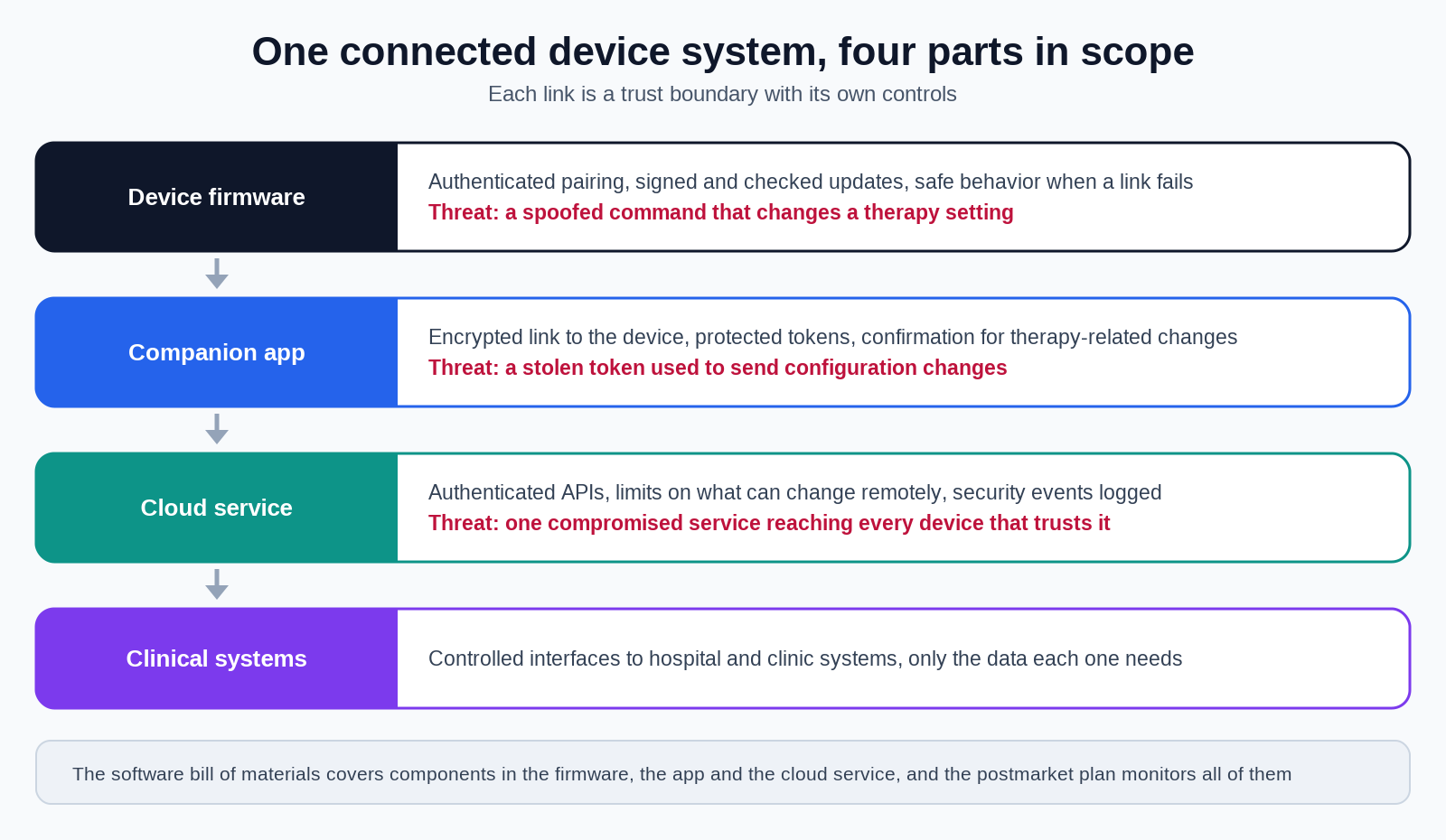
Link each threat to patient harm as well as data loss. A spoofed command that changes a therapy setting matters more than a leaked device serial number, and the risk assessment should say so.
What should the software bill of materials contain?
The software bill of materials lists every software component in the device system, including commercial, open-source and off-the-shelf parts. Reviewers use it to judge exposure when a new vulnerability is published.
- Identity: component name, supplier and exact version.
- Support: whether the supplier still issues fixes, and until when.
- Known issues: published vulnerabilities and your assessment of each.
- Location: which part of the system uses the component.
Generate it from the build, not by hand, so it changes when the code changes.
Which controls belong in the device design?
Design controls should match the threats you found. Most connected devices need the same core set, sized to their risk.
- Authentication: devices, apps and users prove who they are before commands are accepted.
- Integrity: firmware and updates are signed and checked before they run.
- Confidentiality: data encrypted on links and in storage where it matters.
- Logging: security events recorded and retrievable for investigation.
- Resilience: safe behavior when a connection or service fails.
How does the quality system tie in?
Cybersecurity work runs inside the device quality system, through design controls, risk management, supplier controls and change control. A security fix after release is a design change like any other.
FDA's Quality Management System Regulation in 21 CFR Part 820 incorporates ISO 13485:2016 by reference for medical device manufacturers.
What does the postmarket plan need?
The postmarket plan explains how you will learn about vulnerabilities, judge them and respond, for as long as the device is supported. It must include coordinated vulnerability disclosure, so outside researchers have a way to report what they find.
- Monitoring: vulnerability feeds for every component in the bill of materials.
- Intake: a published way for researchers and customers to report issues.
- Assessment: each issue rated for patient risk and exploitability.
- Response: fixes, workarounds and notices to customers, with update delivery tested.
How do companion apps and cloud services change scope?
The duties cover the device and its related systems, so the phone app and cloud service are part of the security case. An attacker who controls the cloud can often control every device that trusts it.
Put the app and cloud through the same threat modeling, bill of materials and testing as the firmware. Keep their release processes inside the quality system, even when a different team builds them.
How should device support and end of life be planned?
Decide before launch how long each device model will receive security fixes, and tell customers. Hospitals plan equipment for years, and a device that stops getting patches while still in clinical use becomes their problem and yours.
- Support period: a stated window for security updates per model.
- Component limits: support dates of key suppliers checked against that window.
- End-of-support notice: advance warning with guidance on safe use or replacement.
- Records: which customers run which models and versions, so notices reach them.
Revisit the plan when a key component loses supplier support, because that can shorten the window you promised.
Where do device teams fail FDA cybersecurity reviews?
Most problems come from evidence that does not match the real system.
- Device-only scope: the app and cloud left out of the threat model.
- Hand-written bill of materials: components missing or versions wrong.
- Generic threats: lists copied from templates, not tied to this architecture.
- No update path: no tested way to deliver a fix to devices in the field.
- Disclosure gap: no route for researchers to report a vulnerability.
A worked example: a home monitoring device with an app
A team built a home monitoring device that paired with a phone app and uploaded readings to a cloud service. Its first threat model covered only the device's wireless link.
Extending the model to the app and cloud showed that a stolen app token could send configuration changes to the device. The team limited what the cloud could change remotely and required a confirmation on the device for therapy-related settings.
The bill of materials, generated from all three builds, exposed an outdated open-source library in the app. The team replaced it and added component monitoring to its postmarket plan.
Who owns what?
Device cybersecurity spans engineering, quality and regulatory teams.
- Engineering: architecture, controls, bill of materials and fixes.
- Security lead: threat model, testing and vulnerability assessment.
- Quality: risk management, design controls and change records.
- Regulatory affairs: submission content and contact with FDA.
- Customer support: notices and update guidance for users.
How do you test device cybersecurity?
Test the finished system the way an attacker would, and test that your fixes reach the field.
- Penetration testing: device, app, cloud and the links between them.
- Fuzzing: malformed input on every interface the device exposes.
- Component scanning: the bill of materials checked against vulnerability data.
- Update testing: signed updates installed, rejected when tampered, and rolled back safely.
What are FDA cybersecurity best practices for connected devices?
Treat the device, app and cloud as one system, build the threat model from its real architecture, and tie each threat to patient harm and a control.
Generate the bill of materials from the build, sign every update, publish a disclosure route, and run security fixes through the quality system with the same care as any other design change.
How Agnotic can help
Agnotic helps connected device teams with cybersecurity engineering and evidence: system threat models, security controls in firmware, apps and cloud services, generated software bills of materials, security testing and postmarket vulnerability processes.
Plan device cybersecurity with Agnotic
Our medical device cybersecurity page covers the security work we deliver for connected devices.
Related reading on Agnotic
Connected devices, testing and FDA rules.


