



The days after discharge are when many patients are most at risk. They go home with new medicines, a follow-up appointment that may be weeks away and instructions they half heard while waiting for a ride. When something feels wrong, the emergency department is often the only door they know.
Telemedicine can put a clinician in contact with those patients before a small problem becomes a return visit. This post explains how to design a post-discharge virtual follow-up program around readmissions: who to enroll, what the first virtual visit covers, how home readings and check-ins fit, how escalation works and how to tell whether it is helping.
How does telemedicine decrease hospital readmissions?
Building a virtual follow-up program?
Our telemedicine platform page covers the video visits, check-ins and EHR connections a post-discharge program needs.
Telemedicine can decrease hospital readmissions by giving recently discharged patients an early virtual visit, regular check-ins and a fast route to a clinician when warning signs appear, so problems are handled at home. Agnotic Technologies builds these programs on hospital discharge data, with clear escalation paths.
Video alone does not prevent readmissions. The program around it, who is enrolled, what is checked and who acts on it, is what makes the difference.
Why do patients come back after discharge?
Patients often come back because of gaps that a timely conversation could have closed: confusion about medicines, missed follow-up, warning signs they did not recognize, and no clear person to call.
- Medicines: new prescriptions not filled, old ones not stopped, doses misunderstood.
- Follow-up: an appointment too far away, or never booked.
- Warning signs: weight gain, breathlessness or wound changes noticed too late.
- Access: symptoms in the evening with no number that reaches a clinician.
Each gap suggests a feature. A program that cannot name which gaps it closes is unlikely to change readmissions.
Which patients should the program enroll?
Enroll the patients most likely to return and most likely to benefit from contact at home. Many hospitals start with conditions that affect their payments and have clear home warning signs.
Medicare's Hospital Readmissions Reduction Program reduces payments to subsection (d) hospitals for excess readmissions, measured for heart attack, heart failure, pneumonia, COPD, coronary artery bypass graft surgery and elective hip or knee replacement.
Add a risk rule the clinical team agrees on, such as recent admissions, several new medicines or living alone, and record why each patient was enrolled. That record matters later when you measure results.
What does a post-discharge virtual program look like?
A post-discharge virtual program starts from the discharge event in the EHR, enrolls the patient before they leave, holds an early virtual visit, then runs scheduled readings and check-ins that sort each patient into stable, warning or urgent paths.
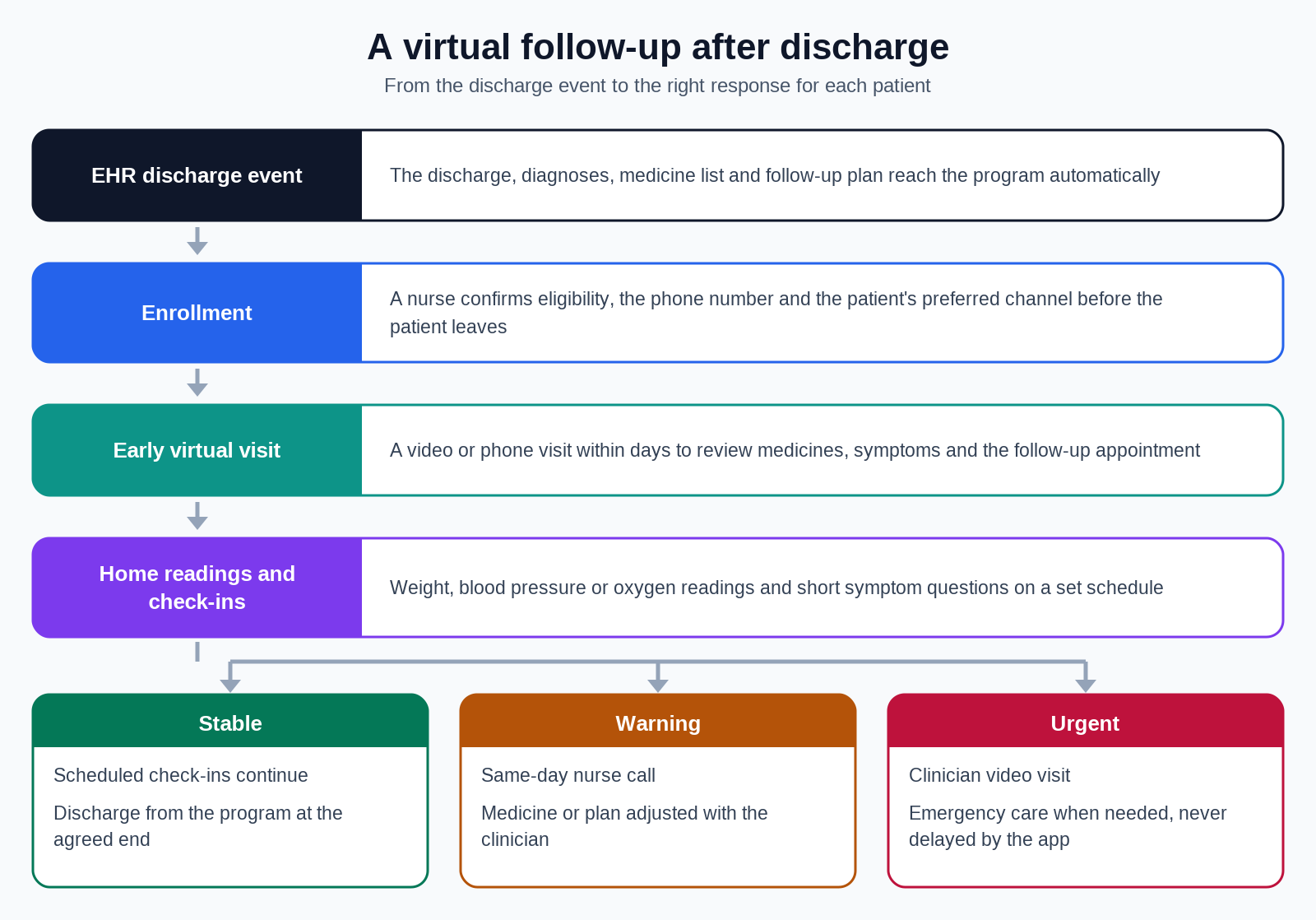
Enrollment before the patient leaves is the step programs most often skip. A patient phoned for the first time after discharge has never met the nurse, may not answer an unknown number and has not tried the app with help at hand.
Language, access and caregivers
A follow-up program only works for patients who can use it. Many of the patients most likely to return are older, live alone, speak another language or have no reliable data connection.
- Channels: video where it works, phone calls where it does not, and text check-ins for patients who prefer them.
- Language: interpreters available for visits and check-in questions written in the patient's language.
- Caregivers: a family member enrolled with the patient's agreement, who receives reminders and can join visits.
- Devices: loaned phones or cellular devices for patients without home internet.
What should the first virtual visit cover?
The first virtual visit should cover medicines, symptoms, the follow-up appointment and who to call. It should happen within the first few days, while the discharge is fresh.
- Medicines: the patient shows each bottle on camera and the nurse checks it against the discharge list.
- Symptoms: questions specific to the condition, such as swelling and breathing for heart failure.
- Appointments: confirm the follow-up visit is booked and the patient can get there.
- Contacts: the program's number, the hours it is staffed and what to do outside those hours.
How should home readings and check-ins fit in?
Home readings and check-ins should be few, condition specific and reviewed by a named person each day. A weight scale for heart failure or a pulse oximeter for lung disease is often more useful than a full kit.
Medicare's remote physiologic monitoring codes include CPT 99453, 99454, 99457 and 99458, and the CY 2026 Physician Fee Schedule added 99445 and 99470 for shorter monitoring periods and shorter management time.
Check-ins can be short questions in an app or by text, such as whether breathing is worse than yesterday. Missing readings matter too: a patient who stops sending data may be the one who needs a call.
How should escalation work?
Escalation should follow written rules: which readings or answers count as warning or urgent, who responds, and how fast. The app sorts; people decide.
- Stable: check-ins continue on schedule.
- Warning: a nurse calls the same day and involves the clinician when a medicine or plan change may help.
- Urgent: a clinician video visit, and emergency care when needed, never delayed by waiting for the app.
- After hours: a clear message on what to do and a number that is answered.
What data does the program need from the hospital?
The program needs the discharge event, diagnoses, discharge medicines, follow-up appointments and the care team, sent automatically from the EHR. Re-keying discharge summaries by hand delays the first contact and introduces errors.
It also needs a way back. Notes from virtual visits and escalation decisions should flow into the patient's record so the follow-up clinician sees what happened at home.
What goes wrong in post-discharge virtual programs?
Programs struggle when they add contact without adding action. Several of the following tend to show up in the first months.
- Enrollment after discharge: patients called cold at home, many never reached.
- Too many devices: patients given kits they do not use.
- Unread data: readings collected with nobody assigned to review them daily.
- Vague escalation: alerts sent to a shared inbox instead of a person.
- No link back: virtual visit notes stuck in the telemedicine system.
A worked example: heart failure patients
A hospital enrolls heart failure patients on the ward. The nurse sets up a connected scale and the app, and books a video visit for the second or third day home.
In that visit, the nurse checks medicines on camera and confirms the clinic appointment. Each morning, the patient weighs in and answers two questions; a weight gain over the threshold the cardiologist set creates a same-day call.
When a call finds swelling and breathlessness, the nurse arranges a clinician video visit, and the diuretic dose is adjusted. Notes go to the EHR, and the patient leaves the program after the agreed period.
Who owns the program?
A clinical lead should own the program's rules and outcomes, with named staff for daily review and an engineering owner for the systems. Shared ownership with the discharging ward rarely survives busy weeks.
- Clinical lead: enrollment rules, thresholds and escalation paths.
- Program nurses: enrollment, first visits, daily review and calls.
- Engineering owner: discharge feed, app, devices and notes back to the EHR.
- Quality team: measurement and reporting to hospital leadership.
How do you measure whether readmissions fell?
Measure readmissions for enrolled patients against a fair comparison group, such as similar patients before the program or on wards not yet enrolled. Raw before and after numbers can mislead when case mix changes.
- Readmissions and emergency visits within the window the hospital tracks.
- Time from discharge to first contact.
- Share of enrolled patients who completed the first visit.
- Escalations and what happened after each one.
What are best practices for virtual follow-up after discharge?
Enroll on the ward, hold the first virtual visit within days, keep devices few and condition specific, assign daily review to named people, write escalation rules down and send notes back to the EHR.
Start with one condition, measure against a fair comparison and widen only when the first group shows results.
How Agnotic can help
Agnotic builds post-discharge virtual programs for hospitals: discharge feeds from the EHR, enrollment tools, video visits, device readings, escalation worklists and notes back to the record.
Plan your readmission program with Agnotic
We build risk lists that help nurses decide who to enroll and call first.
Related reading on Agnotic
Transitional care, remote monitoring and telemedicine.


