



A reading that never leaves the cuff is not monitoring. Neither is a reading that reaches a cloud dashboard and sits there while the night nurse works in the EHR. Wireless patient monitoring fails in the gaps: the radio, the gateway, the patient binding, and the alarm that is supposed to become a charted observation plus a page someone can accept.
This guide follows that path. It is for teams building or connecting monitors, not for a program design about who should be enrolled. Sensors, radios, gateways, and the write into the record are the subject. Enrollment policy, caregiver workflows, and how to tune alert thresholds are separate problems.
What is wireless patient monitoring?
Connecting monitors to the chart?
Agnotic Technologies builds the gateway, alarm, and EHR path for wireless patient monitoring.
Wireless patient monitoring is a chain from a sensor, over a radio such as BLE, Wi-Fi, or cellular, through a gateway, into an alarm service and the EHR. The engineering problem is keeping the reading, the patient, and the alarm attached to each other when the radio drops, the gateway reboots, or the chart match fails.
Each hop fails on its own: a sensor paired to yesterday's phone, a late packet that overwrites a newer value, or an alarm filed on the wrong encounter.
Which radio should the monitor use?
Pick the radio from the place the patient actually is, and from how long the reading can wait. Range, power, and who controls the network decide BLE, Wi-Fi, or cellular. A brochure that says 'wireless' has not made that choice.
- BLE: short range, low power, usually needs a phone or a bedside hub as the gateway. Pairing and bonding are part of the product. Another BLE device nearby is part of the environment, not an edge case.
- Wi-Fi: longer range inside a building you control. The device needs a network it can join without a captive portal, a certificate or key you can rotate, and a VLAN that is not the guest network.
- Cellular: the device carries its own uplink. Useful when you do not own the building network. You then own SIM lifecycle, indoor coverage, and what the device does when the signal is gone.
- Two radios: a common pattern is BLE from the sensor to a hub, then Wi-Fi or cellular from the hub. The hub is the gateway. Losing either hop is a different alarm.
FDA's guidance on radio frequency wireless technology in medical devices, issued in August 2013 by the Center for Devices and Radiological Health, tells manufacturers to address selection of the wireless technology, quality of service, coexistence, security, and electromagnetic compatibility. Those five are design inputs for the product you are integrating, even when you did not build the radio. Ask the device vendor which of them they documented for the room you will use, not for a bench.
What must a gateway do before the cloud sees a reading?
The gateway is the last place that still knows the room. It should buffer, timestamp, bind the device to a patient, and refuse to pretend a late packet is the latest packet.
- Buffer: store readings when the uplink is down, with a limit and an alarm when the limit is close. A gateway that drops samples quietly will look healthy in the cloud.
- Clock: sync the gateway clock and keep the sensor's own timestamp if it has one. A skewed clock makes a fresh reading look stale, and a stale-suppression rule will throw it away.
- Identity: the device serial number is not a patient id. Bind them with an explicit assignment that has a start and an end. Unassign on discharge before the next patient inherits the cuff.
- Order: carry a sequence number. A retry must not overwrite a newer value that already arrived.
- Local alarm: if the clinical rule cannot wait for the cloud, evaluate it on the gateway and say so. Do not discover that split during an outage.
How does an alarm reach a clinician and the EHR?
An alarm is done when a clinician can accept it and the chart holds the same event. A dashboard row, a text message, and an observation are three writes. If they can disagree, someone will act on the wrong one.
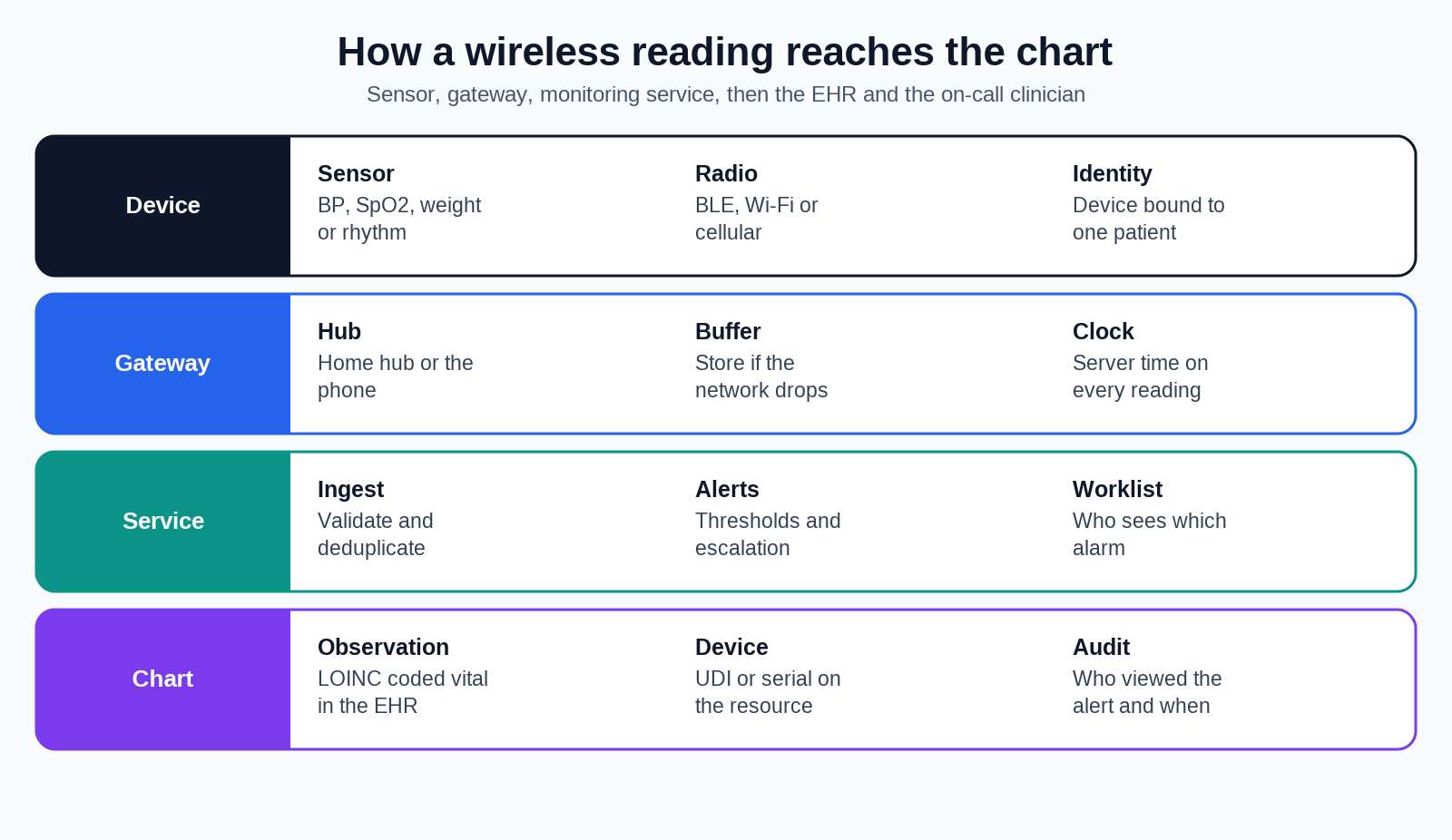
- Event: patient, device serial, value, unit, threshold if this is an alarm, source timestamp, gateway timestamp, and a stable event id.
- Alarm route: an on-call group or a role, not a single person's phone. The route needs a timeout and a second destination.
- Chart write: an HL7 v2 result or a FHIR Observation, tied to the patient and, when you have it, the encounter. Use the event id so a retry does not create a second row.
- Acknowledgement: the accept has to flow back to the alarm service and, if the device is still alarming, to the device or gateway. A charted note that nobody accepted is not a closed alarm.
- Mismatch queue: if patient matching fails, park the event for a human. Do not drop it, and do not attach it to the closest name.
Keep acknowledgement state in one service and show it in the others. Two open alarms, one on a phone and one in the in-basket, means two responses or none.
What does CMS require of a connected monitoring device?
CMS's MLN booklet on telehealth and remote monitoring says remote monitoring lets a patient collect health data with a connected medical device that automatically transmits the data to the provider. For remote physiologic monitoring, the device used to collect and transmit the data must meet the FDA definition of a medical device, the physiologic data must be collected electronically and automatically uploaded to a secure location where the billing practitioner can analyze it, and the patient must give consent when the services are furnished. CMS also says only one practitioner may bill remote monitoring for a patient in a 30-day period.
The same booklet says data must be collected for 2 to 15 days, or for 16 or more days, out of 30, depending on the code descriptor. That day count does not apply to the treatment management codes 99457 and 99458. Do not hard-code a single day threshold for every code. Store which code the enrollment is aimed at, count distinct days with an automatic upload, and surface a second enrollment that would make two practitioners bill the same patient in the same 30 days.
- Manual entry: a value typed by staff is not the automatic upload CMS describes for physiologic monitoring. Keep it out of the day count.
- Consent: store who consented, when, and to which monitoring. A checkbox on a tablet with no record will not answer an audit.
- Device status: record that the assigned device meets the medical-device expectation the program relies on. A consumer gadget and a device that meets the FDA definition are not interchangeable in this workflow.
- Overlap: a query for another practitioner's active monitoring on the same patient before you start a new 30-day period.
Which failures show up only in a real room?
Bench tests use one device, one network, and a clock you set. Units do not. These are the failures that appear after install.
- Wrong pairing: the sensor bonds to a phone that left with the previous patient, and the new patient's hub stays silent.
- Coexistence: a cluster of BLE devices, Wi-Fi on the same band, and a microwave or a telemetry system the site survey forgot. FDA calls this coexistence, and it is a room property.
- Roam: a wearable on Wi-Fi walks between access points and loses the sample mid-reading. The cloud shows a gap and no error.
- Indoor cellular: the bathroom or the basement has no signal. The device must buffer, and someone must see that it has stopped uploading.
- Duplicate delivery: the radio retries, the gateway retries, and the EHR has no idempotency key, so the chart shows two pulses for one moment.
- Late overwrite: a delayed packet arrives after a newer one and the chart keeps the older value because the writer compared arrival time.
- Alarm without a chart, or a chart without an alarm: the two writes were not in one transaction and one of them failed.
Test in the room you will use, with the other radios on. Keep sequence numbers and both timestamps so a disputed reading can be reconstructed.
How do you protect readings while they are in transit?
Protect the hop you actually use. An encrypted cloud API does not cover BLE between the cuff and the hub, and a VPN does not cover a cellular module that still sends an unauthenticated payload to your broker.
The HIPAA Security Rule's transmission-security standard, 45 CFR 164.312(e)(1), requires technical measures to guard against unauthorized access to electronic protected health information transmitted over an electronic communications network. Integrity controls and encryption are addressable implementation specifications: you assess them, you implement them when it is reasonable, and if you do not encrypt you document why and what you did instead. 'The vendor uses wireless' is not that assessment.
- Per hop: BLE link protection, Wi-Fi authentication, cellular, and the gateway-to-cloud API. Write down the mechanism for each.
- Device identity: a key or certificate per gateway, rotated, and revoked when the device leaves the program.
- Payload minimum: the radio packet should not carry more identifiers than that hop needs. The cloud can join the patient. The air does not have to shout the name.
- Tamper evidence: a reading that can be edited in the gateway without detection will not survive a dispute. Sign or hash at the earliest point you control.
What should you buy, and what should you build?
Buy the regulated sensor and its radio. Build the binding, the buffer policy, the alarm routing, and the chart write. Those are where your patients, your call schedule, and your EHR differ from the vendor's demo.
- Buy: the physiologic sensor, its firmware, and the vendor's statement of wireless quality of service, coexistence, security, and electromagnetic compatibility.
- Build or own: patient-to-device assignment, gateway buffer and sequence handling, the alarm service, acknowledgement, and the HL7 v2 or FHIR write.
- Do not rebuild: a radio stack, a cellular modem certification, or a second copy of the vendor cloud that you then have to keep alive.
- Contract for: an export of raw events with timestamps and device ids, so you are not stuck reading a PDF dashboard when the chart is wrong.
If the vendor cloud cannot emit a stable event id and a device serial, idempotent chart writes are impossible. Treat that as a buying criterion.
How Agnotic can help
Agnotic Technologies builds the path from a wireless monitor into clinical operations: gateway ingestion, patient and device binding, alarm routing with acknowledgement, and the write to the EHR as an HL7 v2 result or a FHIR Observation. We treat a stuck queue and a mismatched patient as incidents, not as dashboard filters.
Bring the device notes and the unit's network constraints. We map the hops, name which alarm is local, and keep a retry from doubling a reading.
Take the reading from the radio to the chart
Plan the gateway and EHR path with our engineers, or read more in the remote care hub.
Related reading on Agnotic
Home care operations, device codes, wearable APIs, and how RPM alerts behave inside Epic.


