



Real-world evidence studies stand or fall on the data behind them. A sound statistical method applied to records that were linked badly, mapped inconsistently or changed without a trace will produce results nobody can defend, however interesting they look.
This post is about the engineering underneath real-world evidence: where the data comes from, how records are linked across sources, which quality checks matter, how provenance is kept, and how a study-ready dataset is produced and versioned. It is written for data teams at life sciences companies, health systems and the partners who build pipelines for them.
What is real-world evidence in healthcare?
Planning a real-world evidence platform?
Our fractional CTO service helps teams design data platforms, partnerships and governance before they build.
Real-world evidence in healthcare is clinical evidence about how a medical product is used and what benefits or risks it shows, drawn from routinely collected data such as health records, claims and registries. Agnotic Technologies builds the pipelines that turn those sources into traceable, study-ready datasets.
FDA defines real-world data as data on patient health status or the delivery of health care routinely collected from sources such as electronic health records, medical claims and product or disease registries, and real-world evidence as clinical evidence about a medical product's use and potential benefits or risks derived from analyzing that data.
What does a real-world evidence pipeline look like?
A real-world evidence pipeline receives data from each source with a record of where it came from, links records for the same person, checks quality, maps everything to a common data model and releases versioned datasets for each study.
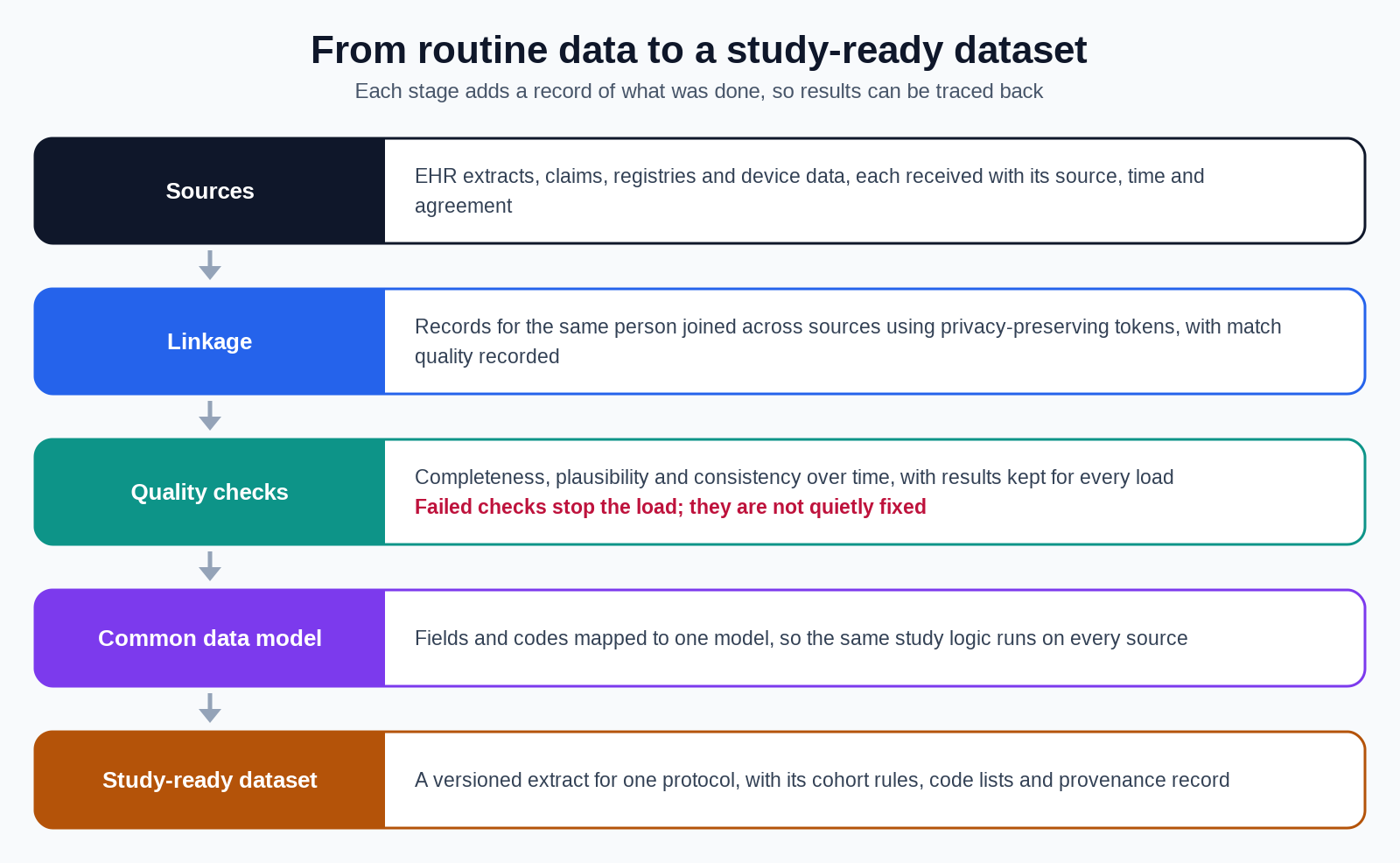
Every stage writes down what it did. That record is what lets a reviewer trace a number in a study table back to the source rows behind it.
Which questions can real-world evidence answer?
Real-world evidence is best at questions about how products are used and how patients fare in routine care: who receives a treatment, how long they stay on it, which safety events follow and how outcomes compare across groups. It is weaker where key information is never recorded in routine care.
- Use patterns: which patients receive a product, in what settings and for how long.
- Safety: rates of recorded adverse events after a product is in wide use.
- Comparisons: outcomes between treatments, with careful handling of who got which.
- Gaps: outcomes such as quality of life that routine records rarely capture.
Write the question first. The question decides which sources, links and checks the pipeline needs, and which ones it can safely leave out for now.
Which data sources feed real-world evidence?
The main sources are electronic health record extracts, insurance claims, disease and product registries, and increasingly data from devices and apps. Each has different strengths and blind spots.
- EHR data: clinical detail such as labs, vitals and notes, but only for care inside that system.
- Claims: a broad view across providers, but coded for payment rather than clinical detail.
- Registries: curated data for a condition or product, often with outcomes others lack.
- Device and app data: frequent measurements, with questions about who wore the device and when.
Record for every source the agreement that allows its use, the period covered and how it was extracted.
How are records linked across sources?
Records are usually linked with privacy-preserving tokens created from identifiers at each source, so the same person can be matched without the pipeline holding names or full identifiers. Each link should carry a quality score.
HIPAA allows two ways to de-identify health data: expert determination, or the safe harbor method, which removes 18 categories of identifiers.
Linkage choices change results. Too strict, and one person becomes two; too loose, and two people become one. Keep the rules versioned and report match rates per source with every dataset.
Which quality checks matter most?
The checks that matter most test completeness, plausibility and consistency over time, because those failures silently bias results. Run them on every load and keep the results.
- Completeness: share of records with key fields, by source and month.
- Plausibility: values inside physical limits, dates in the right order.
- Consistency: sudden shifts in counts or code use that suggest an extraction change.
- Conformance: values that fit the target model's types and code systems.
When a check fails, stop the load and investigate with the source. Fixing data quietly in the pipeline hides the problem from everyone who uses the result.
Why use a common data model?
A common data model lets the same study logic run on every source without rewriting it each time. It also makes code mapping a one-time, reviewable task instead of a hidden step in each analysis.
Mapping local codes to standard vocabularies is the hardest part. Keep mapping tables versioned, owned and reviewed by clinical informatics, and record which mapping version each dataset used.
How should provenance be kept?
Keep provenance as data, not documentation: for every value in a study dataset, the pipeline should be able to say which source, which load and which transformation version produced it.
- Load records: source, time, file or extract identifier and row counts.
- Transformation versions: code and mapping versions tagged in every run.
- Lineage: a link from each output table to its inputs.
- Immutability: raw inputs kept unchanged, so any dataset can be rebuilt.
What makes a dataset study-ready?
A dataset is study-ready when it answers one protocol's questions with documented cohort rules, code lists, time windows and known limitations, and can be rebuilt exactly. A general data lake extract is not.
Version each dataset, freeze it for the analysis, and publish a short data note with match rates, quality results and the mapping versions used.
Privacy and permitted use
Real-world data often starts as protected health information, and its use depends on agreements, de-identification method or research approvals. The pipeline should enforce these, not trust analysts to remember them.
Tag each source with its permitted uses, restrict access by project, keep identifiable data out of analysis environments and log who queried what.
What goes wrong in real-world evidence pipelines?
Failures tend to be invisible until a reviewer asks how a number was produced. These come up often.
- Silent fixes: data corrected in code without telling the source or the analysts.
- Untracked mappings: code lists edited in a spreadsheet with no version.
- Unreproducible extracts: a dataset that cannot be rebuilt the same way twice.
- Linkage drift: rule changes that alter cohorts between study versions.
- Mixed permissions: data used beyond what its agreement allows.
A worked example: a post-market safety question
A device maker wants to compare complication rates after a procedure using hospital records and claims. The pipeline receives both sources with their agreements and periods, and links patients with tokens.
Quality checks find a month where one hospital's extract dropped a field, and the load is stopped until the source resends it. Codes are mapped to the common model with a reviewed mapping version.
The study dataset is built from the protocol's cohort rules, versioned and frozen, and its data note reports match rates and quality results alongside the analysis.
Who owns what in a real-world evidence program?
Ownership spans data engineering, clinical informatics, epidemiology and privacy. Each needs a named person.
- Data engineering: ingestion, linkage, checks, lineage and rebuilds.
- Clinical informatics: code mappings and clinical definitions.
- Epidemiology: protocols, cohort rules and study datasets.
- Privacy and legal: agreements, permitted uses and access reviews.
How do you test a real-world evidence pipeline?
Test that it is correct and that it is reproducible. Rebuild a released dataset from raw inputs and compare it row by row, then inject known errors and confirm the checks catch them.
Keep a small synthetic dataset with known answers, run it through every change, and fail the build if the answers move.
What are real-world evidence best practices?
Record agreements and provenance from the first load, link with versioned rules and report match rates, stop on failed checks, map once to a common model, version mappings and datasets, and make every dataset rebuildable.
Write the data note before the analysis starts, so limitations are known rather than discovered. Share it with the study team and any external reviewer at the same time as the dataset, not after questions arrive.
How Agnotic can help
Agnotic builds real-world evidence pipelines for life sciences and provider organizations: ingestion with provenance, privacy-preserving linkage, quality checks, common data model mapping and versioned study datasets.
Build your real-world data platform with Agnotic
We build platforms that turn routine health data into traceable research datasets.
Related reading on Agnotic
Data management, trials and de-identification.


