



A remote patient monitoring program lives on device data. Blood pressure cuffs, scales, glucose meters and pulse oximeters send readings from patients' homes, and the program needs those readings in one place, tied to the right patient, quickly enough to act on and complete enough to support billing. Most RPM teams face the same early choice: connect each device maker directly, or use an aggregation API that already connects to many devices.
This guide compares the two approaches, explains what the data layer must do either way, and shows how billing requirements shape the integration. It is written for teams building or scaling an RPM program, not for one device type.
What are RPM device aggregation APIs?
Connecting devices for an RPM program?
Agnotic builds RPM device integrations, through aggregators or directly, with a data layer ready for clinical review and billing.
RPM device aggregation APIs are services that connect to many remote monitoring devices and their makers' clouds, normalize the readings, and deliver them to your platform through one interface. Instead of building and maintaining a separate integration for each device brand, an RPM program connects once and receives blood pressure, weight, glucose and oxygen readings in a common format.
The trade is speed and breadth against control and dependence. An aggregator gets you live with several device types quickly; direct integrations give you full control over data, timing and cost, at the price of more engineering and maintenance.
How do aggregators and direct integrations compare?
The right choice depends on how many device types you support, how much control you need over data and timing, and how long you expect the program to run.
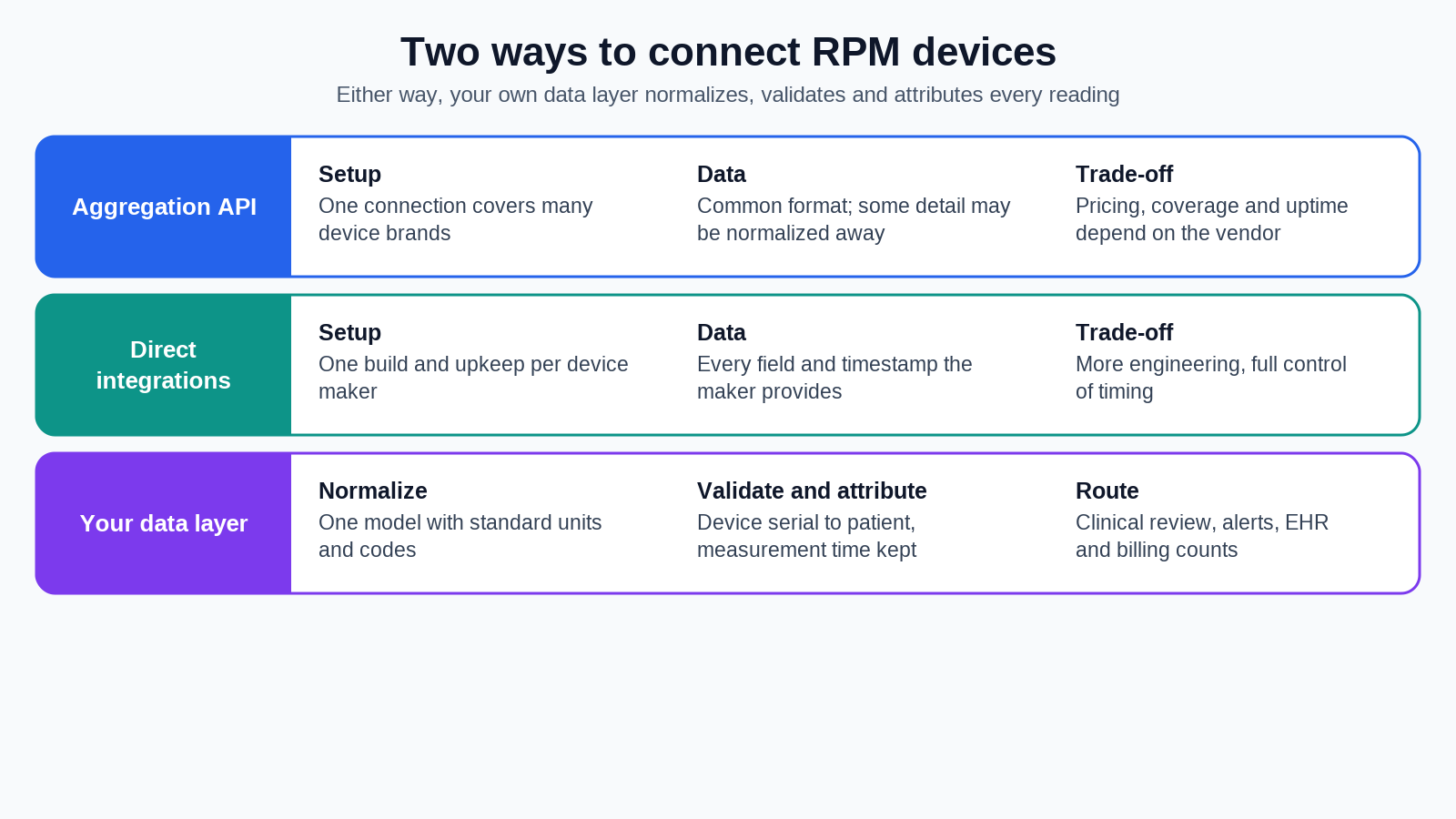
- Time to launch: Aggregators connect many devices at once; direct integrations take a build per device maker.
- Device breadth: Aggregators suit programs that let patients use several brands; direct suits a small, fixed device list.
- Data control: Direct integrations expose every field and timestamp the maker provides; aggregators may normalize away detail.
- Latency: Direct connections can deliver readings as soon as the maker's cloud receives them; aggregators add a hop.
- Dependence: An aggregator's pricing, coverage and uptime become yours.
Many mature programs end up hybrid: an aggregator for the long tail of devices and direct integrations for the one or two device models that carry most of their patients.
Make the decision with your own numbers: how many device models you expect to support in two years, how many patients each will carry, and how quickly clinicians need readings. Those three answers usually point clearly to one model or the hybrid.
How do billing rules shape RPM device integration?
Billing rules decide which data you must keep and how you count it, so they shape the integration from the start. CMS's Telehealth and Remote Monitoring booklet, MLN901705, lists CPT 99454 as covering device supply for 16 to 30 days in a 30-day period, which means the platform must count days with data per patient reliably.
The same booklet notes that only one practitioner can bill for remote monitoring per patient in a 30-day period and that patient consent is required. The integration has to support those rules with data: who is enrolled with whom, when consent was recorded, and which days have valid readings.
- Day counting: Store the measurement time from the device, not just the time the platform received it.
- Device identity: Tie each reading to a device serial assigned to that patient.
- Enrollment and consent: Record start dates, consent and the billing practitioner.
- Audit trail: Keep raw readings and any corrections so day counts can be defended.
Payment rules change, so keep the counting logic configurable and confirm current rules with your billing team each year rather than hard-coding them.
What must the RPM data layer do either way?
Whichever source you choose, your own data layer must normalize, validate and attribute every reading. Do not let an aggregator's format become your internal model.
- 1. Normalize: Map every source to one internal model with standard units and codes, such as LOINC for observation types.
- 2. Validate: Reject or flag impossible values, duplicates and readings with missing timestamps.
- 3. Attribute: Link each reading to the right patient through the device assignment, never by name matching.
- 4. Store raw and clean: Keep the original payload alongside the normalized reading.
- 5. Route: Send readings to clinical review queues and alert rules, and to the EHR where the program requires it.
Owning the internal model is what keeps switching possible. If you later move from one aggregator to another, or add direct integrations, only the mapping layer changes.
How should device assignment and onboarding work?
Device assignment is where attribution errors start. Every device must be linked to one patient before it ships, and that link must change cleanly when devices are returned or replaced.
- Assign by serial: Record the device serial against the patient at shipping or at the clinic.
- Confirm first reading: Treat the first reading as a setup check and call patients whose device has not reported.
- Handle swaps: End the old assignment and start the new one with dates, so readings are never mixed.
- Shared homes: Flag households with more than one enrolled patient and confirm whose readings are whose.
Give the onboarding team a simple view of every device that has not reported in its first few days. A short call at that point, to fix pairing or placement, saves weeks of missing data and an awkward conversation at billing time.
How do you evaluate an aggregation API?
Evaluate an aggregator on the details that matter to clinical use and billing, not on the length of its device list.
- Device coverage: Does it support the specific models your patients use, including cellular devices?
- Data fidelity: Are measurement timestamps, units and device serials passed through unchanged?
- Delivery: Push notifications or polling, and how quickly readings arrive after measurement.
- Security and agreements: A business associate agreement, encryption and access logging.
- Exit path: Can you export all historical data and device assignments if you leave?
Is a device aggregator a business associate?
Usually yes, when it handles readings tied to identifiable patients for a provider or health plan. Under 45 CFR 160.103, a business associate includes a person that creates, receives, maintains or transmits protected health information on behalf of a covered entity, which describes most aggregators and device clouds in an RPM program.
- Agreement first: Sign a business associate agreement before any patient data flows.
- Data minimization: Send the aggregator a device or enrollment identifier rather than full demographics where its API allows.
- Subprocessors: Ask which device clouds and hosting providers sit behind the aggregator, and how each is covered.
- Breach notice: Agree how quickly the aggregator must tell you about an incident and what it will share.
Treat direct device-maker clouds the same way. Each one that receives readings for your patients needs its own agreement and appears in your inventory of systems holding patient data.
What are the common mistakes with RPM device integration?
The common mistakes come from treating device data as a stream to display rather than evidence to keep. These are the ones we see most often.
- Receipt time as measurement time: Day counts shift when readings arrive late.
- Name-based matching: Readings attached to the wrong patient.
- Vendor format as internal model: Switching sources requires rewriting the platform.
- No first-reading check: Devices that never connected go unnoticed until billing.
- Dropped raw data: Normalized values with no original to audit.
What are RPM device aggregation best practices?
The practices that hold up keep the program's data independent of any one source and fit for both care and billing.
- Own the model: One internal reading model, with sources mapped into it.
- Measurement time first: Count days and trends from device timestamps.
- Assign by serial: Every reading attributed through device assignment.
- Keep raw payloads: For audit and reprocessing.
- Plan the exit: Contracts and exports that let you change aggregators.
How Agnotic can help
Agnotic Technologies builds RPM device integrations for programs of any size: aggregator connections, direct device-maker integrations where they pay off, an internal reading model with validation and attribution, day counting from measurement time, device assignment workflows, and routing to clinical review, alerts and the EHR.
If your program already depends on one aggregator, we can add an internal data layer so readings, history and assignments are yours, and a second source can be added without disruption.
Get device data you can act on and bill
Plan RPM device integration with our engineers, or read more remote care articles in the hub.
Related reading on Agnotic
See how RPM programs are built, how alerts and dashboards work, how wearable APIs connect, and how device data is coded with LOINC.


