



Healthcare teams say they have big data when they have a dump of extracts: a claims file, an EHR feed, a folder of device files, and a notebook that joins them on a patient id that does not quite match. The join is slow, the id is wrong for a subset of rows, and someone asks for a count that includes names because the extract was easier to pull that way.
Big data in healthcare is the discipline of landing those sources in stores that match the question, with protected health information kept in a zone you can explain. This guide is for data leads and clinical IT. It is about where to query. It is not a pitch for a platform brand.
What is big data in healthcare?
Landing clinical, claims, and device data?
Agnotic builds healthcare data platforms: pipelines, warehouses, lakes, and the PHI boundaries between them.
Big data in healthcare is the practice of landing clinical, claims, and device data in stores built for their shape, then asking each question of the store that can answer it safely. A warehouse answers governed metrics. A lake holds raw and wide data. Protected health information stays in a zone with access rules, not in every notebook.
Volume is not the interesting part. The hard parts are identity across a claim and a chart, time (a discharge date versus a paid date), and the fact that a device serial number can re-identify a person you thought you had removed. Design for those three before you pick a query engine.
When should a question hit the warehouse instead of the lake?
Hit the warehouse when the metric has a definition, a grain, and a person who signs off when the number changes. Hit the lake when you are still finding the shape of the data, or when the question needs columns the warehouse model dropped on purpose.
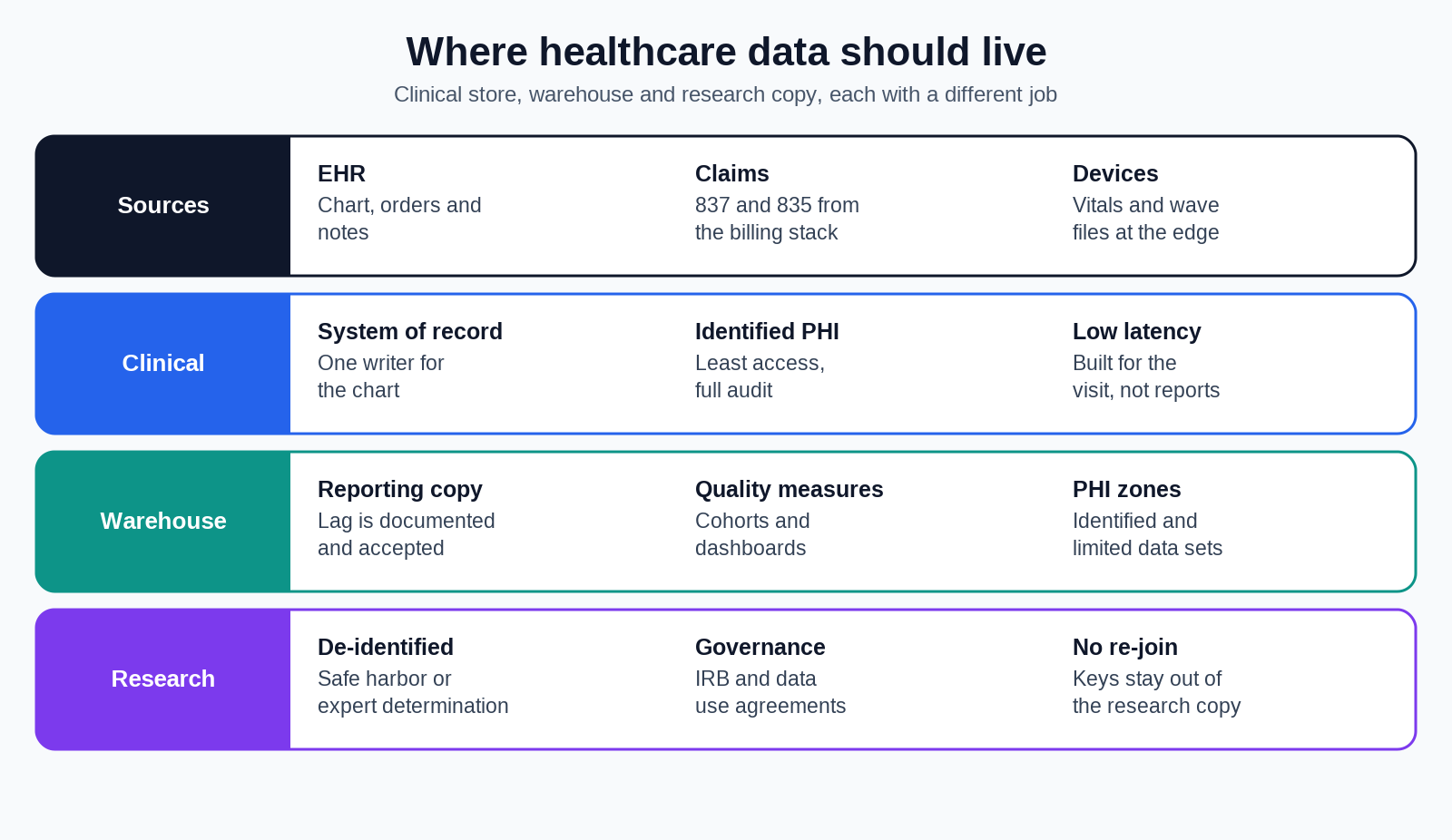
- Warehouse: length of stay, readmission, claim paid amount, panel size, each with a published definition.
- Lake: a new device payload, a one-time investigation, a column you are not ready to model.
- Do not use the lake for the number on a board pack. That number will change when someone edits the notebook.
- Do not force every raw file into the warehouse on day one. You will freeze a bad grain.
A useful pattern is a PHI zone that receives sources, a lake inside or beside that zone for raw files, a warehouse of modeled tables for known questions, and a de-identified extract for people who should never see names. The arrow goes one way out of the PHI zone. It does not loop a de-identified file back next to the key that rebuilds identity.
How should clinical, claims, and device data be landed?
Land each source as it arrived, then match identity in a later step you can rerun. Do not transform away the original file. You will need it when the match was wrong.
- Clinical: FHIR resources, HL7 v2 messages, or an EHR extract. Keep the source id and the received time.
- Claims: the 837-shaped or paid-claim file, with member id, service dates, and the payer. Do not treat a claim line as an encounter until you have matched it.
- Device: readings plus device identifiers, serials, and the vendor patient key. The key is not your medical record number until a match job says so.
- Match: a patient crosswalk with a method and a confidence, reviewed when confidence is low. Unmatched rows stay visible.
- Time: store event time and ingest time. A late file should not look like a late clinical event.
Claims and clinical data disagree on purpose. A diagnosis on a claim is a billing code. A problem in the EHR is a clinical entry. Model them as different facts that can be compared. A single 'condition' column that mixes both will train every downstream user to distrust the warehouse.
How do you keep PHI in the right zone?
Put identifiable data in a zone with named access, and do not copy it into notebooks, tickets, or a shared drive to make a question faster. The zone includes the raw files, the crosswalk, and the warehouse tables that still carry direct identifiers.
- Access: a role for analysts who may see PHI, separate from a role that may see only the de-identified extract.
- Paths: ingestion accounts can write raw files. Analysts cannot browse the ingestion bucket by default.
- Logs: pipeline logs store ids and counts, not names and note text.
- Egress: a ticket to copy data out of the zone, with a purpose and an expiration.
- Keys: the re-identification key, if you keep one, is not in the extract and not in the analyst role.
What does HIPAA de-identification change?
De-identification, done the way the Privacy Rule specifies, takes data outside the Privacy Rule's limits on identifiable information. A file with names removed and medical record numbers left in is not that file. The method has to be one of the two the rule allows, and someone has to be able to say which.
Under 45 CFR 164.514(b), a covered entity may determine that health information is not individually identifiable only by an expert determination or by safe harbor. Expert determination requires a person with appropriate statistical knowledge to find that the risk of identification is very small, and to document the methods and results. Safe harbor requires removal of a listed set of identifiers of the person and of relatives, employers, or household members, including names, detailed geography, most dates, medical record numbers, and device identifiers and serial numbers, plus no actual knowledge that the remaining data could identify someone. Section 164.514(c) allows a re-identification code only if the code is not derived from information about the person and the mechanism is not disclosed for other purposes.
That list is why device data is a trap. A glucose reading feels anonymous. The serial number on the sensor is an identifier the safe harbor tells you to remove. If you need the serial for a safety investigation, that investigation stays in the PHI zone. It does not ride along into the research extract.
What should USCDI change in the model?
USCDI should change which clinical data elements you expect to receive and to align. It should not become your warehouse grain, and it should not be treated as a de-identification method.
ONC's HTI-1 final rule adopted United States Core Data for Interoperability (USCDI) Version 3 to replace Version 1 as the baseline USCDI standard as of January 1, 2026. USCDI is a set of data classes and elements for exchange. Use it to check that your clinical landing zone can hold the elements certified systems will send, and to name gaps when an EHR extract omits something your question needs. A claims fact and a device payload still need their own models. Forcing a paid claim into a USCDI profile will drop the fields finance actually uses.
Which questions are unsafe to answer from the raw lake?
Unsafe questions are the ones that will be repeated, compared across months, or shown to someone who cannot see PHI. The raw lake will answer them differently each time the file format shifts.
- A board metric with no stored definition. Next month's notebook will not match.
- A patient list for outreach built from a join that dropped unmatched members silently.
- Anything that needs a de-identified audience, if the lake still has device serials and exact dates.
- A model training set copied to a laptop because the cluster was slow.
- A count of 'all diabetics' that mixed claim codes and problem-list text with no rule.
If the question will be asked again, promote it: a tested match, a table in the warehouse, a definition in writing. Leave the lake for the questions you have not earned a table for yet.
Also decide how fresh each store is allowed to be. A warehouse metric for yesterday's discharges can wait for a nightly load. A device reading used to page a nurse cannot. Do not point an operational screen at the lake because the lake happens to have the file. Give operational reads a store with a known lag, a failure alert, and a user who is on call when the feed stops. Analytics reads can lag. Mixing the two is how a care team trusts a dashboard that is a day behind a deteriorating patient, or how an analyst queries a live transactional system and slows the chart.
What usually breaks in a healthcare data platform?
Platforms break at identity, at late data, and at access. The storage technology is rarely the first failure. The crosswalk and the copy of PHI in a side folder are.
- One patient, three keys, and a join that multiplies rows so a readmission rate doubles.
- A backfill that overwrites event time with load time.
- Analysts granted PHI access 'temporarily' and never reviewed.
- A de-identified extract that still contains free-text notes.
- No lineage, so nobody can say which file produced the number in the slide.
- Device data landed outside the PHI zone because the vendor called it anonymous.
How Agnotic can help
Agnotic Technologies builds the data path for healthcare teams: ingestion that keeps the original file, a patient crosswalk you can audit, a warehouse for the metrics you will repeat, a lake for the rest, and a de-identified exit that follows 164.514 instead of a hopeful column drop. We separate clinical, claims, and device facts so a billing code is not stored as a diagnosis.
If you already have a pile of extracts, we start with the questions you must stand behind and the identifiers still hiding in the files, then draw the zones around them.
Decide what each store is allowed to answer
Plan the warehouse, the lake, and the PHI zone with our engineers, or read the data engineering hub.
Related reading on Agnotic
A services view of big data work, analytics on the EHR, and a FHIR to OMOP path on one stack.


