



Teams designing a health data platform often frame the choice as FHIR or openEHR, as if one must win. In practice the two were designed for different jobs. FHIR is built for exchanging data between systems; openEHR is built for storing and modeling clinical data for the long term, with clinicians shaping the models.
This post helps you choose by job rather than by preference: what each standard is designed for, which questions decide the choice, when to use both, what each choice costs in skills and tooling, and how to test the decision with a small proof of concept before committing.
Which should you choose, FHIR or openEHR?
Deciding how your platform will model and exchange clinical data?
Our FHIR and SMART on FHIR development service builds APIs, apps and data layers on HL7 FHIR.
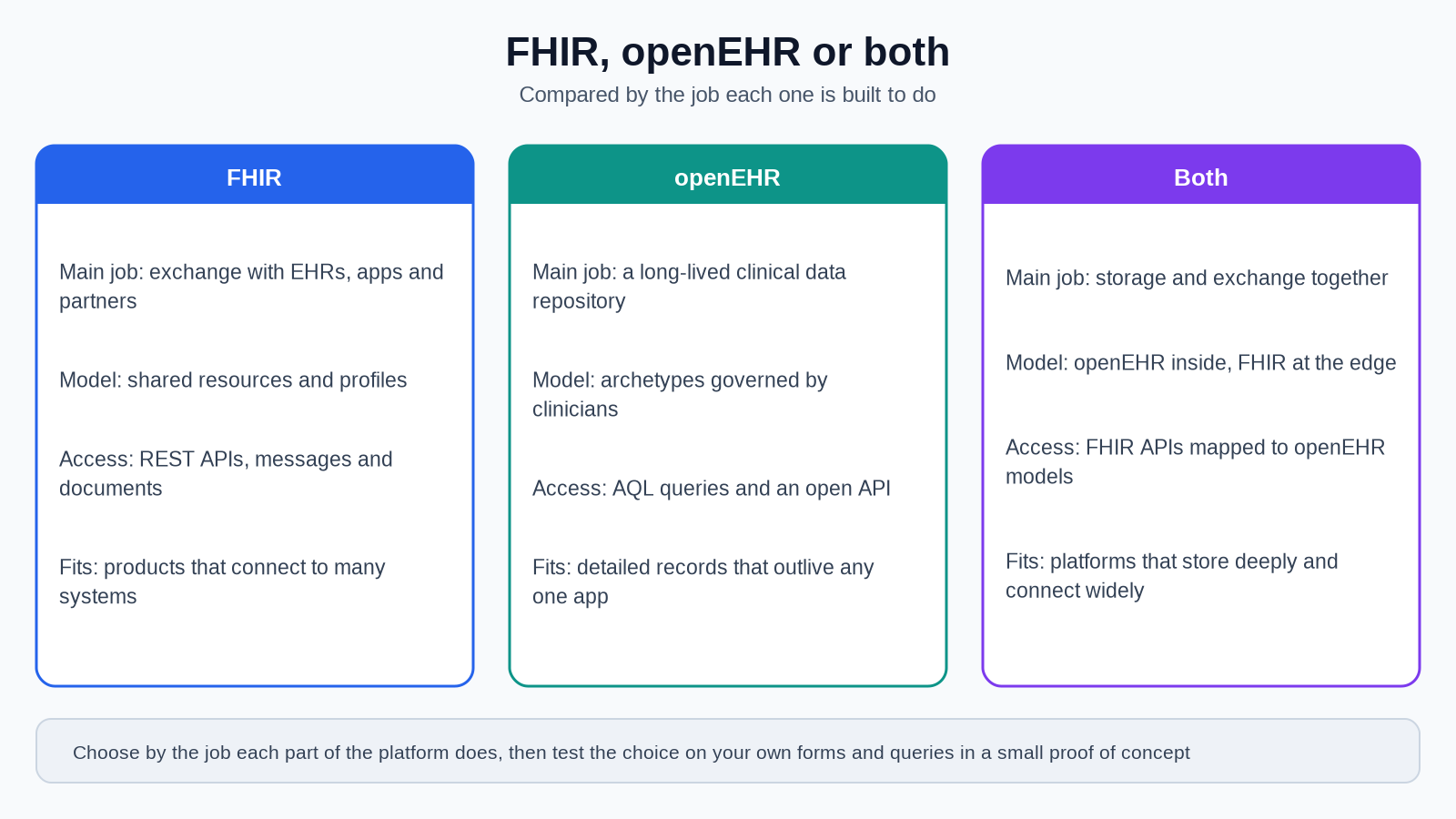
Choose FHIR when the main job is exchanging data with EHRs, apps and partners, and consider openEHR when the main job is a long-lived clinical data repository whose models clinicians govern. Many platforms use both: openEHR inside for storage and FHIR at the edge. Agnotic Technologies helps teams decide by job and builds either approach.
The wrong question is which standard is better. The right question is which job each part of your platform does.
What is each standard designed for?
FHIR is designed for exchange through APIs, messages and documents, using resources that many systems already support. openEHR is designed for storing and querying clinical data over a patient's lifetime, with models kept separate from the software.
HL7 FHIR is a standard published by HL7 International for exchanging health data through RESTful APIs built on defined resources such as Patient, Observation and MedicationRequest.
openEHR describes itself as a technology made of open specifications, clinical models and software that is completely model-driven and separates domain semantics from software, with information models for EHR data, an archetype formalism for domain content, a portable query language (AQL) and an open API specification.
When is FHIR the right choice?
FHIR is the right choice when your product must connect to EHRs, payers or apps, when partners expect standard APIs, or when US rules and programs point you toward FHIR-based access.
- Exchange: reading from and writing to EHRs and partner systems.
- Apps: launching inside clinician workflows and using patient-facing APIs.
- Ecosystem: many vendors, libraries and servers already speak it.
- Scope: products whose data needs fit common resources and profiles.
When is openEHR the right choice?
openEHR is the right choice when you are building a clinical data repository meant to outlive any one application, where clinicians need to define and change detailed models without changing code.
- Longevity: data stored for decades, independent of the apps that write it.
- Detail: rich clinical content, such as specialty assessments, that generic resources fit poorly.
- Governance: clinical modelers own the models, and software follows them.
- Querying: clinical queries written against models rather than tables.
When should you use both?
Use both when you need a long-lived clinical repository and standard exchange with the outside world. A common design keeps openEHR as the store and exposes FHIR APIs at the edge, mapping between the two.
The mapping is real work. Each FHIR resource you expose needs a mapping to the openEHR models behind it, with rules for what happens to detail that one side holds and the other does not.
Regulation and market context
Where you operate shapes the choice. In the US, certified EHRs expose standard FHIR APIs, so any product that connects to them will speak FHIR at least at its edge.
ONC certification criterion 170.315(g)(10) requires certified EHRs to offer a standardized API for patient and population services based on HL7 FHIR.
That does not decide how you store data inside your own platform. It does mean a FHIR layer is close to unavoidable for US products, whichever store sits behind it.
Terminology in either approach
Neither standard replaces clinical terminology. Both rely on code systems for diagnoses, observations and medications, and both need clear bindings from fields to codes.
Decide early which code systems you will use, who maintains the bindings and how local codes from partners are mapped. Poor terminology work undermines either choice, however well the models are designed.
Which questions decide the choice?
Answer a short set of questions about your platform before choosing.
- Main job: is the platform mainly for exchange, for storage, or both?
- Partners: what do the EHRs, payers and apps you connect to expect?
- Lifetime: must the data outlive the applications that create it?
- Model owners: will clinicians govern models, or will developers?
- Skills: does your team or partner have experience with each standard?
What does each choice cost?
Each choice costs differently in skills, tooling and time to first release. FHIR has a large pool of developers and tools; openEHR has a smaller community and requires modeling skills alongside engineering.
openEHR also needs a clinical data repository product or build, plus a modeling process. FHIR-only platforms may later face pressure to extend resources heavily for detailed clinical content, which carries its own cost.
Storage models and analytics
Storing data as FHIR resources is convenient for exchange but can be awkward for detailed longitudinal queries; openEHR's query language is built for querying clinical models. Either way, analytics usually needs a separate layer.
Plan an analytics store fed from whichever source you choose, with clear mappings, rather than running heavy reporting against the operational store.
Changing course later
Teams sometimes start with one approach and add the other as needs grow, such as a FHIR store that later moves detailed content into an openEHR repository, or an openEHR platform that adds a FHIR layer for new partners.
Keep the original data, record which model version produced each record, and treat the move as a data migration with reconciliation. A clear mapping document from the first design makes this far less painful.
What goes wrong with this decision?
Most problems come from choosing by fashion or familiarity. These patterns recur.
- FHIR as a database by default: detailed clinical content forced into extensions.
- openEHR without modelers: archetypes and templates nobody can maintain.
- Ignored mapping: a combined design that underestimates the FHIR edge.
- No proof of concept: the choice made on slides, not on the team's real data.
- Skills gap: a standard chosen that no one on the team has used.
A worked example: a specialty care platform
A specialty care platform needed detailed assessment forms, long-term records and connections to referring hospitals' EHRs. The team first planned to store everything as FHIR resources.
A proof of concept showed that the assessments needed many extensions and that clinicians wanted to change forms often. The team chose an openEHR repository for clinical content and built a FHIR layer for the resources partners needed.
The mapping for those resources was designed and tested first, before any clinic went live. Clinical leads took ownership of the assessment models and began changing forms without waiting for a software release.
Who owns the decision?
The decision needs product, clinical and engineering voices, with one owner.
- Product owner: the platform's main jobs and partners.
- Clinical lead: modeling needs and who will govern models.
- Architect: storage, exchange and mapping design.
- Engineering lead: skills, tooling and delivery risk.
How do you test the choice?
Test the choice with a small proof of concept on your own data and workflows, not on vendor samples.
- Model: represent a few real clinical forms in each approach.
- Exchange: expose or consume the FHIR resources your partners need.
- Query: run the clinical and operational queries you will need most.
- Change: alter one model and see what code changes are required.
What are best practices for choosing between FHIR and openEHR?
Choose by job, not by preference: FHIR for exchange, openEHR for a governed, long-lived repository, and both when you need both. Ask partners what they expect, and be honest about modeling skills.
Run a proof of concept on real forms and queries, design any FHIR mapping early, plan analytics separately, and record the decision and its reasons so later teams understand it.
How Agnotic can help
Agnotic helps teams choose and build clinical data platforms: FHIR APIs and servers, openEHR-based repositories, FHIR layers over existing stores, mappings between models and proofs of concept that test the choice on real data.
Plan your clinical data platform with Agnotic
Our EHR software development service builds clinical data platforms, repositories and integrations.
Related reading on Agnotic
Standards, architecture and clinical data models.


