



Rural hospital EHR integration fails for practical reasons: one person runs IT, the link drops, and a regional partner still expects an ADT message. A design that assumes a city hospital interface team will not survive the first weekend.
Agnotic Technologies builds the feed so it queues, retries and tells someone when it has not moved.
What is different about rural hospital EHR integration?
Rural hospital EHR integration has to keep working when the link drops and when one person is the entire IT team. Agnotic Technologies queues the messages and makes a failure visible, instead of assuming a 24 hour interface desk is watching.
Connecting a rural record to a partner?
EHR integration services cover ADT, results and the monitoring around them.
What should the first interface be?
Start with the message a partner already requires, usually ADT for arrivals and discharges, or a result the clinic cannot see any other way. Do not open with five interfaces.
- ADT in and out, with a queue when the link is down.
- A person on each side who is called when the queue stops.
- A test patient you can send on purpose.
- A written note of which system owns the patient identifier.
Ask the partner for their interface specification and a sample message before any build. Their sample shows which fields they really fill, which is often different from the specification.
Agree the go-live date with both clinical teams, not only with IT. Staff on each side should know which paper step the feed replaces from that day.
How does the low bandwidth post fit?
The low bandwidth telehealth post is the visit. This post is the record moving between the rural hospital and a partner. Both need a local copy and a retry. Our EHR integrations post is the general method. The critical access glossary is the designation, not the interface.
What should you not assume?
Do not assume a VPN that never drops, a team that can restart an engine at 2 a.m., or that the regional partner's test system matches production. Schedule a failover test during the day, with both sides watching.
Do not assume the partner will tell you about their own changes either. Ask to be on their change notice list, so an upgrade on their side does not silently stop your feed.
Which partners does a rural hospital exchange data with?
A rural hospital exchanges data with a short list of partners, and each one matters more because there are so few. The list often includes a referral hospital, a reference lab, an outside radiology reading group, public health registries and the regional health information exchange.
Rank them by clinical risk, not by who asked first. A transfer that reaches the referral hospital without the latest results matters more than a registry report that arrives late.
- Referral hospital: ADT and a clinical summary for transfers out and back.
- Reference lab: orders out and results in.
- Radiology group: orders out and reports in, often read off site.
- Registries and the exchange: the feeds the state or region expects.
How should an interface survive a weak link?
Design every feed to store and forward. The sender keeps each message until the receiver acknowledges it, and the queue survives a restart of the engine or the server.
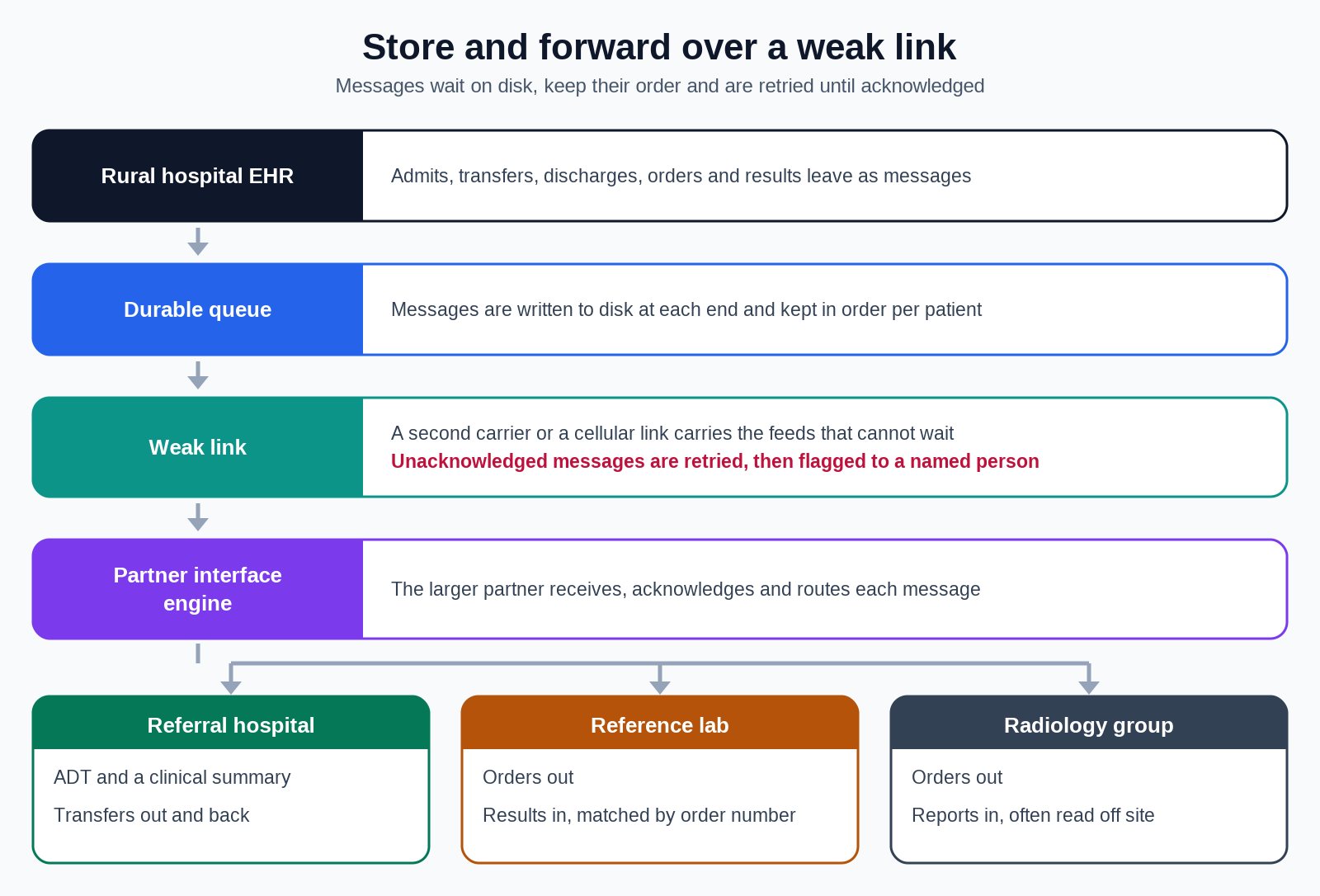
- Durable queue: on disk at each end, not only in memory.
- Acknowledgements: an unacknowledged message is retried, then flagged to a person.
- Ordering: kept per patient, so a discharge never lands before its admission.
- Backup path: a second carrier or a cellular link for the feeds that cannot wait.
Size the queue for the longest outage the hospital has actually had, then test it by pulling the link on purpose during the day.
Shared and hosted EHR arrangements
Some rural hospitals run their EHR through a vendor's hosted service or on a larger health system's shared instance. That changes who can build an interface and where it runs.
Find out early who owns the interface engine. If a parent system or the vendor hosts it, every new feed goes through their change process, and the rural site needs a named contact inside it.
- Vendor hosted: confirm which interfaces are included and how a new one is requested.
- Shared with a larger system: agree who builds, who monitors and who pays.
- Run locally: plan backups, patches and a second person who can restart it.
Who watches the feed when IT is one person?
Monitoring has to reach someone who is not at a desk. Alerts go to a phone with a plain description of what stopped and since when, and a second alert goes to a backup person if the first is not acknowledged.
A managed monitoring service or the partner's interface team can cover nights and weekends. Write down who covers which hours, and test the handover before you rely on it.
The same logs that show a stalled feed also show who opened or resent a message, which matters because the engine holds patient data.
The HIPAA Security Rule requires hardware, software and procedural mechanisms that record and examine activity in information systems that contain or use electronic protected health information.
How should patient identity work across sites?
Agree which system issues the identifier for each partner, and match on more than a name. In small communities, relatives often share surnames and addresses, which makes loose matching risky.
- Send the local record number, and store the partner's number when it comes back.
- Match on several fields, such as name, date of birth and sex, plus an identifier where one exists.
- Route uncertain matches to a person, and never merge automatically.
- Log every merge and unmerge with the user and time.
How do you test with a larger partner?
Book testing early and keep it small. A large partner tests with many sites, so arrive with a test patient, a list of message types and the expected result for each one.
- Step 1, connect: confirm the link and the acknowledgement path with a dummy message.
- Step 2, one patient: send an admit, a transfer and a discharge for the test patient.
- Step 3, the outage: cut the link, queue messages, restore it and check their order on the far side.
- Step 4, sign-off: both sides confirm in writing what was received.
What happens during downtime?
When the link or the EHR is down, staff fall back to paper and phone, and the interface catches up afterwards. Plan the catch-up: which events are back-entered, by whom, and how duplicates are avoided.
Rehearse the procedure during a planned maintenance window, so the first real outage is not the first practice run.
Which feeds can wait?
Feeds that only copy data for reporting can usually wait until the clinical feeds are stable. A nightly file to a quality program does not need the same queue and alerting as a transfer summary.
Write the list in two columns with the clinical lead: feeds that affect care today, and feeds that affect reporting later. Build the first column first, and give the second a simpler design.
How should outside results reach the clinician?
Outside results should land in the chart as discrete results, attached to the order that requested them. A scanned PDF in a documents tab is easy to miss on a busy shift.
- Match each result to its order by the order number the hospital sent.
- Route abnormal results to the ordering provider's inbox, not a shared folder.
- Hold results that cannot be matched in a queue that a named person clears daily.
- Keep the original message, so a dispute can be checked against what arrived.
Security with a small team
A small team needs fewer moving parts, not fewer controls. Use one encrypted connection per partner, one service account per feed, and a short written list of who can change the engine.
Review that list when staff change, and remove vendor remote access once a job is finished. Most of this is routine, so put it on a calendar instead of relying on memory.
How do you know the integration is working?
Count what the partner received, not what you sent. A weekly comparison of messages sent and acknowledged, by feed, shows gaps before a clinician finds them.
Track queue depth, alert response time and the number of manual resends. If resends keep rising, the link or the mapping needs attention before the next outage.
What are rural hospital EHR integration best practices?
- Start with the one feed a partner already requires.
- Store and forward every message, with ordering kept per patient.
- Send alerts to a phone, with a backup person named.
- Know who owns the interface engine in a hosted or shared setup.
- Match patients on several fields and review uncertain matches by hand.
- Test outages in daylight with both sides watching.
How Agnotic can help
Agnotic builds and supports interfaces for rural and critical access hospitals, sized for a small team. We start with the feed your main partner needs, add a durable queue and phone alerts, and document who covers each hour.
Plan rural hospital integration with Agnotic
Interfaces, monitoring and partner testing designed for weak links and small IT teams.
Related reading on Agnotic
The general integration guide, rural visits, critical access rules and message delivery.


